

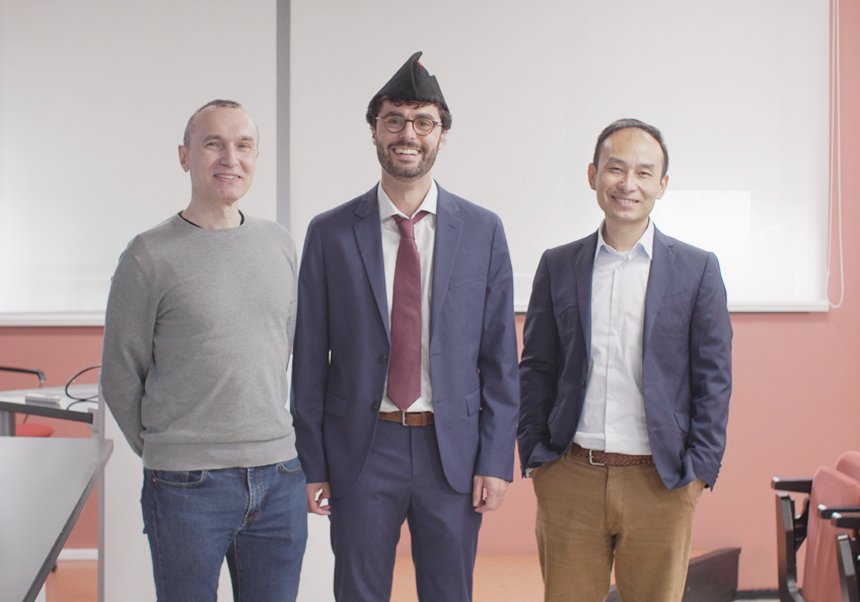
Fernando Álvarez presenta la seua tesi doctoral sobre l’impacte econòmic de les Indústries Culturals i Creatives
Fernando Álvarez Teresa, a member of Econcult, has presented his doctoral thesis, The Economic Impact of Cultural and Creative Industries: An Input-Output Analysis of 76 Countries at Different Levels of Development, a study that provides new international evidence on the role of Cultural and Creative Industries as drivers of economic development.
The thesis, supervised by Rafa Boix and Chuan Li, analyses the impact of CCIs on value added, wages and employment at both global and national levels, using a global multiregional input-output model. The study draws on data from 76 countries for the period 1995-2020, taken from the OECD Inter-Country Input-Output Tables, and makes it possible to compare the effects of cultural and creative activities across economies at different levels of development.
The results show that CCIs have a significant economic impact and, in many contexts, represent one of the most efficient options for generating wealth and employment.
At the same time, the thesis shows that these effects are not distributed evenly: more developed economies capture stronger impacts in terms of value added and wages, while developing economies obtain more pronounced effects in terms of employment. This difference points to a possible widening of productivity gaps between territories.
The research represents an original contribution to the fields of cultural economics and the creative economy, as it moves beyond the usual bias in the academic literature towards developed countries and offers a comparative, systematic and long-term approach. It also provides useful tools for public policy design, particularly in relation to the trade-offs between job creation, value added generation, wages and territorial development.
Fernando Álvarez’s trajectory is closely linked to Econcult. He first joined the group as an internship student from the Master’s Degree in Economic Policy and Public Economics, and later developed his doctoral thesis within the framework of the project Strategies from culture and creativity for the transformation of the Valencian model towards innovation, funded by the Regional Ministry of Economy, Finance and Public Administration of the Generalitat Valenciana.
This project, reference HIECPU/2020/05, was led by Pau Rausell Köster as principal investigator, with the Universitat de València as beneficiary institution. Throughout this period, Fernando Álvarez has taken part in a range of Econcult’s scientific activities and projects, including work on the economic impact of CCIs, applied studies linked to the Valencian territory and collaborations in academic publications.
At Econcult, we celebrate the presentation of this doctoral thesis, which marks the culmination of a path of training, research and collaboration within the group, and reinforces Econcult’s contribution to the rigorous analysis of the role of culture and creativity in transforming productive models, regional development and public policy.



