

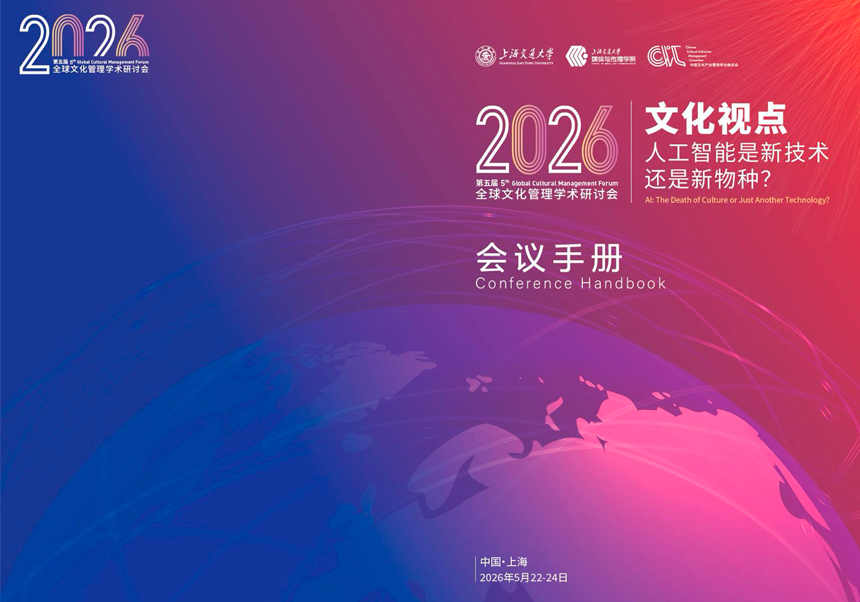
Professor Pau Rausell, from Econcult and the University of Valencia, will take part in the 5th Global Cultural Management Forum, which will be held from 22 to 24 May 2026 at the Minhang Campus of Shanghai Jiao Tong University, in China.
Econcult · Universitat de València
Pau Rausell will present in China the work on the HAICCS scale within the framework of the AISECRETT project
The participation will take place at the 5th Global Cultural Management Forum, devoted to the impact of artificial intelligence on culture, the creative industries, cultural tourism and contemporary cultural management.
Professor Pau Rausell, from Econcult and the University of Valencia, will take part in the 5th Global Cultural Management Forum, which will be held from 22 to 24 May 2026 at the Minhang Campus of Shanghai Jiao Tong University, in China. His contribution will present the work developed around the HAICCS scale, within the framework of the AISECRETT project, as part of an international conference devoted to analysing the impact of artificial intelligence on culture, the creative industries, cultural tourism and contemporary cultural management.
The forum programme identifies Pau Rausell’s presentation under the title “Who did this? The role of humans and AI in the production of creative content. The AISECRETT project experience”, and presents him as a professor at the University of Valencia, Spain. The presentation is included in the main sessions of the conference and addresses one of the most relevant issues of the current moment: how creative production is being redefined when cultural processes incorporate artificial intelligence systems, and how the relationship between human contribution and technological intervention in the generation of content can be analysed.
Under the theme “AI: The Death of Culture or Just Another Technology?”, the forum raises a central question for the future of cultural policies and the creative industries: whether artificial intelligence represents a profound rupture in the way culture is produced, consumed and valued, or whether it should be understood as a new technology within a broader historical trajectory of cultural transformations. According to the programme, the forum invites researchers from China and abroad to examine how AI is changing or influencing the production and consumption of cultural and tourism products from four main dimensions: culture, cultural and tourism industries, management, and disciplinary development.
In this context, Pau Rausell’s presentation will explain the experience of the AISECRETT project and the work linked to the HAICCS scale, a tool aimed at analysing the role of humans and artificial intelligence in cultural creation processes. The question framing the presentation —“Who did this?”— refers directly to debates on authorship, responsibility, recognition, trust and creative value in environments where cultural production can no longer be understood only as the result of individual human action, but rather as a process involving tools, models, platforms, digital infrastructures and diverse forms of collaboration between people and machines.
Authorship and creativity
The programme includes debates on the reconstruction of creative agency and authorship in contexts of AI-assisted cultural production.
Culture and technology
The forum treats AI not only as a technical tool, but as a cultural, economic, institutional and social phenomenon.
Heritage and tourism
The sessions also address heritage mediation, cultural tourism, audience experience and forms of access to culture.
The conference programme provides a particularly relevant framework for this discussion. The sessions include debates on AI as a possible “new species”, the reconstruction of creative agency and authorship, platform governance, the transformation of cultural labour, AI-assisted audiovisual production, the relationship between technology and humanities education, heritage mediation, cultural tourism, audience experience and new forms of emotional interaction with intelligent systems. This thematic breadth places Econcult’s contribution within an international agenda that does not treat AI merely as a technical tool, but as a cultural, economic, institutional and social phenomenon.
One of the most significant aspects of the forum is precisely the connection between artificial intelligence and authorship. Several sessions in the programme address how AI alters traditional notions of creator, work, creative process and responsibility. In this respect, Pau Rausell’s presentation speaks to a concern shared by researchers in different contexts: how to attribute creation when a work has been produced through a combination of human intention, algorithmic decisions, model training, digital platforms and automated processes. Within this framework, the HAICCS scale is linked to the need for instruments that help understand and measure these new forms of human and technological participation in cultural creation.
The forum also incorporates a broad perspective on the cultural and creative industries. The programme includes sessions on creative platforms, music, audiovisual production, screenwriting, micro-dramas, animation, AI-generated content, creative labour and institutional governance. This set of topics places AISECRETT within a debate that goes beyond an abstract discussion on technology and culture: AI is already affecting the material conditions of production, distribution circuits, forms of consumption, professional profiles, authorship rights and the criteria through which the value of cultural content is recognised.
Another important axis of the programme is the relationship between AI, heritage and cultural tourism. The parallel sessions include presentations on AI-assisted translation in museums, cultural heritage in the Global South, dissemination of intangible cultural heritage, visitor experience, consumer trust and sustainable marketing strategies in cultural tourism. This orientation shows that AI is not only transforming artistic or audiovisual creation, but also forms of mediation, interpretation and access to culture. The conference therefore proposes a transversal view of AI as a technology that intervenes in the production, circulation, reception and management of cultural goods.
Econcult’s participation in this forum strengthens the group’s international visibility in debates on cultural economics, cultural policies, innovation and the creative industries. Pau Rausell’s presence in the programme connects research developed at the University of Valencia with a global conversation involving universities and research centres from different countries. The forum brings together speakers affiliated with academic institutions in China, the United Kingdom, Spain, Hong Kong, Macao, Australia, Indonesia and other contexts, reinforcing the international and interdisciplinary nature of the event.
In addition to the keynote presentations, the programme includes parallel sessions, a roundtable, academic collaboration activities, meetings with journal editors and a closing ceremony. This structure reflects the forum’s aim to combine theoretical debate, presentation of research results, institutional exchange and editorial projection. For Econcult, participation in this framework represents an opportunity to share results from the AISECRETT project, compare them with other international approaches and strengthen dialogue with researchers working on AI, culture, cultural management and the transformation of the creative industries.
Pau Rausell’s contribution therefore takes place at a particularly significant moment for the study of culture in the digital age. The expansion of generative tools has opened up new possibilities for creation, but has also raised questions about authorship, responsibility, quality, transparency, trust and the distribution of value. In this scenario, the work on the HAICCS scale and the experience of the AISECRETT project contribute to organising a debate that often advances more quickly at the technological level than at the conceptual, institutional and methodological levels.
With this participation, Econcult continues to develop a line of reflection on the changes affecting the cultural and creative industries in a context of advanced digitalisation. Its presence at the 5th Global Cultural Management Forum places this reflection on an international stage and connects it with issues running across the whole programme: AI as a tool, as infrastructure, as an agent of mediation, as a possible creative subject and as a factor reshaping the relationships between culture, economy, technology and society.
Links:



