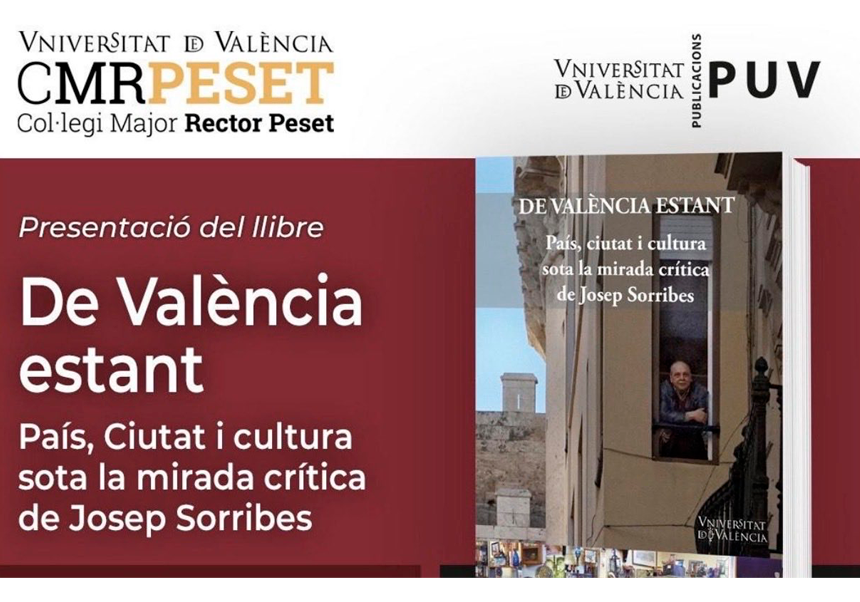
On Tuesday 20 January at 7:00 pm, the event will take place in the Sala de la Muralla, featuring María Vicenta Mestre Escrivá, Amando Llopis and Joan Romero.
Rector Peset hosts the presentation of De València estant, a collective perspective on Josep Sorribes
On Tuesday 20 January at 7:00 pm, the event will take place in the Sala de la Muralla, featuring María Vicenta Mestre Escrivá, Amando Llopis and Joan Romero.
On Tuesday 20 January at 7:00 pm, the Sala de la Muralla at the Rector Peset College Hall will host the presentation of De València estant. País, ciutat i cultura sota la mirada de Josep Sorribes. Admission is free until full capacity is reached.
The presentation will feature María Vicenta Mestre Escrivá, Rector of the Universitat de València; Amando Llopis, architect at VTiM arquitectes; and Joan Romero, Professor of Human Geography at the Universitat de València. The event is organised by Publicacions de la Universitat de València (PUV) and the Rector Peset College Hall of the Universitat de València.
Published by PUV, the volume combines a selection of texts by different experts and close colleagues of Sorribes with a compilation of nearly 250 press articles published between 1998 and 2023, and also includes a final unpublished text. The publication thus offers a plural approach to his figure and ideas, placing the debate on country, city and culture at the core of its perspective.
The book links Josep Sorribes’ trajectory to the academic sphere and to an intense civic and intellectual activity. It presents him as a significant voice in urban analysis and as a pioneer in the study of urban economics, with an extensive body of work on this issue and other lines of reflection.
One of the key themes running through the publication is the call for a metropolitan approach to València, an idea Sorribes pursued consistently and which points to the need to plan and manage, at metropolitan scale, areas such as mobility, the water cycle, waste management, land use, housing, major facilities and economic promotion.
In addition, the book brings together a selection of press articles that trace the evolution of his perspective on the city and the territory over more than two decades, helping to contextualise public debates on urban transformation, planning and collective strategy.