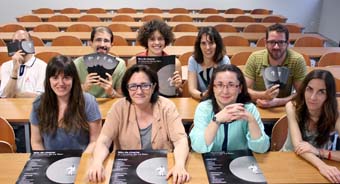
Until 23 July, always at 22:00 p.m. the Cinema Class of the UV retakes their traditional summer event “Nits de cinema al Claustre de la Nau” (Cinema nights into the Cloister of La Nau) which offers, for the seventh consecutive year, night-time and free outdoor projections, in original version subtitled, with a further colloquy.
“Dreams” (1990), a chapter film, is formed by eight narratively independent shorts but connected by common desires and agonies, and will allow us to approach on Thursday 17 July the Japanese culture and history, through eight tails, extracted from real dreams from Kurosawa himself.
Lastly, the rest of the series, speak about a more geographically and culturally close reality. On Friday 18 July, the assistants will enjoy a piece not very known of the best Spanish Francoism cinema “Mi calle” (My street), 1960, a costumbrist portrait of Madrid at the beginning of the 20th Century, with which Edgar Neville said goodbye to cinema. On Sunday 20 July “La estrategia del caracol” (The snail’s strategy), Sergio Cabrera, 1993, takes us to Colombia to talk about neighbors’ strategies, within a neighborhood in Bogotá, who try to stop the demolition of their house. The series will end in La Nau, Tuesday 22 July, with the projection of “Gente en sitios”- (People in places), Juan Cavestany, 2013, which may be the most disconcerting film Spanish film made recently, a tail that goes from Comedy to Drama, Social Notes, Terrorism and Surrealism, with constant human disconcert. From 1 August, at the Music Palace gardens, other seven choral films, belonging to Comedy gender- with unforgettable heads, such as “To be or not to be”, Ernst Lubitsch, 1942 or “Plácido”- (Placid), Luis G. Berlanga, 1961; cult films, such as “Amanece que no es poco”, (Dawn the morning, as it’s not a few) , José Luís Cuerda, 1988- will enlarge the series under the Summer Film Library, organized, one more year by the CulturArts IVAC.
The Cinema Nights Programme is completed by the series “Històries de l’espai”- (Space histories), a very heterogeneous selection formed by five films in which characters cohabitate in outer space or dream to travel there. The series start on Saturday 12 July with the projection of “Forbidden planet”, Fred M. Wilcox, 1956, a Hollywood classical, inspired by “The Tempest”, by Shakespeare, which tells about the arrival of an expedition of astronauts to Altair IV, the planet governed by an expatriate. On Monday 14, the British film “Luna” (Moon), Duncan Jones, 2009, will be projected, in which one an astronaut lives isolated, for years, in a mining site in the Moon. A jewel of the silent Soviet cinema, Aelita, Yakov Protazanov, 1924, will be the main protagonist on Wednesday 16 July, a session in which spatial trips will be mixed with proletarian revolutions, Bolshevik proclaims, dazzling sceneries and constructivist dressing rooms. Monday 21 July will be the turn of a European animation classic, “Le planète sauvage” (The wild planet) René Laloux 1973, presenting conflicts of a far planet, called Ygam. The film show will be completed with the silent short “Le voyage à travers l’impossible”(Trip towards that impossible) 1904, made by George Meliès, director of the first spatial movie in the history of cinema. The cycle will be completed Wednesday 23 July with one of the greatest spatial movies, the mythic “Alien”, Ridley Scott, 1979.
Information and programming, click here.
Last update: 14 de july de 2014 08:00.
News release