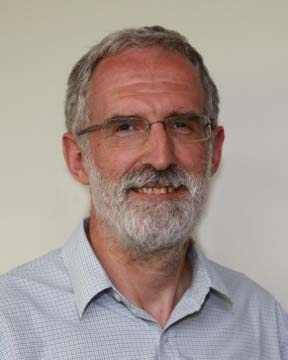
Roger Butlin, professor of the University of Sheffield (United Kingdom), gives the conference ‘How do new species evolve?’ this Thursday 19 at the Burjassot-Paterna Campus. The act is held on the ocassion of the 8th Pelegrí Casanova Memorial, in a recognition to the full university professor of Anatomy and who introduced the evolutionist ideas to the Universitat de València between the end of the 19th century and the beginning of the 20th century.
The conference has been organised by the Chair for Science Divulgation and the Cavanilles Institute of Biodiversity and Evolutionary Biology, and it will take place in the Charles Darwin Hall at 12:30.
In his conference, Roger Butlin will speak about Evolutionary Biology with examples of grasshoppers, plant louses and snails. So, according him, the evolutionary biology tries to explain two main features of the living being like the adaptation and the diversity. The diversity is discontinue with organisms in several groups (phenotype and genotype) which form the specie. The number of species increases through the separation of the lineage (specialisation) and decreases due the extinction. Precisely, the huge diversity of the live in the Earth is the result of a general excess in the specialisation on the extinction.
In organisms which are reproduced by sexually reproduction, the difference between species is the result of the fact that the reproduction is only successful with members of the same specie, and not with different ones. So, the key to understand the specialisation is to explain how this restriction, know as isolate reproduction, evolves. Despite this phenomenon can takes lots of forms, there are only three kind of processes that intervene; it can be a secondary effect of the independent evolution; a sub-product about the divergent selection; or it can be favoured by support.
Roger Butlin, of the Department of Animal and Plant Sciences of the University of Sheffield, has been president of the European Society of Evolutionary Biology (2013-2015), editor of several scientific journals and medal of the Linneana Society in London 2015, among other recognitions. His research is focused mainly in the origin of obstacles in the gases interchange, specially the evolutionary genetics of isolate reproduction. Another research area is the one which refers to the evolution of the asexual reproduction. He is also interested in the evolution of the wide in ranges and their implications in genetics conservation.
Memorial
The Pelegrí Casanova Memorial, organised by the Cavanilles Institute of Biodiversity and Evolutionary Biology and the Chair for Science Divulgation of the Universitat de València, with the patronage of CAM, the la Societat Catalana de Biologia and the l’Institut d’Estudis Catalans. The visiting scientists to other memorial have been: 2003 Stanley L. Miller (University of California, San Diego); 2004 David M. Hillis (University of Texas, Austin); 2007 Francisco J. Ayala (University of California-Irvine); 2008 José Luis Sanz (Universidad Autónoma de Madrid); and 2009 Rosemary and Peter Grant (Princeton University). The last memorial, in 2012, had the attendance of Michael Lynch (Indiana University).
A person who introduced Darwin ideas
Pelegrí Casanova Ciurana (Valencia, 1849-1919) was full university professor of the Faculty of Medicine of the Universitat de València and who introduced evolutionary ideas. He was also who organised the Darwin homage which took place in the Paranymph of the Universitat de València in 1909, on the occasion of the birth of the English scientific. His publications and work covered several Medicine fields, specially Morphology. Pupils of Ernst Haeckel, he was a faithful follower of Darwin and a rigorous evolutionist, and made Valencia a peninsular focus of the evolutionism spreading. The library of Health Sciences of the Universitat de València is called with his name.
Last update: 16 de may de 2016 13:47.
News release