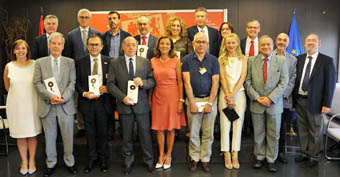
Corpuscular Physics Institute (IFIC) received today the "Severo Ochoa" certification that distinguishes it as a Centre of Excellence. This distinction recognises the excellence and the scientific contributions that the centres and national and international units carry out, their business and social impact, and their capacity to attract talent.
The presentation of this certification took place in a ceremony presided by the R&D Secretary of State, Carmen Vela, in the headquarters of the institution, bound to the Ministry of Economy and Finance. To the ceremony attended IFIC’s director, Juan José Hernández; his ancestor in the position, Francisco Botella; CSIC’s president, Emilio Lora-Tamayo; and the vice-principal for Research of Universitat de València, Pilar Campins.
IFIC (joint centre of CSIC and Universitat de València) received its certification as Centre of Excellence “Severo Ochoa” together with the Institute for Bioengineering of Catalonia. Both join the 18 centres of excellence that got the certification in previous editions, and will receive an annual million of euros during the following four years.
These distinctions are the biggest recognition of the scientific research addressed to centres and units of excellence in Spain, and are awarded after a rigorous evaluation process carried out by international scientific committees grouped in three areas: life sciences and medicine, experimental sciences, mathematics and engineering, and human and social sciences. The certified centres and units are significant both for the international impact of the scientific contributions that they carry out, and for their innovative capacity and their intense relationship with the social and economic environment. Also, they are global reference institutions able to attract international talent.
In her intervention, the Secretary of State, Carmen Vela, has indicated that the excellence “needs to be recognised, needs to identify the centres and units that successfully compete at an European and global level, and that have strategic and research plans that allow them to continue competing to the higher level. These centres and units are particularly important because they act as driving agents among the Spanish System for Science, Technology and Innovation.” Besides, she has reminded that these centres “are not only the ones that best scientific research carry out in Spain, but they are also among the best in the world in their speciality.”
IFIC is leader in experimental and theoretical research on particle physics, astroparticles and nuclear physics. It has a rooted participation in activities of international prestige and is at the forefront of the scientific knowledge in fundamental physics. IFIC is pioneer in Spain in the experimental research on matter constituents, with a career that started in the 1950s. The most recent stage of IFIC started in 1985, when Universitat de València and CSIC signed a collaboration convention that gives place to the actual institute. Some of its scientific objectives are the study of Higgs boson, of quark top, the search of new particles and matter models, the study of neutrinos and their use as cosmic messengers, nuclear physics and its applications, as well as the development of technology for new detectors and particle accelerators.
As well as the importance of the research carried out at IFIC, which has milestones such as the participation in the design, construction and operation of the ATLAS experiment of the Large Hadron Collider (LHC) of CERN, where Higgs boson were discovered in 2012, the “Severo Ochoa” certification as Centre of Excellence values IFIC’s capacity of attracting talent, since the 35% of their research staff comes from other countries. It also recognises the application of these developments in some ‘spin-offs’ related to the applications of Nuclear Physics and of Particles in Medical Physics and in other areas.
In the ceremony, that took place on Thursday, the “María de Maeztu” certifications were also awarded, a novelty in this call that recognises the excellence in smaller research organisational structures than the centres, located specially in universities. To the ceremony have attended representatives of the recognised units: the Institute of Cosmos Sciences from University of Barcelona; the Department in Experimental and Health Sciences of the Pompeu Fabra University; the Condensed Matter Physics Centre of the Autonomous University of Madrid; the Department in Economics of the Carlos III University of Madrid; the Unit for Structural Biology of CSIC; and the Barcelona Graduate School of Mathematics of the Consorci Centre de Recerca Matemàtica. The units have a financing of 500.000 annual euros for four years.
More information:
Last update: 17 de july de 2015 09:11.
News release