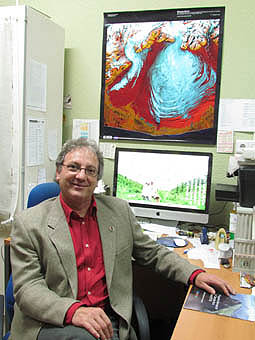
José Ignacio Valenzuela Ríos, lecturer of Palaeontology of the Universitat de València, has been appointed as president of the Spanish Committee for International Geological Correlation Programme (IGCP) of UNESCO and scientific subcommittee and advisor member of National Committee for Geoparks. Moreover, he will coordinate an international cooperation plan next summer in Uzbekistan.
The IGCP is a joint initiative of the UNESCO and the IUGS (International Union of Geological Sciences), which promotes international and interdisciplinary researches on global problems related to Geology in order to help society and improve life conditions of all human beings. The IGCP promotes joint projects, which apport benefits for society and encourage knowledge exchange among developed and emergent countries, people training and social and scientific progress.
Main criteria to select these subsidized projects are scientific quality along with international and interdisciplinary cooperation degree.
The IGCP is the only global cooperation programme on Geological Sciences and it was created in 1972; since then IGCP has supported 335 projects around 150 countries. Spanish Committee is one of the most actives: it has participated in more than 100 projects and, next year, it will celebrate its 40th foundation anniversary.
Main IGCP thematics are five: Global Change and the Evolution of Life: Evidence from the geological record; Geohazards: Mitigating the risks; Hydrogeology: Geoscience of the water cycle; Earth Resources: Sustaining our Society; and Geodynamic: Control our environment.
Lecturer Valenzuela Ríos got his doctorate in 1989 by the University of Zaragoza, although his researches were done along with the collaboration of the Braunschweig University of Technology, in this last one thanks to financial support of the German Academic Exchange Service (DAAD) which awarded him a scholarship in two times. Immediately after he got a Fulbright Program grant in the University of California, Davis (1989-1991) and, later, he was hired as lecturer in the University of San Francisco (1992-94) and as researcher in the University of California, Davis. After his stay in America, he stayed in Germany thanks to a grant of Humboldt Foundation in the Braunschweig University of Technology, where soon after he was named “Gast-Wissenschaftler”. Recently, he got a grant of Salvador de Madariaga Programme for senior researchers in the University of California, Riverside (2013).
He has made several research stays, among which stand out: France (Université de Lille), United States of America (Universities of California, Davis and Riverside; University of Iowa), Canada (Geological Survey of Canada in Calgary), Germany (Braunschweig University of Technology, University of Würzburg, Senckenberg Nature Research Society), the Netherlands (Naturalis Biodiversity Center of Leiden), Czech Republic (Academy of Sciences and Geological Survey, Prague), Russia (Academy of Science, Siberian branch in Novosibirsk), Uzbekistan (Geological Reserve of Kitab) and, recently, in Mongolia, where he was invited to take part in an international expedition to do multidisciplinary studies on Devonian of “Baruunhuurai Terrane” in the West of the country, in Altai-Gobi high desert.
His large research work has focused on Devonian materials (between 419 and 359 millions of years) in a worldwide scale. In these materials and with a paleontological foundation given by a group of microfossil (conodont elements), he has established a biostratigraphy subdivision global in scope which lets to establish very precised correlations between materials from different continents, compare the evolution of represented environments in different places and infer possible causes and effects of this global events, which affected the Earth and life on Earth during this period of time.
As a result of these researches, there are more than 250 scientific contributions, mainly in international reviews of high quality. The latest innovation of his results has favoured that he was invited as “keynote speaker” on the two last worldwide congresses most important in his speciality: the 34th International Geological Congress (IGC), which took place in Brisbane (Australia) and the Third International Conodont elements Congress, which took place in Mendoza (Argentina).
The quality and significance of done researches favoured that he was elected as member with full rights of the Subcommission on Devonian Stratigraphy (SDS) in 2004. This subcommission is made up by 19 worldwide experts, who analyse and deal with all aspects related with Devonian System.
Nowadays, he is the IP in a Project of National Plan, co-director in an international project in collaboration with the Academy o Sciences of Czech Republic and Spanish coordinator of the IGCP 596 Project on biodiversity and climate change in Devonian and Carboniferous (2011-2015).
Within the IGCP Programme, he supervised other project in Spain (IGCP-499 between 2005-2010), he has been chair (2004-2011) and general secretary of National Committee (2011-2014). Recently (June 2014), along with the general secretary of the programme and the director of the Science Regional Office of UNESCO in Latin America and Caribbean and promoted by UNESCO and the SIDA (Swedish International Development Cooperation Agency), he organised a workshop in Monteviedo for South American leaders training on IGCP projects.
Last update: 9 de december de 2014 14:22.
News release