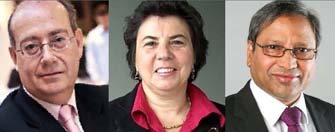
On Friday, 11 December, the Institute for Molecular Science (ICMol) of the Universitat de València celebrates its 15th annual Scientific Conference, an annual dissemination session, a classic event of this research centre, discussing in this occasion the relationship between the Light and the Molecular Nanoscience. The conference, that finishes in Valencia the “International Year of Light” (UNESCO), will have three Excellence scientists as the protagonists: Luisa de Cola, Mohammad Khaja Nazeeruddin and Miguel Ángel Miranda.
The general director of University, Research and Science, Josefina Bueno, and the principal of the Universitat de València, Esteban Morcillo, will inaugurate on Friday, 11 December, the 15th Scientific Conference of the Institute for Molecular Science of the Universitat de València, a dissemination event that ICMol is doing since its beginnings, in 2000, on the occasion of the anniversary celebration. Along with them, will open the conferences José Adolfo de Azcárraga, president of the Royal Spanish Physics Society (RSEF), Miguel Ángel Miranda, member of the government body of the Royal Spanish Chemistry Society (RSEQ), and Eugenio Coronado, director of ICMol. The session will take place from 09:00 to 14:00 at the Assembly Hall of the Research Institutes of the Parc Científic.
The current edition, that commemorates the “International Year of Light” declared by the UNESCO for 2015, will be focused on the relationship between the Molecular Nanoscience and the Light, from the luminescent molecules and photoactive nanomaterials to the applications of these molecular systems in the utilisation of solar energy, in photochemistry, and in medicine. And it will do so with three Excellence scientists, Luisa de Cola, Mohammad Khaja Nazeeruddin and Miguel Ángel Miranda, whose career and international leadership place them at the top of the photochemistry and photophysics research, as well as in the design of nanomaterials and molecular nanostructures of interest for the energy storage and medicine.
All the interventions will be carried out in a disseminating way. After the inauguration, Miranda will award, on behalf of the RSEQ President, with the “Premio Hispano-Francés Catalán-Sabatier 2015” the Italian researcher Luisa de Cola.
The ICMol is a reference centre in Chemistry and Molecular Nanoscience focused on the design and synthesis of functional molecules, supramolecular associations and molecular materials with physical or chemical proprieties of interest, as well as on the study, characterisation and analysis theoretical and experimental, of these proprieties. It also applies these molecular systems in different areas of interest such as molecular magnetism, molecular electronics, nanotechnology and biomedicine.
After fifteen years of activity, the ICMol has more than 150 people distributed in eight scientific teams. Its payroll of consolidated researchers increases each year with the incorporation of young researchers that, according to their director, the full university professor of Inorganic Chemistry Eugenio Coronado, “bring dynamism to the institute and shoe their leadership aiming each call of the Starting Grants of the European Research Council (ERC)”, an European proposal addressed to young researchers with potential to became European research leaders. “This year, says Coronado, a researcher of the ICMol achieved one of these prestigious distinctions”. In this sense, the ICMol also has seven Ramón y Cajal scientists, the most prestigious Spanish science contract, and a guarantee of competitiveness. The ICMol scientific excellence has just also been recognised by the MINECO, which distinguished it as a “María de Maeztu Excellence Unit”.
THREE SCIENTISTS OF EXCELLENCE
Luisa de Cola (Messina, Italy) is Professor of the University of Strasbourg (France) and director of the Chemistry and supramolecular Materials laboratory of this distinction, and also half-time scientist at the INT-KIT, Karlsruhe of Germany.
Her researcher trajectory is focused on the luminescent molecules and their connections for the creation of new porous materials and structures for bio-applications. She published 300 articles, 30 patents and has an H index of 58 (11 000 quotations). She has an Advanced Grant (2009), the best equipped aids of the European Research Council (ERC), in addition to recognitions such as the IUPAC award for Distinguished Women in Chemistry and Chemical Engineering (2011), the Gutenberg (2012) and the “Prof. Luigi Tartufari International Award of Chemistry of the Accademia dei Lincei (2014). She is a member of different academies such as the Europeae or the Academy of Sciences Leopoldina (Germany). In 2015 she received the Catalán-Sabatier-Award.
Mohammad Khaja Nazeeruddin (India). He is a scientific of the Swiss Federal Institute of Technology Lausanne (EPFL), and has been very involved in the discovering and development of the solar cellules based on perovskite, an authentic boom for being as efficient as silicon cells and for becoming a possible alternative to the last ones. Not without reason, he works in the same centre as Michael Gräetzel, an indisputable figure in molecular solar cellules whose name sounds as a possible Nobel prize. Nazeeruddin has more than 350 articles in prestigious journals, nine book chapters and 40 patents. He is one of the more internationally quoted chemist (more than 25 000 quotations) and he has an H index of 76. He directs several industrial projects in the area of hydrogen energy, photovoltaic energy (DSC), and Organic Light Emitting Diodes. He has been distinguished with different awards such as the EPFL Excelencia or the FAPESP Fellowship of Brasil.
Miguel Ángel Miranda. He is Professor on Organic Chemistry by the Universitat Politècnica de València and director of the Institute of Chemical Technology (ITQ). His research lines are mainly focused on photochemistry and photobiology. He was awarded with several distinctions such as the Honda-Fujishima Lectureship Award of the Photochemistry Japanese Association (2007), the Janssen-Cilag Award in Organic Chemistry of the Royal Spanish Chemistry Society (2008), and the Theodor Förster Memorial Lecturship Award of the German Society of Chemistry and the Bunsen Society of Physical Chemistry (2010).
Last update: 10 de december de 2015 12:50.
News release