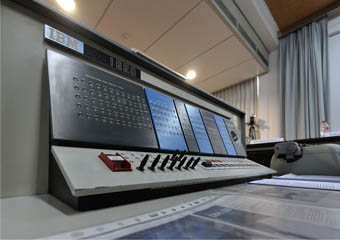
The Valencian government recognised as a Permanent Museum Collection of Valencian Community a singular collection from Universitat de València. It is the Information and Communication Technologies Museum Collection (ICT) that contains from mechanical and electromechanical calculators, and IT material from the 50s and 60s, as well as all kinds of antique ‘software’ and ‘hardware’. Located at Burjassot-Paterna Campus, the Collection is already part of the Valencian culture patrimony.
After a long administrative and field process, on 30 June the Diari Oficial de la Comunitat Valenciana (DOCV) published the Resolution of 23 June 2015 of the Valencian Department of Education, Culture and Sport, by which this recognition is effective.
Since the creation in 1955 of the old Data Centre until today, many systems, equipments, ‘hardware’ and ‘software’, manuals or documentation have passed by Universitat de València. All this material that the Information System Service and the School of Engineering (ETSE) have inherited and conserved, coming from own and external funds together with advanced equipments as the supercomputer Tirant, are a clear indicative of the big technological jump occurred throughout the last 60 years, since the first informatics until the supercomputing of the 21st century.
Although Universitat de València has been carried out occasional guided visits since 2010 to the Collection –over 1.200 have already participated–, the Information System Service plans now the formal establishment of a visit agenda to the ICT Museum.
The diversity of pieces that form the ICT Museum Collection will allow visitors to travel in time and contemplate the evolution of technology throughout half century, starting with the mechanical calculators of the decade of 1950, or with the IBM 1620, whose memory capacity was measured in Kilobytes and its processing power in Kflops, and ending with the actual computers with Terabyte capacity and Teraflops powers.
Half way you can find water-cooled processors or different kinds of information support, for example, punched cards, half-inch magnetic tapes and huge disks of low capacity, among others.
Last update: 9 de july de 2015 07:00.
News release