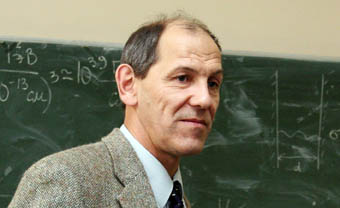
Is it possible to create a universe like ours at the laboratory? Is it possible to get to know what happened in the Big Bang? Valery A. Rubakov, chief scientist of the Institute for Nuclear Research (INR) of the Russian Academy of Sciences, will deal with these intriguing questions in two conferences that will give on Friday, 18th September, at the Institute for Corpuscular Physics (IFIC, CSIC-UV); and at the Faculty of Physics of the Universitat de València on 24th September.
With Rubakov it starts a series of lectures given by internationally renowned scientists organised as a result of the recent concession of the distinction as Severo Ochoa Centre of Excellence to the Institute for Corpuscular Physics.
Rubakov, specialist in quantum field theory and high-energy physics, gave on Friday 18th the colloquium titled ‘Towards creating a universe in the laboratory’, where he dealt with an old theory issue: Is it possible to artificially create an universe like ours at the laboratory? Although postulates such as the Penrose-Hawking singularity theorem exclude this possibility, Rubakov will expose other theories that allow for this scenario.
The colloquium organised by IFIC took place at the Assembly Hall of the Head Building of the Science Park of the Universitat de València (Catedrático José Beltrán street, 2), on Friday 18th, at 11:30h. It is within the framework of the IVICFA’s Fridays, a series of workshops organised by the Valencian Institute for the Advanced Cooperative Research in Physics, a network of 18 groups of excellence in different fields of Physics created with the support of the Valencian Generalitat and coordinated by IFIC.
On Thursday 24th September, at 12:30h, the Russian scientist will visit the Faculty of Physics of the Universitat de València (Assembly Hall of the Sciences Libraries, Burjassot-Paterna Campus) to offer the students the conference ‘The universe before the hot Big Bang’, where he will address other fundamental theoretical issue: Is it possible to get to know what happened at the very moment of the Big Bang that gave origin to our universe? With experiments as the Large Hadron Collider (LHC) we can rebuild the conditions that existed a few moments after the Big Bang (10-10 seconds), but Rubakov will speak about the possibility of going further.
Rubakov (Moscow, 1955) graduated in Physics at the Moscow State University in 1978, and carried out his doctorate at the Institute for Nuclear Research of the Russian Academy of Sciences in 1981, where he started his career as a researcher. In 1987 he became deputy manager for research of the institution, and chief scientist in 1944. He is also a professor at the Moscow State University.
He has received numerous awards for his research, including the Gold Medal and the Prize for Young Scientists of the Russian Academy of Sciences in 1984; the A.A. Friedman Prize of the Russian Academy of Sciences in 1997; the Pomeranchuk Prize of the Institute for Theoretical and Experimental Physics in 2003; the M.A. Markov Prize of the Institute for Nuclear Research in 2005; the Bruno Pontecorvo Prize in 2008; the J. Hans D. Jensen Prize of the Heidelberg University and the Solvay Chair in Physics of the International Solvay Institutes in Brussels in 2009; and the Julius Wess Prize in 2010.
More information:
Lecture at IFIC:
Lecture at the Faculty of Physics:
Last update: 17 de september de 2015 11:47.
News release