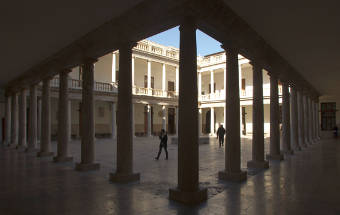
The programme ‘Art i Ment’, of social and cultural intervention for teenagers through art, starts today Wednesday 25 January at the Cultural Centre La Nau of the Universitat de València with the conference, titled ‘Adolescencia: hacia un desarrollo saludable’ (Adolescence: towards a healthy development). This will be given by María Zarza, from the Berklee College of Music and Milos Stohanovic, head of programmes of the United Nations UNODC Serbia. The event will start at 19:00 and the entry is free.
Zarza and Stohanovic will speak about the psychobiological bases that explain impulsive and experimental behaviours which are typical for the teenagers. These are generated by the constant emotional changes, the identity conflicts or the thoughtless conducts or even the high-risk ones such as the experimentation with drugs or unprotected sex, for instance. In short, it is a fragile development period to which the physical changes and the fight for acceptation are added. This vulnerability ‘is even greater in marginal populations or with low incomes’ according to the Doctor María Zarza.
During their conferences, both speakers will try to answer questions like these: how to help teenagers during their development? Do our teenagers face greater dangers nowadays? How can we protect them? Which are the protection keys within family and community? Which resources can help to achieve a healthier development? How the effective preventive programmes are?
They will also analyse the contents of the international standards about prevention of drug use, which are based on policies that, provided working with the family, the school and the community, ‘these could achieve that children and teenagers, especially the poorer ones, are healthy and safe since the growing period to the adulthood and old-age’.
In this regard, Zarza and Stohanovic will refer to The Strengthening Families Programme. This is implemented by ONUDD since 2010 with the collaboration of the UNUDD Programme Office in Serbia. The programme has been conducted with more than one thousand families of the European Southeast with members of 10-14 years old. According to Zarza, this intervention ‘has proved to be effective with families in general as well as families in risk’ through the work in parallel with parents and teenagers, the establishment of limits and consequences, the encouragement of the appropriate conduct and the empathy, the valuation of good friendships, the peer pressure against the consumption, the increase of self-esteem and the reduction of stress and anxiety of teenagers, among other strategies.
In her opinion, ‘the preventive strategies need to be attractive for teenagers and parents’. With this statement, Zarza affirms that art (music, painting, writing, dance, theatre, etc.) together with the game and social interaction ‘motivates the retention of the programme, apart from representing one of the best vehicles for communication and the emotional and cognitive development of teenagers’.
The speakers
María J. Zarza is Doctor in Clinical Psychology by the Universidad Autónoma de Madrid and the Universidad de Rutgers (New Jersey, USA). He conducted researches in gender violence and sexual abuse for her thesis and worked in clinical intervention programmes with victims and attackers, including the treatment in drug addiction. Then, she developed her career within the evaluation of clinical assistance programmes of drug use, violence, AIDS and violence prevention in marginal groups in Los Angeles.
Nowadays, she is the clinical director of Bionexum Health, a private centre of treatment and she works as international consultant for the United Nations (UNODC). She also works as adjunct professor in the Universitat de València and the Berklee College of music.
Milos Stohanovic is Doctor in Dental Medicine. He is Director of the United Nations Office on Drugs and Crime (UNODC) programmes in Serbia. He is expert in preventive programmes about substance abuse, AIDS in young people, teenagers and minorities in the Serbian Regional Office that helps countries like Croatia, Bosnia-Herzegovina or Albania. He works with United Nations since 2010 in the implementation of training programmes for professionals.
The programme ‘Art i Ment’
‘Art i Ment’ is a sociocultural intervention project promoted by the Office of the Vice-Principal for Culture and Equality of the Universitat de València with the aim of encouraging creativity, artistic expression and social integration of minors. The programme includes training sessions of psychotherapy and workshops on self-esteem, music therapy, art therapy, dance and theatre, as well as a cycle of conferences and open debates addressed to all the citizenship. All the activities are free, although workshops require registration, and all are addressed to children under 10 and 11 years old, and to their families.
The intervention programme will consist of 12 sessions which will be held on Saturdays from 10:00 to 13:00. There will be workshops from 28 January to 27 May in the Cultural Centre La Nau. Registration is open, free and places are limited. Registrations and detailed information on the content, duration of the workshops, conferences and other complementary activities are explained in the web: http://www.uv.es/cultura/artiment.
The setting up of this programme has been possible thanks to the General Foundation of the UV and the implication of a great number of entities: Caixa Popular, Per Amor a l’Art Foundation, Antonia Mir Foundation, Berklee College of Music of Valencia, the Faculty of Psychology of the UV (Master’s Degree in Drug Dependence: Research, Treatment and Drug Pathologies), the Professional School of Music of Valencia, the United Nations Office on Drugs and Crime, Associació ÀMBIT, Fundación por la Justicia, IVAJ (Generalitat Jove) and the public schools Cervantes, Dr. Oloriz, Primer Marqués del Turia, Mestalla and Nuestra Señora de los Desamparados.
Last update: 25 de january de 2017 08:00.
News release