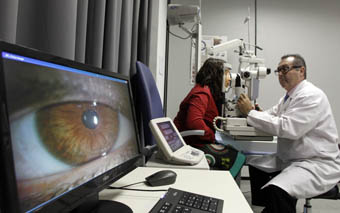
The University of Valencia, through the Unit of Optometry and Vision Sciences of the Department Of Optics of the Faculty of Physics, organises the fifth edition of the symposium 'The vision in the world: universal access to eye health', Thursday , 31 October. The presentation ceremony of the event, which will take place in the Saló de Graus of the Faculty of Mathematical Sciences, and will begin at 9:15.
The symposium will begin with an overview of university cooperation for development at the University of Valencia and presented various projects and cooperative initiatives in eye health. Thus the day will open with Valencia ophthalmologist intervention Tomas Torres, who will give the presentation “20/ 20 The great hope” (20/20 La gran esperanza).
Throughout the morning, some matters will be exposed, such as trachoma and blindness, by Sandra Johanna Garzón, from the universities 'Antonio Nariño' and 'La Salle' in Bogota, Colombia; and tropical diseases with ocular involvement, by Elfi Bossio, of Equatorial Guinea.
Following the first break, the debate will include matters such as the plan of action of the World Health Organization (WHO) and Vision 2020 for the prevention of blindness and visual impairment, also by Sandra Johanna Garzón; detection of vision problems in schools of Ixcan, in Guatemala, by Professor Doctor Antonio López Alemany, of the University of Valencia, and Joan Bou, from Solidarity Schools; the selection, management and logistics of essential medicines for development cooperation and humanitarian action and emergencies, by Antoni Bugeda, technical director of Humanitarian Logistics Area of Farmamundi Spain; optometry in Ecuador, by Andrea Villegas, and optics and optometry in Peru by Álvaro Alonso .
The global visual impairment in figures
In the world there are about 285 million people who are visually impaired, of which 39 million are blind and 246 suffer low vision. The 90 percent, roughly, is concentrated in countries in process of development, where the risk of failure is higher in women than in men. So, prevention is the major challenge that experts in Vision Science face: 75 percent of blindness can be preventable and/or cure.
This is the aim of the action plan of the WHO 'Vision 2020: the Right to See', promoted through the awareness campaign of the World Sight Day, designated by the General Assembly of the United Nations the second Thursday in October, to which is added the University of Valencia with the celebration of this V Day of Vision in the World.
The purpose of this campaign is to focus attention on blindness, visual impairment and rehabilitation of people with this functional diversity, and the central issue of 2013 is health and equal access to eye care.
Last update: 30 de october de 2013 10:27.
News release