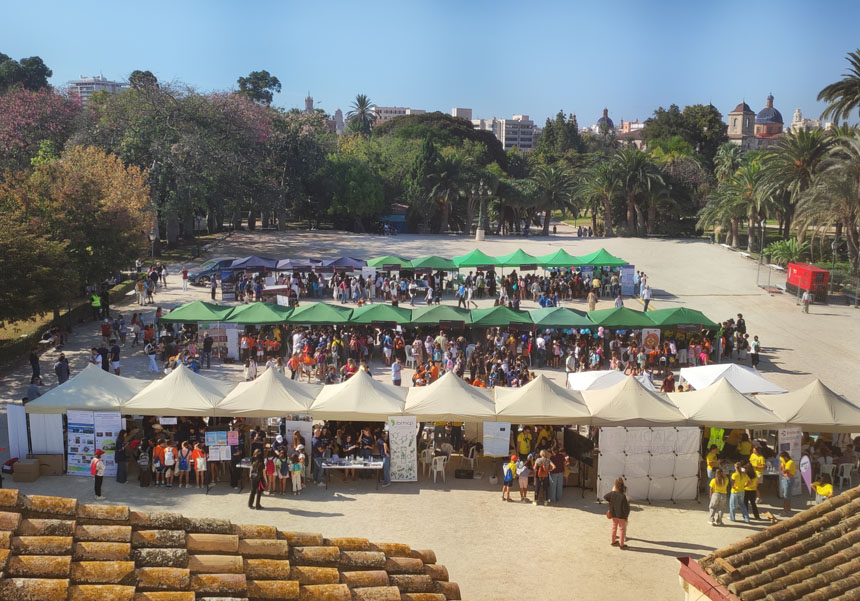
Eight Valencian institutions are the organisers of the European Researchers’ Night at Viveros Gardens in Valencia. It is a celebration of science and science communication held across Europe on the last Friday of September each year – this year on the 25th – during which science takes to the streets through fun, educational activities for the general public and families, in a festive, collaborative and participatory atmosphere. The event will feature around forty free workshops, in the morning (10 a.m. to 1.30 p.m.) and in the afternoon (5 to 8 p.m.).
The European Researchers’ Night in València is organised by the University of Valencia (UV), the Polytechnic University of Valencia (UPV), the Catholic University of Valencia (UCV), the delegation of the Spanish National Research Council (CSIC) in the Valencian Community, the INCLIVA Health Research Institute, the Foundation for the Promotion of Health and Biomedical Research of the Valencian Community (Fisabio), the Research Foundation of the General University Hospital of Valencia (FIHGUV), the Valencian Institute for Agricultural Research (IVIA), with the collaboration of the Paleontological–Museum of Natural Collections of Valencia City Council.
The morning’s science workshops will be aimed at primary and secondary school pupils and will require prior registration, while those in the afternoon will be open to the public and free to attend. The workshops (five from each participating institution) will cover areas including microbiology, nutrition, chemistry, materials and magnetism, anatomy using augmented reality, archaeology, biomaterials, civil engineering, 3D design and aquatic fauna, among others.
Specifically, the UV workshops are: “Everything You Eat Is Science”, organised by the Department of Preventive Medicine and Public Health, Food Sciences, Toxicology and Forensic Medicine; “Archaeo-Science” (organised by the Institute of Materials Science of Valencia (ICMUV) and the Department of Prehistory, Archaeology and Ancient History); and “The (Almost) Invisible World of 2D Materials”, “The Power of the Invisible: Magnetism & Conductivity” and “The Chemistry of Blandiblú (Slime)”, the latter three organised by the Institute of Molecular Science (ICMol).
Carlos López Olano, vice-rector for Communication, Participation and Transparency at the UV, highlighted that “the European Researchers’ Night is a key event for bringing the work of researchers at the University of Valencia closer to society from a fun and educational perspective, explaining their research and its applications in language that is accessible to everyone”.
Science and Beers
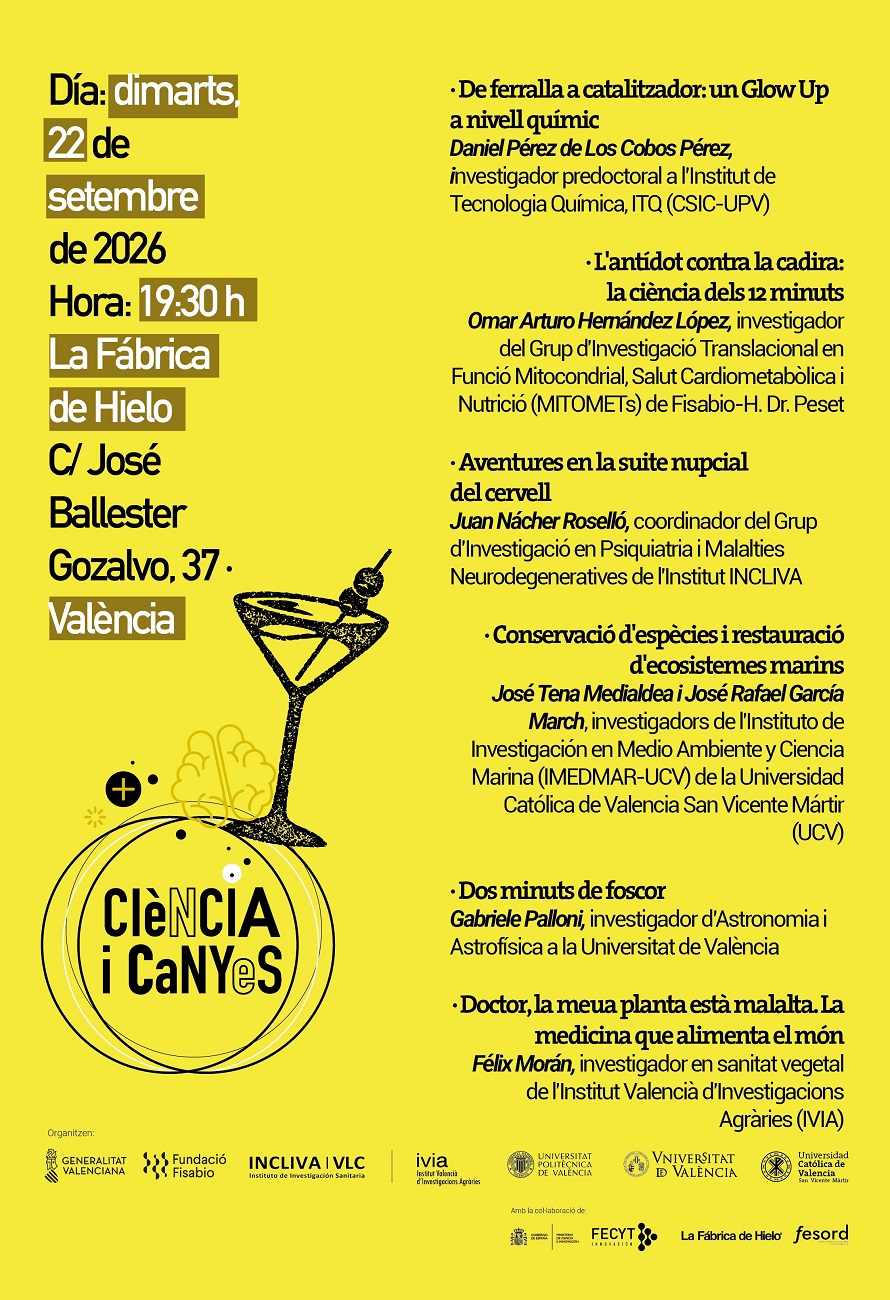
Meanwhile, also as part of the European Researchers’ Night programme, Ciència i Canyes (Science and Beers) returns tomorrow, Tuesday. It is a series of scientific talks and stand-up performances that brings research closer to the public in an informal and relaxed setting. The first session of the new season will take place next Tuesday, 22 September, at 7.30 p.m., at La Fábrica de Hielo (C/ José Ballester Gozalvo, 37, València).
The session will begin with the talk “From Scrap Metal to Catalyst: A Chemical Glow Up”, given by Daniel Pérez de Los Cobos Pérez, a predoctoral researcher at the Chemical Technology Institute (CSIC–UPV). Fisabio will be represented by Omar Arturo Hernández López, a researcher in the Translational Research Group on Mitochondrial Function, Cardiometabolic Health and Nutrition (MITOMETs) at Fisabio–Doctor Peset Hospital, with the talk “The Antidote to the Chair: The Science of 12 Minutes”. Representing INCLIVA, Juan Nácher Roselló, coordinator of the Research Group on Psychiatry and Neurodegenerative Diseases and also a researcher at the UV, will give the talk “Adventures in the Brain’s Bridal Suite”.
Marine biodiversity will also be in the spotlight thanks to José Tena Medialdea and José Rafael García March, researchers at the Institute for Research into the Environment and Marine Science (IMEDMAR-UCV) of the Catholic University of Valencia, who will present “The Race to Save the Mediterranean Fan Mussel: Species Conservation and Marine Ecosystem Restoration”. Astronomy will be represented by Gabriele Palloni, a researcher in Astronomy and Astrophysics at the University of Valencia, with “Two Minutes of Darkness”. Finally, Félix Morán, a plant health researcher at the Valencian Institute for Agricultural Research (IVIA), will close the session with “Doctor, My Plant Is Ill. The Medicine That Feeds the World”.
Images: