

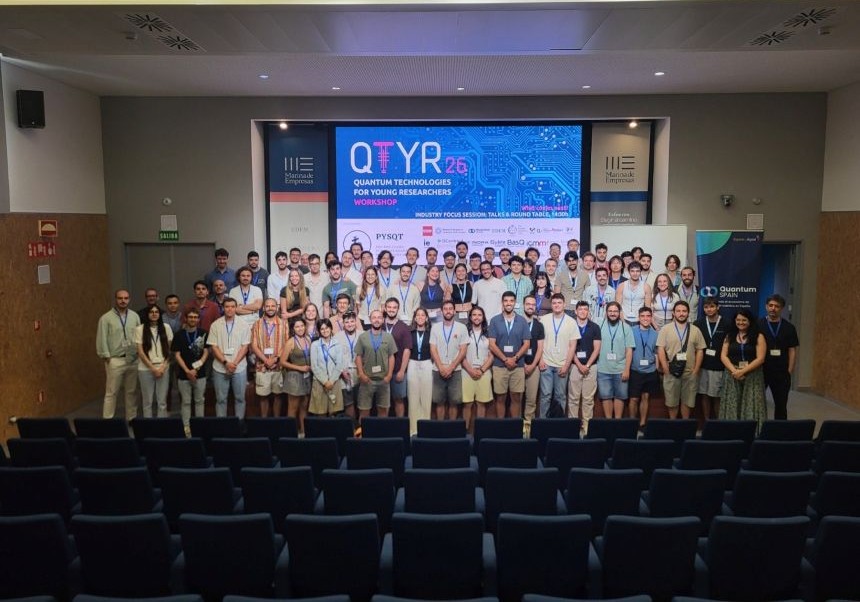
From 22 to 26 June, Valencia hosted the Quantum Technologies for Young Researchers (QTYR 2026) workshop, organised by the PhD and Young Scientists in Quantum Technologies Network (PYSQT), which brought together 112 participants from different areas of quantum science and technologies at EDEM, in the Port of Valencia.
The workshop, an initiative of the Spanish Quantum Information Network (RITCE), is part of the programme of activities of the Interuniversity Master's Degree in Quantum Technologies, offered and taught by the Faculty of Physics of the Universitat de València, in collaboration with the Spanish National Research Council (CSIC) and other Spanish universities.
The scientific meeting addressed the current state of quantum computing, quantum information, quantum optics, quantum communication and cryptography, quantum hardware, and quantum machine learning. It also offered participating master's students, PhD candidates and postdoctoral researchers the opportunity to present their work, exchange ideas and establish contacts with colleagues from different institutions and research fields. The workshop also devoted a session to the important role of companies in the development of quantum technologies.
The local organizing committee included our colleague Manuel Gessner, Professor in the Department of Theoretical Physics and member of IFIC, together with Dr Miriam Lucio (IFIC, CSIC–UV) and Dr David Ibáñez (EDEM). The event was made possible thanks to the collaboration and sponsorship of several institutions and initiatives active in the Spanish quantum ecosystem, including IFIC (Severo Ochoa Centre of Excellence), the Faculty of Physics of the Universitat de València, and the Quantum Spain project, among others.
With the celebration of QTYR 2026, the Faculty of Physics of the Universitat de València reinforces its commitment and its role as an active meeting point for the quantum technologies community in Spain, contributing to connecting young researchers, established scientists, research institutions and companies, while promoting the participation of new generations in one of the most dynamic areas of contemporary science.



