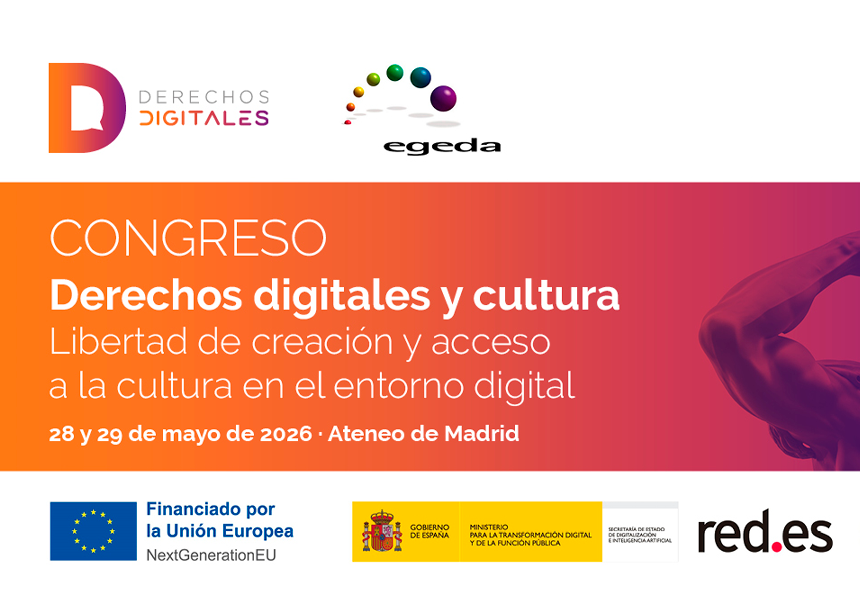
The congress Digital Rights and Culture. Freedom of Creation and Access to Culture in the Digital Environment will bring together academics, institutional representatives and cultural professionals at the Ateneo de Madrid on 28 and 29 May 2026 to discuss the main challenges posed by digital transformation in contemporary culture.
Five researchers from the Universitat de València participate in the “Digital Rights and Culture” Congres
The Universitat de València will have a significant presence at the congress through the participation of five researchers who will present scientific papers on artificial intelligence, digital rights, cultural labour, audiovisual platforms and cultural policies in the digital environment.
The congress Digital Rights and Culture. Freedom of Creation and Access to Culture in the Digital Environment will bring together academics, institutional representatives and cultural professionals at the Ateneo de Madrid on 28 and 29 May 2026 to discuss the main challenges posed by digital transformation in contemporary culture. The event, which will take place in the Ramón y Cajal Hall, will address issues related to freedom of creation, access to culture, intellectual property, digital governance and the impact of generative artificial intelligence on cultural and creative ecosystems.
The Universitat de València will have a significant presence at the congress through the participation of five researchers who will present scientific papers on artificial intelligence, digital rights, cultural labour, audiovisual platforms and cultural policies in the digital environment. These contributions are part of the scientific communications session scheduled for the second day of the congress, focused on the legal, social and cultural challenges associated with generative AI and the digital transformation of culture.
Among the selected communications is “¿Quién hizo qué? Transparencia y agencia en la contribución cultural creativa entre humanos e IA. La escala HAICCS”, presented by Amparo Oliver from the Universitat de València. The research focuses on the relationship between human creativity and artificial intelligence systems, as well as on mechanisms for transparency and identification of creative contributions in hybrid processes involving people and generative technologies.
Víctor Fernández Pallarés will also participate with the paper “La IA generativa y la reconfiguración del valor cultural: autoría, plataformas y gobernanza en el ecosistema creativo europeo”. The work examines how generative artificial intelligence may transform systems of cultural value, authorship models and governance structures within European creative industries, particularly in a context increasingly shaped by digital platforms.
Within the same thematic block, Chuan Li will present “Los intérpretes como datos: trabajo creativo impulsado por IA y la gobernanza de la interpretación digital en Estados Unidos y China”. This contribution analyses the effects of digitalisation and artificial intelligence on interpretative work and on governance systems linked to the digital circulation and exploitation of cultural content.
The territorial and socioeconomic dimension of culture in the digital era will also be represented by Rafael Boix Domènech, who will present “Creatividad, territorio y políticas públicas: luces y sombras del valor social y económico de las industrias culturales y creativas en la era digital”. The paper reflects on the effects of technological transformation on cultural and creative industries and on the role of public policies in responding to changes derived from digitalisation and AI.
Finally, Francesc Felipe Campillo will present “AI Slop, plataformas audiovisuales y derechos digitales: la crisis de la descubribilidad y la desigualdad en el acceso en la era de la inteligencia artificial generativa”. The paper focuses on the proliferation of algorithmically generated or amplified content and on the problems of cultural discoverability within audiovisual platforms, as well as the inequalities of access that may arise from automated recommendation and visibility systems.
The congress will also include keynote lectures and round tables featuring representatives from academia, institutions and the professional sector. Featured participants include Eleonora Rosati, Professor of Intellectual Property Law at Stockholm University, and Luana Lo Piccolo, expert in AI governance, technology law and digital policy.
The event is linked to the Derechos Digitales programme and includes the participation of institutions and organisations such as Red.es and EGEDA, within a space aimed at reflecting on freedom of creation and access to culture in the new digital environment.
Links: