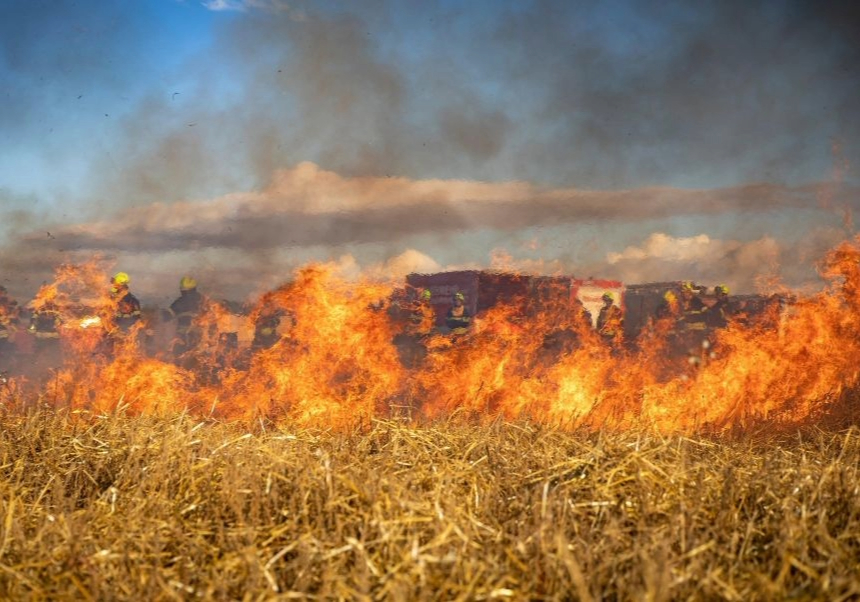
A study points to high temperatures as a key factor in the fires in the northwest of the peninsula, which accounted for more than half of the area burned in Europe and mainly affected scrubland and pine forests
This study, led by researchers from the University of Murcia and involving researchers from several CSIC centers, highlights the urgency of climate action and land management
The combination of extreme weather conditions and vegetation prone to burning is the main cause of the record-breaking area burned during the fires recorded last August in the northwest of the Iberian Peninsula. This area, which represents barely 2% of the European Union, accounted for more than 50% (some 540,000 ha) of the total area burned in Europe between January and August during the month of August alone.
This was one of the conclusions reached by an international team led by the Regional Atmospheric Modeling Group at the University of Murcia, with the participation of the Desertification Research Center (CIDE), a joint center of the Spanish National Research Council (CSIC), the University of Valencia, and the Valencian Regional Government, the Biological Mission of Galicia (MBG-CSIC), and the Joint Institute for Biodiversity Research (IMIB, CSIC-University of Oviedo-Principality of Asturias). This multidisciplinary group jointly analyzed both climatic aspects and vegetation characteristics of the burned region. The results are published in the journal Global Change Biology.
The study emphasizes that these fires were not a random phenomenon, but rather occurred during an intense heat wave that lasted 16 days in southwestern Europe, creating extreme weather conditions conducive to the spread of fire. “This was reflected in an increase in the Fire Danger Meteorological Index, which reached the most extreme monthly value recorded in the northwest of the Iberian Peninsula in the period 1985-2025,” says Marco Turco, a researcher at the University of Murcia.
However, the study highlights that, although extreme weather conditions are necessary, they are not sufficient to explain the magnitude of the fires. To understand the intensity of last August's fires in the northwest of the Iberian Peninsula, another key factor must be taken into account: the vegetation affected.
Fire and different types of vegetation
“The study makes it clear that extreme fires depend on extreme weather conditions,” explains Juli G. Pausas, a CSIC researcher at CIDE and co-author of the article. “But the type of vegetation also influences the spread of fires: scrubland and pine forests burned more than other types of vegetation, in relation to what was available in the area,” he says.
“On the other hand, native oak forests, for example, burned less than they would have if all vegetation burned equally,” notes researcher Cristina Santín of IMIB. Santín adds that “this analysis finds no evidence that protected areas burned more than unprotected areas, which is something that was repeated a lot in the media this summer.”
To prevent summers like 2025 from happening again, researchers believe it is essential to move from a predominantly reactive strategy to proactive prevention that recognizes fire resilience as a matter of national security. “To ensure that summers like 2025 remain exceptional and do not become the new norm, action is needed in all dimensions of risk, hazard, exposure, and vulnerability through coordinated mitigation and adaptation,” concludes Dominic Royé, a researcher at MBG-CSIC.
Sánchez-Hernández, G., M. Turco, I. Repeto-Deudero, D. Royé, M. Baudena, J. P. Montávez, R. Pietroiusti, A. Provenzale, C. Santin, M. A. Torres-Vázquez, J. G. Pausas 2025. Record-Breaking 2025 European Wildfires Concentrated in Northwest Iberia. Global Change Biology 31, no. 12: e70649. https://doi.org/10.1111/gcb.70649
CIDE Communication