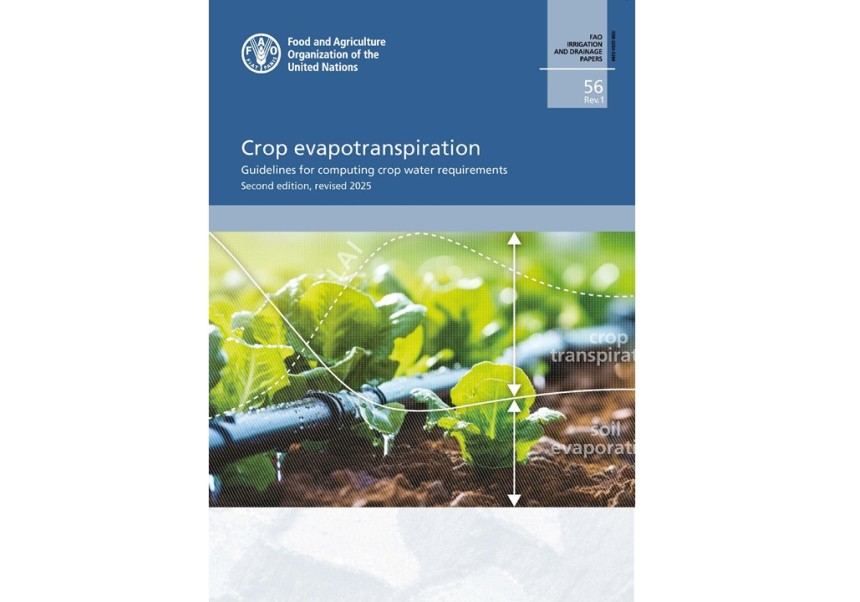
Ramón López Urrea, a research scientist at the Centre for Desertification Research (CIDE), a joint centre of the Spanish National Research Council (CSIC), the University of Valencia (UV) and the Valencian Regional Government (GVA), has co-authored the second revised edition of FAO Irrigation and Drainage Paper No. 56 Rev.1: Crop Evapotranspiration – Guidelines for computing crop water requirements, considered a key document for accurately calculating crop water requirements and efficient water management in agriculture. Building on the global acceptance and proven reliability of the original manual (more than 47,000 citations in Google Scholar), this new edition integrates scientific and technological advances and practical tools to address the challenges facing agriculture in the face of climate change, water scarcity and growing food demand.
A benchmark since 1998
First published in 1998, FAO 56 quickly became a global benchmark for governments, development agencies, research centres, universities and farmers, with the aim of effectively managing water resources, optimising irrigation practices and promoting sustainable agricultural systems.
The updated document reaffirms the fundamental concepts, while introducing improved methodologies for estimating crop evapotranspiration. These include the use of remote sensing, Internet of Things (IoT) applications and improved energy balance approaches, tools that increase accuracy, adaptability and scalability. In addition, this edition presents new approaches and datasets, making it adaptable to conditions in different regions, with a focus on arid and semi-arid areas.
From global vision to local action
This revision is also essential for addressing the pressing challenges posed by climate change. Rising temperatures and changing rainfall patterns reinforce the need for more accurate information on crop water requirements and more efficient water use in agriculture. This updated version introduces refined methodologies for optimising water resource allocation, incorporating water-saving strategies and new crop coefficients. These improvements enable stakeholders to adapt their irrigation practices to local conditions, conserve water and support food security, while minimising environmental impact.
"Participating in the update of this manual has been an opportunity to translate scientific research into concrete applications that can help millions of farmers around the world use water more efficiently. The improvements incorporated allow for more accurate and sustainable irrigation decisions, which is key in the face of the challenges of climate change, water scarcity and meeting the growing demand for food," says Dr López Urrea, who is co-author of the second edition of the manual.
With this update, FAO reinforces the importance of applied science in agriculture, providing farmers and policymakers with reliable technical tools to address water, climate and food security challenges around the world.
Pereira, L.S., Allen, R.G., Paredes, P., López-Urrea, R., Raes, D., Smith, M., Kilic, A. & Salman, M. 2025. Crop evapotranspiration – Guidelines for computing crop water requirements. Second edition, revised 2025. FAO Irrigation and Drainage Paper, No. 56 Rev.1. Rome, FAO.
https://doi.org/10.4060/cd6621en
CIDE Communication