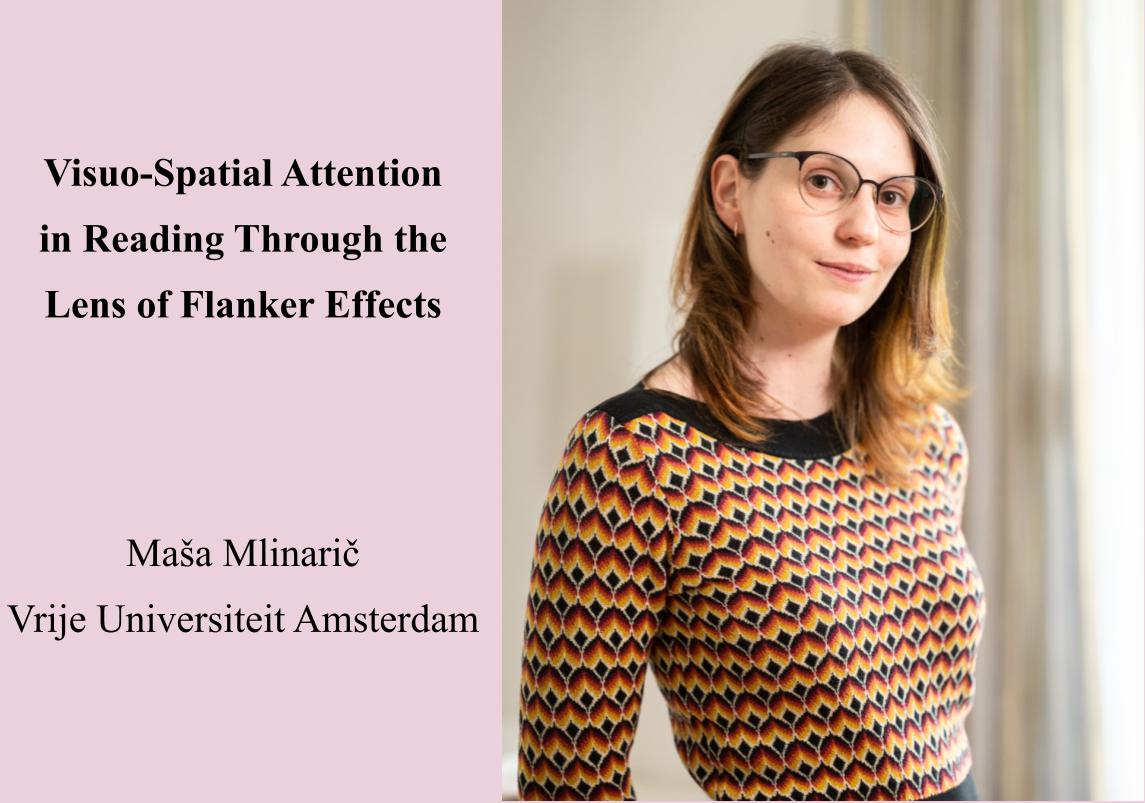
April 15, 2026 – 1:00 p.m. On-site and online session (Room M204, Faculty of Psychology and Speech Therapy). Language: English.
Visuo-Spatial Attention in Reading Through the Lens of Flanker Effects
Maša Mlinarič
Vrije Universiteit Amsterdam
When we read, we do not only process the word that we are fixating on, but we also attend to some of the surrounding words. Which are these words?
In my talk, I will focus on the first experiments I conducted during my PhD – investigating the shape and scope of attention in reading with the use of flanker effects, as well as the timing of these effects. We know that various models of reading assume that visuo-spatial attention is distributed across multiple words in a gradient shape. To test this assumption, we designed a lexical decision flanker task with three flankers on each side of the target. Flanker effects were only present for flankers immediately to the left and right of the target word, suggesting that attention was distributed to these words. Returning to the lexical decision flanker task in our second study, we manipulated the timing of orthographically related flankers. Our results suggest that flanker effects occur in the early stages of orthographic processing.
Bio
Maša Mlinarič, MD is a PhD candidate at the Vrije Universiteit Amsterdam (the Netherlands), in the Section for Cognitive Psychology. She is a medical doctor with a general license to practice medicine and holds a Master’s degree in medicine from the University of Ljubljana, Slovenia. She is a member of the Snell Language Lab and is affiliated with the Institute Brain and Behaviour Amsterdam. Her line of research focuses on the distribution of visuo-spatial attention in reading among dyslexic and non-dyslexic readers, specifically investigating flanker-relatedness effects. Her aim is also to better understand the underlying mechanisms of dyslexia, contributing to the growing literature on letter position coding uncertainty in dyslexic readers.