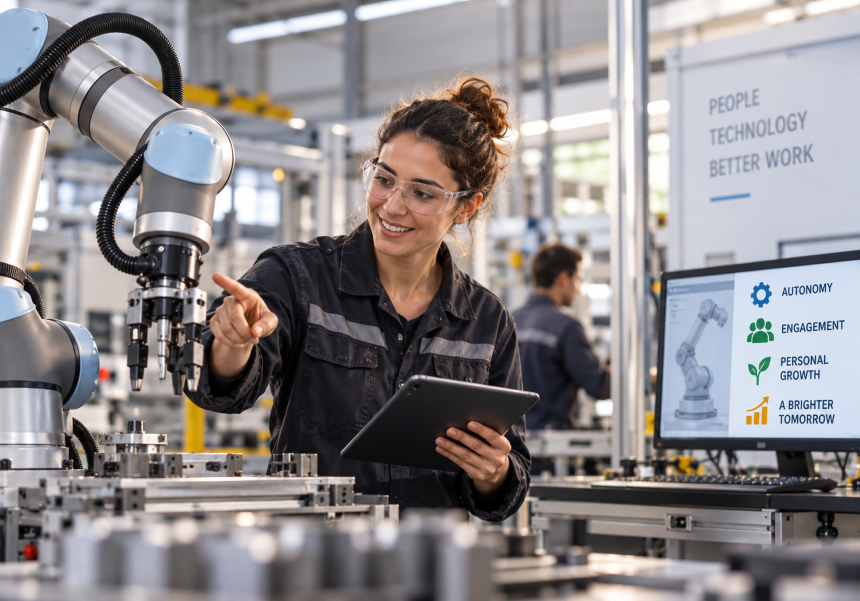
This empirical study examines how the frequency of interaction with robots (FIR) influences employees' eudaimonic well-being, specifically personal growth at work. Analyzing a sample of 299 manufacturing sector workers, the research examines the mediating roles of job autonomy, work engagement, and emotional exhaustion. The findings show that a higher frequency of interaction with robots is positively associated with greater perceived job autonomy. Furthermore, job autonomy fosters increased work engagement, which in turn boosts personal growth at work. Additionally, the study reveals that employees' positive attitudes toward robots act as a key moderating factor that strengthens the FIR-autonomy positive relationship. Ultimately, these results demonstrate that robotization can enrich work characteristics and employee well-being when properly integrated with supportive worker attitudes.
Schweizer, T., González-Romá, V., Peiró, J. M., Jonczyk, N., & Barrera, L. (2026). Working with robots and eudaimonic well-being at work: A moderated mediation model via job autonomy, work engagement, and emotional exhaustion. Journal of Work and Organizational Psychology, 42, Article e260776. https://doi.org/10.5093/jwop2026a8