

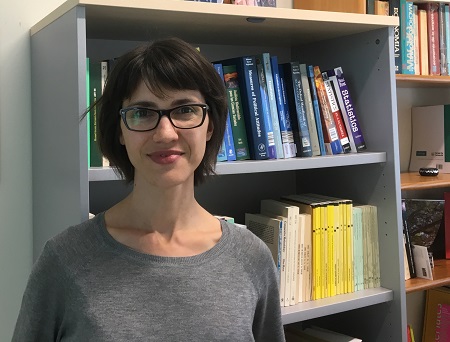
A study by Sandra Obiol, professor at the Faculty of Social Sciences, relates the higher education level with a lower perception of the work uncertainty. Research published in ‘Aposta. Revista de ciencias sociales’, she compares young workers who are not qualified in the textile sector in the regions of l’Alcoia, el Comtat and la Vall d’Albaida, with students of master’s degrees in the Universitat de València.
Despite the perception of the uncertainty that creates the job insecurity that is common among them, having higher education studies works as a tool to alleviate this uncertainty.
“My objective was getting to know how these collectives managed the uncertainty generated by the labour market, and what role had the level of their studies in this management”, highlights Sandra Olbiol. “Scarcity reaches all dimensions of their work experience, whether they have university studies or not. It also generates high levels of uncertainty that they interpret as a symptom of discomfort for which they can use compensatory strategies with the resources at their disposal”.
This way, the work ‘shows us that the position people have in the social structure is key to understand how they live, what decisions they make and what are the consequences of these decisions. And not bearing this in mind increments inequalities even more’, indicates the researcher from the Universitat.
‘After all, this difference leads us to structure differences, to different positions in the social structure. And textile and dressmaking workers are the ones that have the weakest structure position’, it has highlighted Sandra Obiol in the article ‘Incertidumbre laboral y nivel de estudios en los jóvenes valencianos’ (‘Job uncertainty an education level of Valencian youth’).
The research lays stress on the fact that -material and symbolic- resources that this collectives have at their disposal are not the same. Therefore, in the case of young workers they use a series of compensatory strategies based precisely on the vital precariousness that they suffer and that are focused on strategies that rest on the search of certainty in other areas, specially in family.
‘They assume the precariousness of work conditions (long work days, low income, underground economy) but, instead, what they try with their integration into the employment market is to get an occupation for a long period of time, a lifelong work’ concludes Obiol.
On the contrary, students of Master’s Degrees see in their studies an increase of certainty, of security. And at the same time, they conceive the planning of their educational and job trajectory as a source of certainty, even when they are aware of the provisional nature of this planning. ‘The students of Master’s Degrees are building their response to uncertainty with more resources, at least with the confidence that their studies will offer them a distinctive element and an improvement of their profile. The option of going abroad has a specific importance, it is a decision to consider’, according to the research.
The article is the result of the comparison of part of field work carried out for two researches. On the one hand, the doctoral thesis by Sandra Obiol, in which the researcher wanted to know how textile and dressmaking workers deal with the uncertainty of seeing themselves immersed in a crisis that generated the trade liberalisation of the sector in 2005. On the other hand, a research project about Master’s Degrees students of the Universitat de València directed by Alícia Villar, in which they wanted to research, among other issues, how students reached, if they were doing it, the decision of emigrating.
In the research on textile and dressmaking workers there were made 42 interviews in two periods of time (2004/2005 and 2008) to active workers. In the case of Master’s Degree students of the Universitat de València, there have been 20 interviews to people that in the middle of 2013 were studying a Master in any of the knowledge areas, with the requirement of having made a great part of their training programme in the Valencian education system. From both researchers, Obiol has focused on the interviews made to individuals that were 30 years old or younger.
Youth unemployment
In the transition from 2007 to 2014, the Valencian youth unemployment rate -the context of the article published by Sandra Obiol- went from 28,6% to 72,7% in people between 16 and 19 years old, and from 15,2% to 51,75% in those between 20 and 24 years old. The unemployment rate of the general population was 8,71% in 2007 and 25,24% in 2014. These rates, in the Valencian case, were slightly higher.
To this factors, we should add the high job temporariness of Valencian salaried, a situation that also reaches young people with higher education. Although the incidence is lower, the unemployment rate of people with higher education in Spain in 2012 was 15,2%, which increased to 39,7% in people between 20 and 24 years old; and o 24,2% between 25 and 29 years old.
Research career
Sandra Obiol is full university professor in Sociology at the Universitat Autònoma de Barcelona and professor of the Department of Sociology and Social Anthropology at the Universitat de València. She is also member of the Grup de Recerca Internacional i Interuniveristari Copolis (International and Intercollegiate Copolis Research Group). Her research activity was focused on the processes of job and vital precariousness, as well as the analysis of single-parent families and family policies.
Article:
Obiol, Sandra ‘Incertidumbre laboral y nivel de estudios en los jóvenes valencianos’. Aposta. Revista de ciencias sociales (Social sciences magazine). 68 (enero-marzo 2016) ISSN 1696-7348
Caption:
Sandra Obiol, professor at the Faculty of Social Sciences at Universitat de València



