





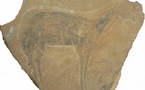

A team of scientists from the Institute of Material Science (ICMUV), the Department of Applied Physics and Electromagnetism and the Department of Prehistory and Archaeology of the University of Valencia, led by professors Clodoaldo Roldán and Valentín Villaverde, carried out the first characterisation of pigments from rock fragments in Cova del Parpalló (Gandia, Valencia), a very important collection in Europe because of the volume of materials and the large chronological period that it covers, spanning from 21,500 years BP to 12,000 years BP. The materials found in the archaeological site of Cova del Parpalló, one of the most important sites in the peninsula, consist of engravings and paintings on more than 5,000 limestone fragments that show the cultural expression of hunter-gatherer populations of the Upper Paleolithic the Mediterranean coast of the Iberian peninsula. The long temporal sequence of the Parpalló collection is unique in establishing the characteristics and evolution of Paleolithic art in southwestern Europe, so the work carried out has contributed greatly to this goal.
To analyse the pigments, made from a palette of basic colors (black, red and yellow), researchers used portable non-destructive techniques, like EDXRF spectrometry and spectrocolorimetry, in order to avoid the deterioration of the pigments, to study and monitor the temporal evolution of its chromaticity coordinates and to contribute to their conservation. The first results, published in the Journal of Archaeological Science, correspond to the analysis of black pigments and have shown a high proportion of figurative motifs made with charcoal, the use of manganese black and the absence of black pigments from calcined bones.
The research is the result of a multidisciplinary collaboration between physicists and archaeologists from the University of Valencia. It is part of a project focusing on the Middle and Upper Palaeolithic in the Spanish Mediterranean, whose objectives are, among others, the characterisation of the raw materials and their management systems, the definition of the lithic and bone operational sequences (chaînes opératoires), and the characterisation of the dyes found in the sites and of the processeses related to their use in the decoration of walls, objects, or in body ornaments.