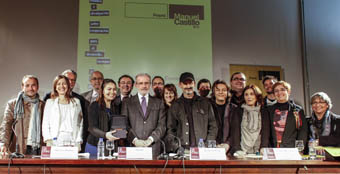
The University of Valencia will present next Wednesday, 6 March, the Manuel Castillo Awards on research and journalism for peace and cooperation for human development, in a ceremony to be held at 19:00 in the auditorium of the Cultural Centre La Nau and chaired by the principal Esteban Morcillo. This year, in the fourth edition of the awards, comes with innovations: allowing participations to be state-wide and the introduction of the category of Doctoral or Master's Thesis, which has increased to three in the modalities of the prize.
The organization of the Manuel Castillo Awards is an initiative by Patronat Sud-Nord of the General Foundation of the University of Valencia that meets the legacy of Manuel Castillo, a professor who served in Valencia, but was exiled to Mexico, leaving his legacy to the University to contribute to the promotion of peace studies and cooperation between peoples and nations.
These awards, created in 2009, aim to recognise and publicise noteworthy results for Spanish society on international cooperation, peace, and their contribution to sustainable human development of all the peoples in the world.
In the category of research papers, the jury has decided to award two prizes this year ex aequo to the works La Cooperación al desarrollo en la Comunidad Valenciana, authored by Guillermo Santander and Juan Josçe Iborra, and La coherencia de políticas para el desarrollo en España. Mecanismos, actores y procesos, by Natalia Millán with Guillermo Santander, Pablo Aguirre and Anabel Garrido. Both studies are initiatives by the 2015ymás Platform.
In the category of journalistic reporting, the award has gone to the documentary Cuestión de confianza. Historias bancarias que acaban bien, an audiovisual work that presents the difficulties in overcoming health and life through microcredit, produced by the Fontilles Association and developed by Jordi Pla and Jordi Sebastià. The honorable mention of this modality has been for Frontera Abierta, directed by Claudia Yanira Zavala. The jury has seen fit to make this special mention to the path of the program and its sensitizing task through Valencia's Municipal Broadcasting Network.
Finally, in the new category of Doctoral Thesis or Master's Thesis, the award has gone ex aequo to Aproximación a las propuestas de desarrollo desde perspectivas holísticas, a partir de las alternativas de organizaciones indias de caràcter ecológico y social, by Vicente Palop, graduate student at the Technical University of Valencia, and La comunicación para el cambio social en los proyectos de cooperación internacional Camino a la transversalidad, by Javier Díaz, from the University of Granada. These works will be published together in the collection La Nau Solidària.
The jury, chaired by the principal Esteban Morcillo, was formed by the chief executive of Patronat Nord-Sud, Guillermo Palao, director general of Immigration and Cooperation for Development of the Valecian Government, Herminia Palomar, Maria Jesús Martínez, professor in the Department of Comparative Education and Education History at the University of Valencia; Joan Lacomba, professor at the Department of Social Work and Social Services and full member of the Nord-Sud Patronat; the president of the NGO Valencia Coordinator, Carles Xavier Lopez Benedí; José María Gracia, representing the legacy of Manuel Castillo and full member of Patronat and Ximo Revert, secretary of the jury and Technical Director of Patronat Sud-Nord.
Manuel Castillo (1870-1964)
Manuel Castillo's biography is that of a singular character, who lived 94 years and was ahead of his time. Born in 1870, in a difficult social environment, he graduated in Arts, worked as a librarian in Salamanca and as a French teacher in Cáceres and Valencia.
His social interest led him to promote editorial and newspaper initiatives in Extremadura and Valencia, where he arraived in 1919. Besides teaching, he continued his philanthropic activities and was a member of the Provincial Body for Child Protection and the Advisor to the Savings Bank and Monte de Piedad of Valencia at the proposal of the Minister of Labour. From both institutions, he supported outstanding social projects.
After the war, he went into exile with his wife and children to Toulouse and then to Mexico. He died aged 94 in 1964. With the restoration of democracy in Spain, his children decided to return to their roots and settle in Valencia, the city where he had been educated. Two of them decided that a very substantial part of the family legacy be allocated to the University of Valencia for solidarity and cooperation activities as a way to honor the memory of his father, and thus created the Patronat Sud-Nord, a body that since 1991 has been working on these programs with the universitary cooperation towards development.
More information on the web:
www.uv.es/premimanuelcastillo
Last update: 7 de march de 2013 07:03.
News release