Pier Paolo Pasolini, his life and his artistic and intellectual work, has once again taken centre stage in the cultural landscape – from which, in truth, he has never truly been absent – linked to two particularly significant commemorative dates. November 2025 marks the fiftieth anniversary of his murder in Rome, and March 2022 the centenary of his birth in Bologna. A deluge of publications, events, editions, performances, readings, installations, audiovisual materials, public discussions, film screenings, etc., has filled the cultural landscape, renewing, among other things, the body of scholarship, focusing both on his literature (poetry, fiction, articles, essays…) and on his theatre and cinema, as well as on his historical, symbolic, critical and intellectual dimensions. Having been a scourge of capitalist-consumerist society, insisting on denouncing the anthropological transformation of the Italian society of his time, many have revisited the assessment of his visionary or even prophetic side, but contributions have also been made in all manner of fields, including philology.
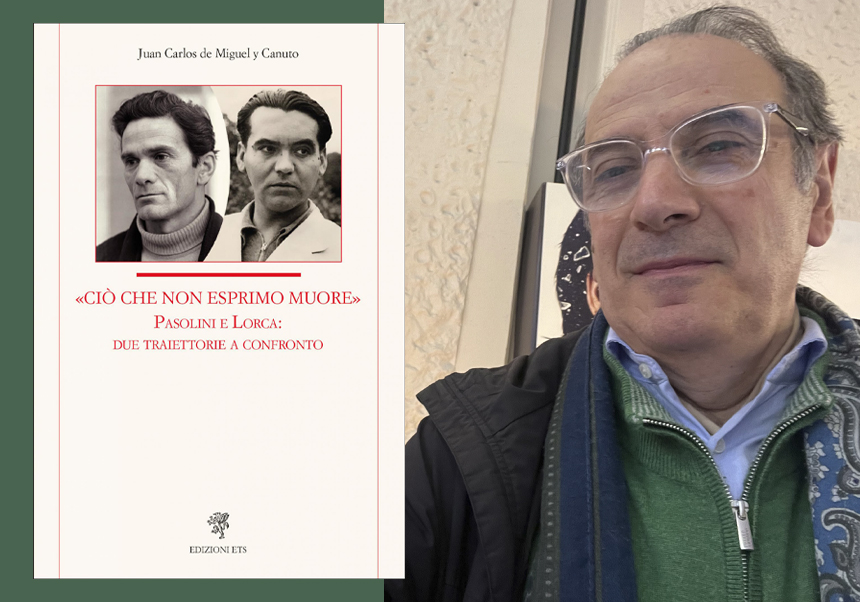
In this vibrant atmosphere of work and innovation, which has also borne fruit in Spain, Juan Carlos de Miguel, Professor of Italian Philology, has written the play Corre, Pasolini, with the aim of raising public awareness of the author; it was premiered as a staged reading at the Faculty itself, as part of the University of Valencia’s theatre programme, and he has published the book «Ciò che non esprimo muore». Pasolini e Lorca: due traiettorie a confronto (Pisa, ETS, 2025). <https://www.edizioniets.com/scheda.asp?n=9788846767141> The volume is an essay that draws on the expansion of contrastive cultural studies experienced over the past several years, to connect Pasolini with Federico García Lorca in a very broad sense, going beyond strict intertextuality and seeking instead a kind of broad transtextuality that allows for the reciprocal illumination of distinctive aspects of both figures, their artistic legacies, and the contemporary culture and history of their respective countries.
Exact publication details: de Miguel y Canuto, Juan Carlos (2025): ‘Ciò che non esprimo muore’. Pasolini e Lorca: due traiettorie a confronto. Pisa: ETS.