The Universitat de València has presented on 9 December at the Alaquàs Castle the exhibition ‘Otra economía es posible… y ya está aquí. Transformar y dar soluciones desde el cooperativismo y la economía social’. This exhibition aims to show the public the contemporary role of cooperatives and social economy entities from a different perspective.
Universitat de València presents on 9 december at 7 p.m. at the Alaquàs Castle the exhibition ‘Otra economía es posible… y ya está aquí. Transformar y dar soluciones desde el cooperativismo y la economía social’. This exhibition aims to show the public the contemporary role of cooperatives and social economy entities from a different perspective.
The exhibition is produced by the Universitat de València through the programme Universitat-Society of the Office of the Vice-Principal for Culture and Society and has the collaboration of Caixa Popular, Alaquàs Townhall and Valencian Provincial Council hall. It is within the framework of the celebration of the International Year of Cooperatives 2025, declared by United Nations, on the occasion of the 30th anniversary of the Cooperatives Principles and shows the global contribution of these entities to the economic democracy, social equity and sustainable development
Curated by Rafael Chaves Ávila, professor of the Universitat de València- of Institute IUDESCOOP and CIRIEC- and international reference of social economy, public policies and economic statistics, the exhibition offers a clear and updated tour on how the agrarian cooperatives, of credit, work, mutual societies, associations and entities of the tertiary sector have emerged as collective responses to face diverse socioeconomic problems. Some of these problems are: inequalities, unemployment, housing, credit, energy or care and how nowadays, in a context characterised by new inequalities, climate crisis and digital challenges, they continue promoting innovative solutions and transforming the system with a new model based on democracy and social equality.

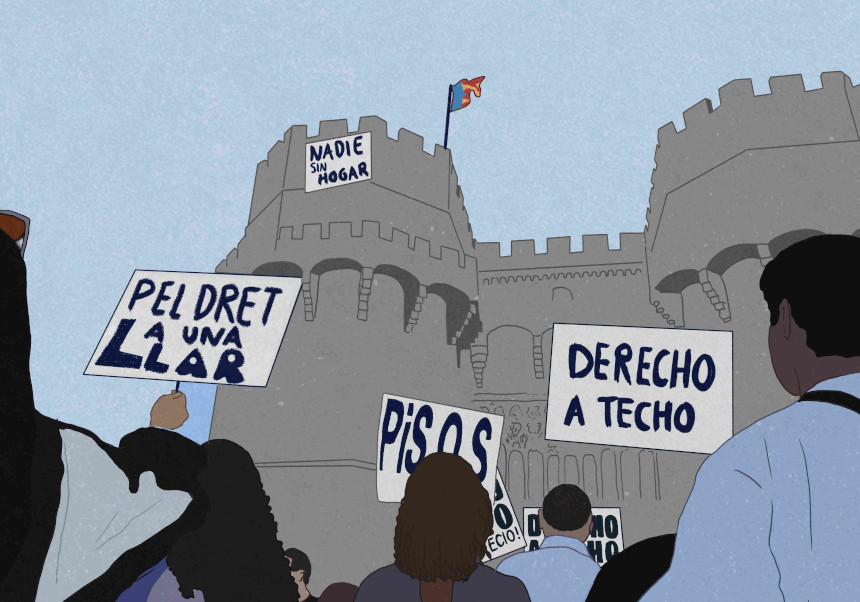
This narration combines clarity and scientific rigour: it shows data, such as that in Europe, more than 11.5 million of people work in social economy, together with paradigmatic cases and accessible contents through QR codes, integrated in a set of visual and audio-visual resources that facilitate comprehension. The original illustrations by Elena Muñoz Collado, created specially for this exhibition, provide an expressive and symbolic dimension that reinforces the human perspective, the values and social economy projection. Elena Morales Oliva has directed a documentary that collects some testimonies of cooperative members and people from different entities of the sector, providing an internal perspective on the complexity, commitment, and real impact of contemporary Valencian cooperativism.
Alaquàs, cradle of emblematic Valencian cooperatives.
The election of Alaquàs as first headquarter is due to its importance in recent story of Valencian cooperativism. The municipality is where emblematic examples such as Consum and Caixa Popular were born from the processes of communitarian organisation and that have been consolidated as models of economic democracy and commitment with the territory. Starting at this place the exhibition tries to recognize the grate legacy and qallign it with the current challenges.
The exhibition addresses the diversity of the social economy ecosystem: it includes nearly a hundred entities and cooperative businesses in work, energy, agri-food, education, housing, consumption, social banking, third sector entities, and volunteering, but also other key ecosystem actors such as governments and their promotional policies, federative structures, academia, and citizen organizations. Through this overview, the exhibition provides an understanding of how these models generate social cohesion, strengthen the productive fabric and democracy, and are system-transforming.
The exhibition, that will be able to be visited at Alaquàs until 17 January, will continue its tour through different Valencian municipalities during 2026, approaching this other type of economy that it is a reality, spreading the transforming power of cooperativism and social economy in the Valencian Community.