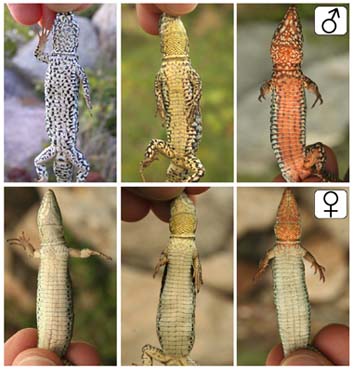
Scientists from the Cavanilles Institute of Biodiversity and Evolutionary Biology of the Science Park of the University of Valencia have provided for the first time a description about the relationship between the diverse colours present on a species of lizard ('Podarcis muralis'), which is typical from northern Iberian Peninsula, and the mating preferences. 'Podarcis muralis' can have three different colours on its belly, white, yellow and orange, as well as various combinations of them, which is known as the polychromatism phenomenon. Researchers have discovered that the majority of these lizard matings occur between specimens of the same colour. The conclusions of this research have been published on the magazine ‘Behavioral Ecology’.
Researchers from the Cavanilles Institute made a monitoring during six consecutive reproductive periods (2006-2011) of a population of Podarcis muralis at Cerdanya, the Catalan Pyrenees. They studied the colouration from the birth till the sexual maturity since lizards reach a final colour on the adult age and, on females, it only affects the lower part of the head, whereas the rest remains white. In addition, Valencian scientifics incorporated a new technique on this field, the reflectance spectrophotometry. ‘We haven't studied the coloration of the animals through photographies and other coloring measure subjective methods, but we have analyzed physically the colouration of the skin of lizards by measuring its reflectance spectrum, which allowed us to take into account the visual particularities of this specimen such as the vision in the ultraviolet spectrum, a type of light we cannot perceive’, argues Guillem Pérez i de Lanuza, the principal researcher of the project.
Polymorphisms in general (polychromatism is a type) present a great challenge for biologists who for several decades have worked hard to discover the evolutionary mechanisms responsible for its origin and maintenance. Polychromatism – coexistence of individuals of several colours on a single population- of some species of lizards of the genus Uta was detected in the USA fifteen years ago. Recently, Italian and French researchers have found similar polychromatisms on Podarcis gender, but nor in the USA, neither in Europe the color was linked to mate choice before. The work of the researchers from the Cavanilles Institute contributes a new variable on the equation of polychromatism on lizards. Valencian scientifics wondered why in Podarcis muralis remains a variability of colours very elevated when theoretically, natural selection promotes the adoption of that coloration that results more efficient, less costly or more attractive. The results point that this mate choice system according to the colour, plays a very important role on the maintenance of polychromatism.
The researcher and professor from the University of Valencia Enrique Font, co-author with Pérez i de Lanuza and Pau Carazo claims: ‘in order to advance on the behavior study from the evolutionary point of view, we think is is important to know how the colour pattern affects. Considering the fact that there are also matings between specimens of different colours, it is unlikely to reach a progressive separation on different species’.
Communication against predators
This researching team from the Etiology Laboratory from the Cavanilles Institute of the University of Valencia has recently published several works about Podarcis muralis. In addition to the discovering of lizards which are able to see ultraviolet light, they have also discovered that they present ultraviolet colorations, which combined with the white, yellow and orange ventral coloration; make them more striking in the eyes of other individuals of the same species. On the other hand, this year they made another interesting discovery. ‘We detected and described that these lizards make leg movements to communicate. Somehow they communicated with other lizards and, even more surprising, with us; they used quick and subtle movements- freely, not in captivity. In the specific case of kicks aimed at humans, it is an anti-predatory signal performing in the presence of potential predators, a behavior described in mammals and birds but unknown in reptiles’, adds Enrique Font.
Further information at: http://www.uv.es/biodiver/v/inve/grup_eto.htm
Last update: 6 de november de 2012 11:45.
News release