February 6, 2026 – 1:00 p.m. On-site and online session (Room M204, Faculty of Psychology and Speech Therapy). Language: Spanish.
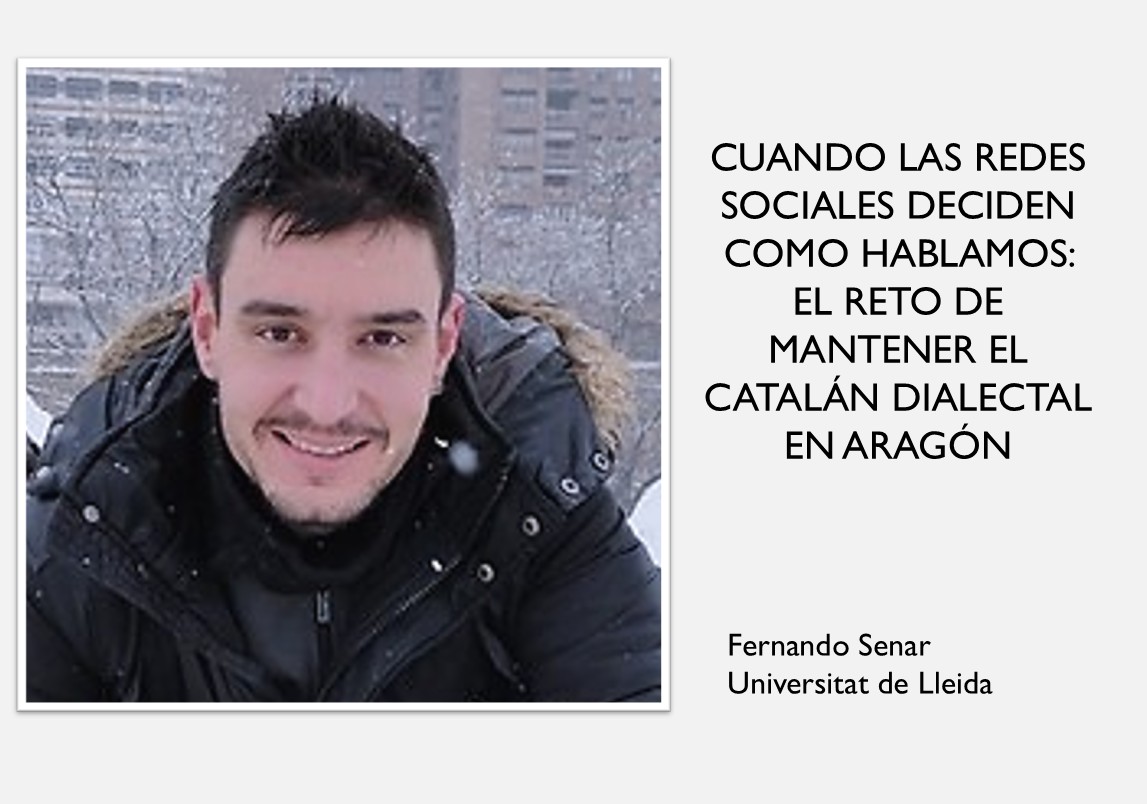
CUANDO LAS REDES SOCIALES DECIDEN COMO HABLAMOS: EL RETO DE MANTENER EL CATALÁN DIALECTAL EN ARAGÓN
Fernando Senar
Universitat de Lleida
This paper examines how contemporary social networks—structured through mechanisms of continuous consumption (infinite scroll) and algorithmic recommendation systems—have become a central space for adolescent socialization, shaping linguistic exposure and, consequently, communicative practices and linguistic identities. Based on a quantitative study with adolescents from the Franja de Ponent, the findings reveal a widespread predominance of Spanish in the main socialization contexts (especially in academic settings and peer interactions) as well as in digital environments, with a particularly pronounced imbalance in the consumption of influencer content. Although the use of Catalan in the home remains relatively more balanced, a decline in dialectal Catalan is observed compared to previous studies, a trend consistent with a weakening of intergenerational transmission. The results suggest that the impact of social networks on the displacement of dialectal Catalan operates primarily through a mediating mechanism of linguistic attitudes: greater centrality of Spanish in digital socialization is associated with lower appreciation of dialectal Catalan, which in turn affects its use in educational contexts and the perception of the Catalan subject as less useful or necessary.
Bio
Fernando Senar is a professor of Developmental and Educational Psychology at the University of Lleida. His research focuses on the psychosocial factors that influence the pace of academic language acquisition among immigrant youth. He is a member of the “Language and Education” research group and has published articles in high‑impact national and international journals, stemming from competitive research projects. Among other distinctions, he received the Extraordinary Doctoral Award in 2024.