
Universitat de València commemorates the International Day of Disability with the Conference for Inclusion 2025. From 1 to 4 December and under the ‘All of us people are different’, an intense programme of ten activities aiming to raise awareness and reclaim real opportunity equality and full inclusion in university and society took place.
Universitat de València remains at the front of disability attention, an area within its principles and the institutional policies of the Academy. Like Principal Maria Vicenta Mestre has mentioned, the aim is to advance ‘in the path towards an inclusive University, equal and fair, since people are of utmost importance; equal opportunities are not a favour but a right for all citizens’.
According to the last Study on the Inclusion of People with Disabilities in the Spanish University System, presented by Universia Foundation in 2023, the Valencian Community registered 1767 students with disabilities and 1131 enroled in Universitat de València, meaning that 64 % of them chose UV for their higher studies.
This number represents the 2021-2022 academic year. By the 2023-2024 academic year, it increased to 1352 according to the data reported by Uvdisability, the Universitat de València Integration Service for People with Disabilities. According to its last memories (2024), the increase of students with disabilities in the UV represents a 21.6 % in five years, going from 1060 enroled students in 2020 to over 1300 in 2024.
This information lies within the national university context. The Universia radiography indicated that 22 000 students with disabilities join the Spanish university: around 1.6 % of the total.
So, Universitat de València has the largest number of enrolment in Spain: a crucial point determining its leadership and example in the Spanish university system regarding true inclusion work and management.
UVdisability develops different programmes aimed for students, professors, researchers and professional administrative staff (individuals other than students were added to inclusion university policies in Spain by Universitat de València for the first time). They are inclusive lines of work, specific and adapted to the need of each member of the university community, that is 1632 people in 2024.
These programmes address the psychological-educational and individual counselling (with over 650 adaptations and attention to 58 incoming Erasmus students, 16 outgoing and 305 non-university students (EBAU), among others); actions for equal opportunities to improve accessibility to the lectures (with a sign language intepreter, physical support in exams, classrooms, etc.); activities to raise awareness, educate and volunteer (like the UV Conference for Inclusion); the overall accessibility of the UV turns it into an environment in which all people can interact (special mention to te implementation in the Joan Reglà Humanities Library and the María Moliner Education Library); and the meassures of integration for PDI and PTGAS added to those for students.
These effirts are combined with those from UVjob for guidance and social-laboural inclusion of university talent, with special mention to this year’s 31 % incorporation of people assisted by the service, managed by ADEIT Foundation and integrated in the Vice-Principal Office of Continuous Training, Teaching Transformation and Employment.
Report of the Universit Conference for Inclusion 2025
In celebration of the International Day of People with Disabilities stablished by the United Nations on 3 December, Universitat de València has organised a series of activities for four days starting on 1, thanks to Uvdisability, with the participation of the Asindown Foundation to reflect on the new challenges for education, and Adecco Foundation that addressed the professional activity that is accessible for people with disabilities.
On Tuesday 2, the morning was dedicated to the analysis of the situation faced by families with children with ASD. Music for Autism brought the documentary ‘Quiero ser cebra’ (‘I want to be a zebra’) to the Faculty of Psychology and Speech Therapy which explores the ‘therapetuical power of music’ to treat and advance in the cognitive and social progress of people with autism.
This brought out a topic not often debated: how do families face education when autism is one more aspect of their illnesses? It appears that there is still much to do. Access to public treatment still poses several barriers. In the case of Raquel’s son, who suffers from an invisible disease with an inferior incidence of a rare disease, he wasn’t provided with any public treatment or therapy.
The next session came from professor Manuel Martín, representing the Mira’m Foundation, to talk about diagnosis and educative necessities of ASD students. His experience as a professor and active member of the Foundation made an example to understand the daily life both diagnosed people, experts and therapists.
3 December
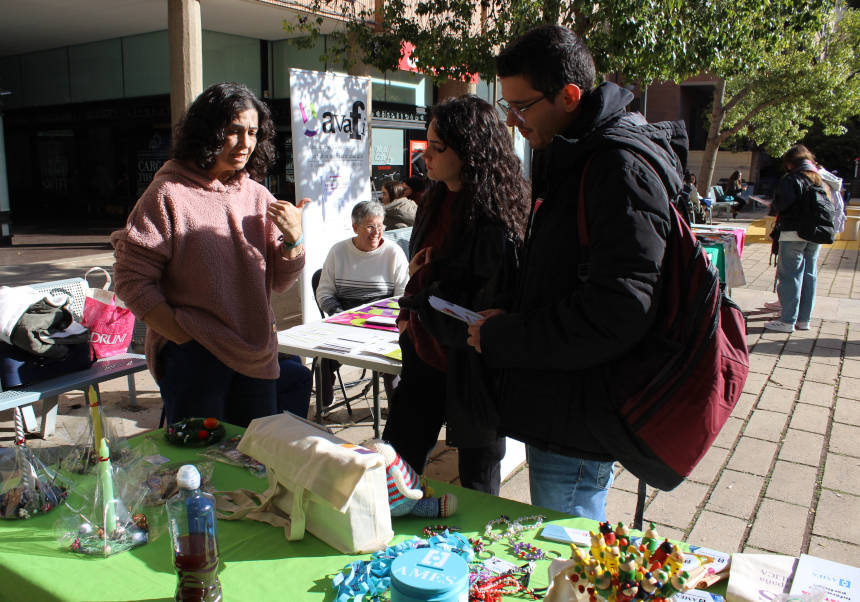
On the International Day of People with Disabilities, the activity started with the installment of the Inclusive Forum, a yearly event celebrated in a space of the Universitat de València and a call for tens of NGOs and specialised entities. This year, the stage has been the outside of classroom buildings 1 and 3, with 11 entities attending.
The morning brought an Action guide against suicidal behaviour of student, conducted by the Vice-Principal Office of Sustainability, Cooperation and Healthy Life of Universitat de València, a tool created by professors Sandra Pérez and Francisco Atienza in order to detect and prevent this kind of behaviour. This guide is a publication of the ‘fundamental points of prevention with an action protocol that provides tools and information on how to properly react in front of a suffering person (what to say and not to say), as well as resources to attend to in this situation’ explains professor Sandra Pérez.
The guide is created in a moment when society needs to address these behaviours as a reality. The most unsettling data put suicide as the third most common cause of death for young people in the world, and Sandra Pérez adds that ‘to avoid that, the most important part is to help people and stop their suffering’
Within this frame, Cristina Martínez provided the students access to ‘La niña amarilla’ Association, dedicated to the prevention of this kind of behaviour and act ‘out of love and correct communication’, for what she demanded ‘social empathy’.
Then, the documentary ‘Abril se va en noviembre’ (‘April stops in November’), produced by Rosa Cabrera was played to invite debate in the room.
The afternoon was centered around the Conference for Fibromyalgia and ME/CFS in the Valencian Community, organised in collaboration of Universitat de València at the Faculty of Philosophy and Education Sciences with the support of Generalitat Valenciana, València City Hall and the Provincial Council. A conference to raise awareness on an illness with no external effects and to claim the recognition of patients who are double victimised: for their illness and for the society, just like expert doctors, rheumatologists and therapists.
Previous to the conference, the presentation of the Professional Activity Support Unit by Integra CEE Group and aimed for Social Education students that received the main items on the legal frame of protection for women with disabilities facing gender-based violence among other matters.
The University Conference for Inclusion ended on Thursday 4 with a gathering of 14 entities participating in the Inclusive Forum for the entire morning, and two coloquium at the Tarongers Campus about the project ‘Mujeres, arte y participación ciudadana’ (‘Women, art and citizen participation’) in charge of FEVADIS, and the social work with paediatric oncology patients by the ASPANION Association. Both conferences had the collaboration of Faculty of Teaching Training and Faculty of Social Sciences.
Association network, education and technical debate
Universitat de València is committed to achieve complete inclusion, so it bets on precise actions throughout the year as a reference to develop educative programmes: fifteen students with intellectual disabilities graduate from the third edition of UNINCLUV (ONCE Foundation), a continuous training course for employment, to cooperate in the Valencian association fabric with collaboration agreements signed with the Representative Committee of People with Disabilities in the Valencian Community (CERMI CV) and Asindown Foundation; as well as the university debate on universal accessibility with the 14th Gathering of the Attention Service Network for People with Disabilities in Universities, where over 100 of experts from 49 Spanish universities work in the unification of criteria, university coordination and institutional commitment for the inclusion of all students and equal opportunities.


