

-
Economic and social impact of the musical societies in the Requena-Utiel plateau.
Julio Montagut Marqués, Pau Rausell Köster
(2018). ArticleOleana: Cuadernos de Cultura Comarcal. No.Nº 32, 2018
Musical societies are one of the most important signs of Valencian identity, due to the deep roots they have in our Autonomous Region, which is why they were declared "of local relevance" in 2011, and since then work is being done to have them declared "of cultural interest". The SSMM bring together a series of particularities, properties and concepts that make them unique and that include actions such as associationism, voluntary work, musical production and training, recreational activities, etc., causing with all the output generated an economic and social impact on the population and the region. In this paper, we would like to focus on some of the consequences of the SSMM in the Meseta...
Musical societies are one of the most important signs of Valencian identity, due to the deep roots they have in our Autonomous Region, which is why they were declared "of local relevance" in 2011, and since then work is being done to have them declared "of cultural interest". The SSMM bring together a series of particularities, properties and concepts that make them unique and that include actions such as associationism, voluntary work, musical production and training, recreational activities, etc., causing with all the output generated an economic and social impact on the population and the region. In this paper, we would like to focus on some of the consequences of the SSMM in the Meseta de Requena-Utiel region.
Read more Hide ISSN: 1139-4943 -
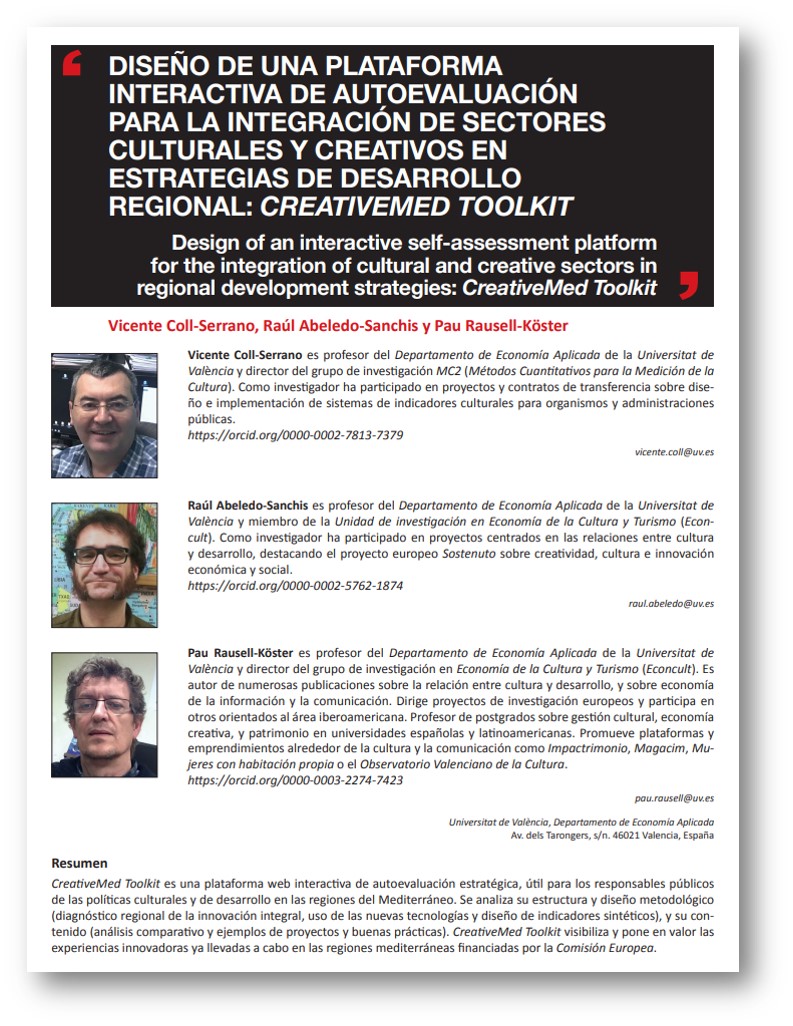
Design of an interactive self-assessment platform for the integration of cultural and creative sectors in regional development strategies: CreativeMed Toolkit.
Coll-Serrano, Vicente Abeledo-Sanchis, Raul Rausell-Köster, Pau
(2018). ArticleCreativeMed Toolkit is a useful, strategic, self-assessment tool for policymakers responsible for cultural and development policies in the Mediterranean regions. Its structure, methodological design (regional diagnosis of integral innovation, use of new technologies, and design of synthetic indicators), and content are discussed. A comparative analysis and examples of projects and good practices are presented. CreativeMed Toolkit reveals and highlights innovative experiences that have already been developed in the Mediterranean regions and funded by the European Commission.
Vol. 27, no. 2, Mar.-Apr. 2018, pp. 395
-

Cultural attitudes and tourist destination prescription.
Pardo-García, C Coll-Serranoa, V Rausell-Köster, P Pérez Bustamante-Yábar, D
(2018). ArticleThis research note analyzes the effect of cultural, cognitive and hedonic attitudes of the urban tourist (Brida, Nogare, & Scuderi, 2017; Um & Crompton, 1990) towards the destination on being a prescriber of it. A tourist prescriber of the destination is not only highly satisfied with the destination but also recommends it strongly to others, the type of tourist policy makers are most interested in. Undoubtedly, satisfied tourists are more likely to recommend a destination (Chen & Chen, 2010), or develop loyalty towards a destination (Yuksel, Yuksel, & Bilim, 2010). However, tourist satisfaction can be: (1) a direct consequence of the quality of the services received; or (2) a broader...
This research note analyzes the effect of cultural, cognitive and hedonic attitudes of the urban tourist (Brida, Nogare, & Scuderi, 2017; Um & Crompton, 1990) towards the destination on being a prescriber of it. A tourist prescriber of the destination is not only highly satisfied with the destination but also recommends it strongly to others, the type of tourist policy makers are most interested in. Undoubtedly, satisfied tourists are more likely to recommend a destination (Chen & Chen, 2010), or develop loyalty towards a destination (Yuksel, Yuksel, & Bilim, 2010). However, tourist satisfaction can be: (1) a direct consequence of the quality of the services received; or (2) a broader concept based on emotion and pleasure (De Rojas & Camarero, 2008)
Read more Hide
DOI: https://doi.org/10.1016/j.annals.2018.01.003 -
The Calatrava model: reflections on resilience and urban plasticity
Boix, Rafael; Rausell, Pau; Abeledo, Raül
Valencia: Routledge , 2018. ArticleEuropean Planning Studies. No.Volume 25, Issue 1 (2017)
The article introduces a critical reflection on the effects that the version of cultural capitalism based on large events and architectural symbols has on the resilience of cities when used as an engine, and not as a complement to the policies of urban transformation. The article introduces as a case of study the so-called ‘Calatrava model’ of the city of Valencia. The model of a cultural bubble of Valencia, designed to enable a new space, is developed and contrasted with other two examples of urban transformation designed to revitalize spaces: Bilbao – symbolically represented by Frank Gehry's Guggenheim museum – and the Barcelona 22@ – symbolically represented by Jean Nouvel's Agbar...
The article introduces a critical reflection on the effects that the version of cultural capitalism based on large events and architectural symbols has on the resilience of cities when used as an engine, and not as a complement to the policies of urban transformation. The article introduces as a case of study the so-called ‘Calatrava model’ of the city of Valencia. The model of a cultural bubble of Valencia, designed to enable a new space, is developed and contrasted with other two examples of urban transformation designed to revitalize spaces: Bilbao – symbolically represented by Frank Gehry's Guggenheim museum – and the Barcelona 22@ – symbolically represented by Jean Nouvel's Agbar Tower. Through the notion of ‘plasticity’ we analyse how, despite the overall failure of the Calatrava model and its negative effect on the short-term ability of the city to absorb shocks, Valencia is able to adapt and absorb the urban transformation around the Calatrava's architectural complex and to incorporate it into their processes of dynamic resilience.
Read more HidePages 29-74
DOI: 0.1080/09654313.2016.125757ISSN: 0965-4313
-
Culture, Economy and economic progress
Rausell Köster, Pau
(2017). LlibreCulture, Innovation and The Economy.
Biljana Mickov, James E. Doyle (eds)
ISBN: 978-1138219014 -
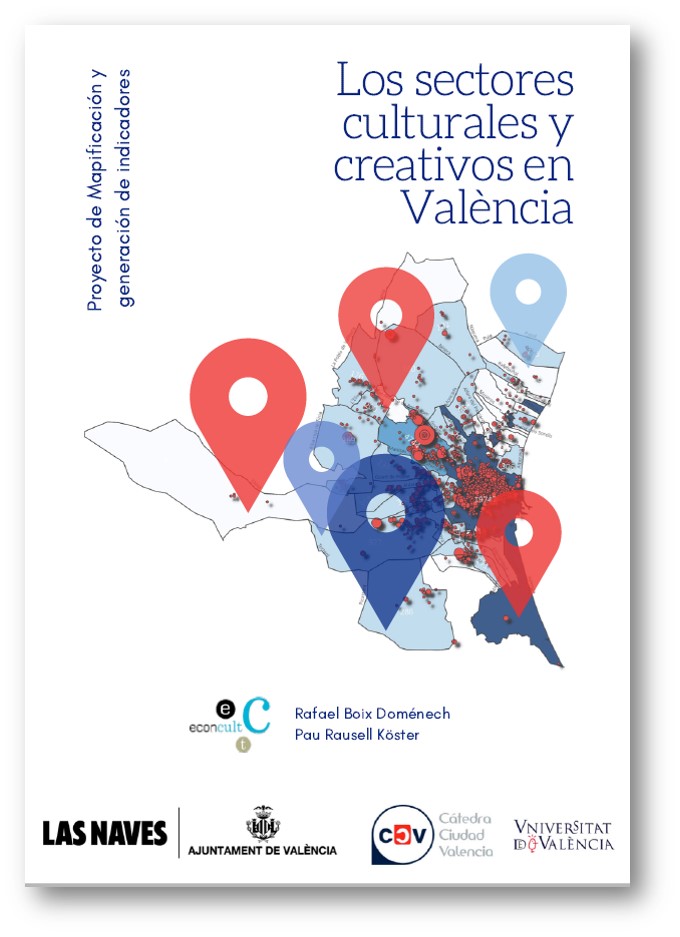
Los sectores culturales y creativos en València. Proyecto de mapificación y generación de indicadores.
Boix Domènech, Rafael Rausell Köster, Pau
València: Las Naves , 2017. InformesThe general objective of the following work is the design of an information and location system for monitoring the dynamics of the cultural and creative sectors in the city of Valencia. monitoring the dynamics of the cultural and creative sectors in the city of Valencia. To this end, a set of specific objectives are established, such as: Delimitation of the economic activities related to culture and creativity. [Analysis of the proposal IVIE, 2014]. Spaces related to cultural creation, production and distribution will be included. 2. Design and evaluation of the system of indicators and selection of variables; [companies by size, employees by gender and age, turnover 2. Design and...
The general objective of the following work is the design of an information and location system for monitoring the dynamics of the cultural and creative sectors in the city of Valencia. monitoring the dynamics of the cultural and creative sectors in the city of Valencia. To this end, a set of specific objectives are established, such as: Delimitation of the economic activities related to culture and creativity. [Analysis of the proposal IVIE, 2014]. Spaces related to cultural creation, production and distribution will be included. 2. Design and evaluation of the system of indicators and selection of variables; [companies by size, employees by gender and age, turnover 2. Design and evaluation of the system of indicators and selection of variables; [companies by size, employed by sex and age, turnover, added value, economic profitability, productivity]. 3. Analysis of the quality and comparability of sources on cultural and creative activities at local level. [SABI, Social Security, IAE, Census, EPA, other sources]. 4. Mapping of cultural and creative activities in the city of Valencia. 5. Recommendations on the information system and on local policies aimed at the cultural and creative sectors, especially in relation to the 5. Recommendations on the information system and on local policies oriented to the cultural and creative sectors, especially related to spatial logics.
Read more Hide -

MAIN CONNECTIONS BETWEEN CULTURAL AND CREATIVE ACTIVITIES AND THE SOCIO-ECONOMIC SPACE
Rausell Köster, Pau Abeledo Sanchis, Raül
Olesncia (Poland) , 2016. Participació en congressosCULTURE FOR SHARED, SMART, INNOVATIVE TERRITORIES.
The symbolic structure of a community has always played a relevant role in the configuration of the socioeconomic space. However, this influence has become stronger in the last two decades. As the EU indicates in its Green Paper “Unlocking the cultural potential and creative industries” (2010), factory floors are progressively replaced by creative communities whose raw material is their ability to imagine, create and innovate. All formulations of the Knowledge or Information Society highlight the growing importance and centrality of the symbolic dimension in social and economic relations. However, this perception has become a topic that lacks complete evidence and is definitely necessary to...
The symbolic structure of a community has always played a relevant role in the configuration of the socioeconomic space. However, this influence has become stronger in the last two decades. As the EU indicates in its Green Paper “Unlocking the cultural potential and creative industries” (2010), factory floors are progressively replaced by creative communities whose raw material is their ability to imagine, create and innovate. All formulations of the Knowledge or Information Society highlight the growing importance and centrality of the symbolic dimension in social and economic relations. However, this perception has become a topic that lacks complete evidence and is definitely necessary to clearly explain the causes, variables, relationships between these variables and their consequences.
Read more Hide13 pàgines.
Citat a un document del Parlament Europeu
Explicat a un Podcast:
-
I am granted, therefore I create.
Caspar Nieuwenhuis Pau Rausell-Köster
(2016). InformesReport from the IETM Valencia Plenary Meeting, 3 - 6 November 2016 This session featured two futuristic, provocative and controversial concepts, which headed off from the idea that the status quo needs a radical change and it needs it now. The first one went into cyber anarchism by calling to clear away the whole subsidy based system and then substitute it with what seems to be a neoliberal paradigm of project based grants and audience retention estimations. The second concept appeared to comply with the established system of subsidies but it undermined the core wealth distribution principles of today by introducing the basic income model in art and cultural sector funding. Specific...
Report from the IETM Valencia Plenary Meeting, 3 - 6 November 2016 This session featured two futuristic, provocative and controversial concepts, which headed off from the idea that the status quo needs a radical change and it needs it now. The first one went into cyber anarchism by calling to clear away the whole subsidy based system and then substitute it with what seems to be a neoliberal paradigm of project based grants and audience retention estimations. The second concept appeared to comply with the established system of subsidies but it undermined the core wealth distribution principles of today by introducing the basic income model in art and cultural sector funding. Specific models differ greatly across countries; therefore, the local context’s influence on each speaker’s attitude towards government, funding, policies, evaluation has to be taken into consideration. As well as their professional backgrounds, of course.
Read more Hide -
The value of the Valencian musical heritage. An approach from the economics of culture.
Rausell-Köster, Pau
Universitat de València: Editorial Aranzadi, SA , 2016. LlibreEl valor cultural de la música. Punt de partida per a l'estudi del patrimoni musical.
Pp. 183-192
ISBN: 978-84-9098-859-6 -
La política cultural europea. 欧洲的文化政策
Rausell Köster, Pau
Yunnan: Yunnan University Press , 2016. LlibreResearc On Regional Culture Industries.
Europe now stands at a complex crossroads, where global issues such as development, citizenship, competitiveness and sustainability are at stake. Given the importance of creativity and social innovation for European development strategies, the potential of culture as a tool for strategy implementation is crucial. Therefore, a range of public policies in the field of culture and creative industries need to be rethought and reformulated in order to strengthen the multi-level coordination between different policies, to enhance their centrality in regional development and to provide legal and financing mechanisms for policy responses to different challenges. This paper provides a quick review...
Europe now stands at a complex crossroads, where global issues such as development, citizenship, competitiveness and sustainability are at stake. Given the importance of creativity and social innovation for European development strategies, the potential of culture as a tool for strategy implementation is crucial. Therefore, a range of public policies in the field of culture and creative industries need to be rethought and reformulated in order to strengthen the multi-level coordination between different policies, to enhance their centrality in regional development and to provide legal and financing mechanisms for policy responses to different challenges. This paper provides a quick review of the main features of the different cultural policies implemented by the EU member states, analyses the financial budgets allocated by the main EU countries to their cultural policies and outlines the main features of European cultural policies as reflected in the European Agenda for Culture. Finally, the need to reformulate cultural policies in accordance with a more comprehensive paradigm is elaborated
Read more HideEn Chino
ISBN: 978-7-5482-2835-6
 Research Unit in Cultural Economics and Tourism (ECONCULT)


© 2025 UV. - Avinguda dels Tarongers, s/n. 46022 València. Phone number: (+34) 963 828 645