

-
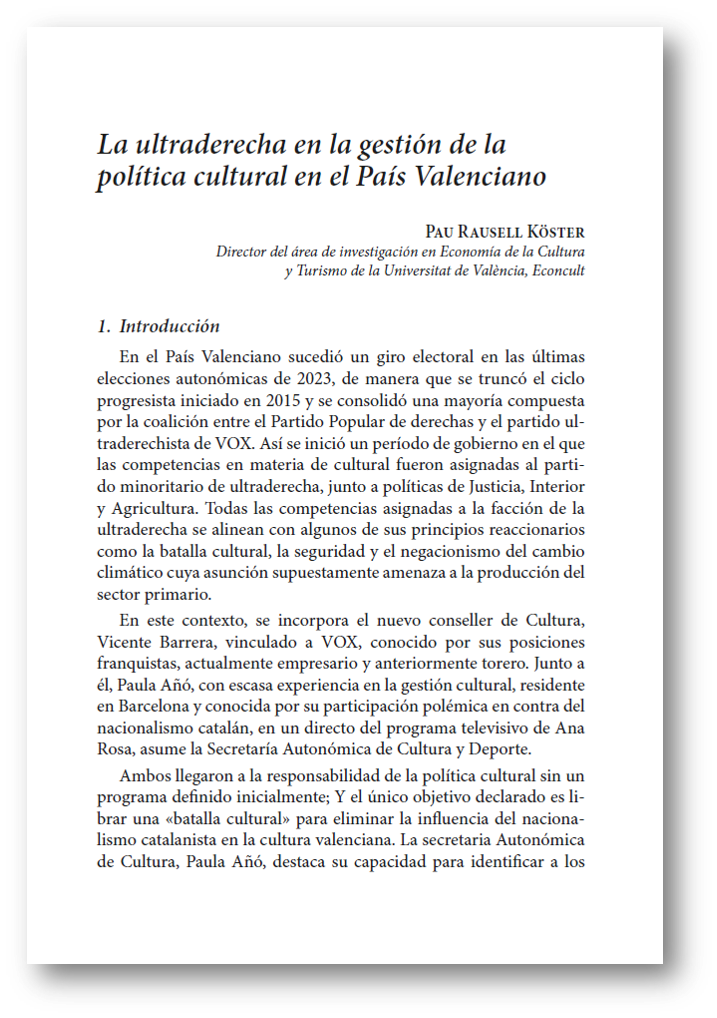
La ultraderecha en la gestión de la política cultural en el País Valenciano
Pau Rausell Köster
València: PUBLICACIONS UNIVERSITAT DE VALÈNCIA , 2025. LlibreIn the Valencian Country there was an electoral shift in the last regional elections of 2023, so that the progressive cycle that began in 2015 was cut short and a majority was consolidated, made up of the coalition between the right-wing Partido Popular and the far-right party VOX. Thus began a period of government in which cultural competences were assigned to the minority far-right party, along with Justice, Interior and Agriculture policies. All the competences assigned to the far-right faction are aligned with some of its reactionary principles such as the culture war, security and climate change denialism, the assumption of which supposedly threatens production in the primary sector.
Article extractat del llibre
-

Observatori Cultural de la Universitat de València: Reflections, experiences and practices on contemporary cultural management
Raúl Abeledo Sanchis, Marcia Jadue Boeri
(2025). LlibreThis third volume edited by the Cultural Observatory of the University of Valencia addresses urgent and significant issues for the cultural and creative sectors. From the perspective of experts with recognized experience, we reflect on the intersections between culture and politics, with special emphasis on the contemporary exercise of cultural rights and the risks of the political instrumentalization of culture. The experience of projects that have made the leap to internationalization is also shared, revealing the strategies with which those responsible have overcome the complex challenges that entails. Finally, voice is given to local initiatives, highlighting the historical significance...
This third volume edited by the Cultural Observatory of the University of Valencia addresses urgent and significant issues for the cultural and creative sectors. From the perspective of experts with recognized experience, we reflect on the intersections between culture and politics, with special emphasis on the contemporary exercise of cultural rights and the risks of the political instrumentalization of culture. The experience of projects that have made the leap to internationalization is also shared, revealing the strategies with which those responsible have overcome the complex challenges that entails. Finally, voice is given to local initiatives, highlighting the historical significance of alternative spaces that, supported by autonomous management models, have collaborated in the survival of local ecosystems and the construction of community identities.
Read more Hide DOI: doi.org/10.7203/PUV-OA-747-8 -
Virtuopolis.
Pau Rausell Francesco Molinari
Radical Creativities , 2024. ArticleThis article introduces "Virtuopolis", an innovative concept of a digital city designed around the principles of virtue and excellence across the social, cultural, intellectual, and ethical dimensions. Unlike traditional digital twins, Virtuopolis aims to replicate not only the physical aspects of a city but also its cultural, emotional, and symbolic dimensions. The three-layer framework of Virtuopolis comprises "The Things", focusing on digitizing and preserving cultural heritage; "The Flows", capturing dynamic cultural interactions; and "The Experiences", measuring the impact of cultural experiences on personal and social life. By leveraging advanced computational methods and network...
This article introduces "Virtuopolis", an innovative concept of a digital city designed around the principles of virtue and excellence across the social, cultural, intellectual, and ethical dimensions. Unlike traditional digital twins, Virtuopolis aims to replicate not only the physical aspects of a city but also its cultural, emotional, and symbolic dimensions. The three-layer framework of Virtuopolis comprises "The Things", focusing on digitizing and preserving cultural heritage; "The Flows", capturing dynamic cultural interactions; and "The Experiences", measuring the impact of cultural experiences on personal and social life. By leveraging advanced computational methods and network theory, Virtuopolis provides a platform for urban planning experimentation, fostering collaboration among diverse stakeholders and enhancing the liveability of cities through the integration of cultural and artistic values.
Read more Hide HANDLE: URL Podcast -

Collaborating for Museum Innovation. Technological, Cultural, and Organisational Innovation in Spanish Museums
Li, Chuan
(2024). Llibrehis book is a fresh reflection on the study of museum innovation, with special attention paid to the enabling role of collaboration within the process. It sets out to capture the innovation dynamics of museums and explore to what extent and how collaborative arrangement can contribute to different types of innovative activities in the museum sector. The book presents a holistic review of museum innovation from multiple perspectives of, among others, economics, sociology, museology, and organisational study, while adopting an interdisciplinary approach to explore and analyse the innovation process and collaboration mechanism from the viewpoint of economics and sociology. The research...
his book is a fresh reflection on the study of museum innovation, with special attention paid to the enabling role of collaboration within the process. It sets out to capture the innovation dynamics of museums and explore to what extent and how collaborative arrangement can contribute to different types of innovative activities in the museum sector. The book presents a holistic review of museum innovation from multiple perspectives of, among others, economics, sociology, museology, and organisational study, while adopting an interdisciplinary approach to explore and analyse the innovation process and collaboration mechanism from the viewpoint of economics and sociology. The research presented is based on three interdependent aspects: first, a holistic definition and taxonomy of innovation in museum organisations; second, qualitative and quantitative analysis of the enabling role of collaboration in technological, cultural, and organisational innovation in museums; and third, multiple case studies for the identification and evaluation of effective collaboration models in different types of innovation. This is a problem-oriented study, which avoids focusing on those large and super museums that have been well-documented in prior studies; instead, it concentrates on small- and medium-sized museums, which account for more than 85% of museums in the world and have become the main resources of cultural tourism and the creative economy at a regional level. Primarily written for postgraduates, researchers, and academics interested in innovation study, innovation in cultural and creative sectors, and museum study, the findings may also have important implications on innovation management and policy for regional museums and public authorities.
Read more Hide -

Sectorial and territorial analysis of the cultural and creative sectors in the Canary Islands..
Tony Ramos Murphy Jordi Sanjuán Belda Rafael Boix Aitana Cabedo Andreu Francés Pau Rausell
(2024). LlibreThe impact of the covid-19 pandemic The main value that this work aims to provide is to draw lessons for the future in the face of the new changing context that has been emerging in recent years and that forces us to rethink strategies for greater proactive resilience of the Canary Islands economy. To this end, this document starts from the characterization of the cultural and creative sectors and the analysis of the context that surrounds them in the Canary Islands. Next, after clarifying some concepts about of how the SCC relate to and influence the economic system, an exercise is carried out analysis based on municipal and detailed data from the SCC, observing How the Canarian cultural...
The impact of the covid-19 pandemic The main value that this work aims to provide is to draw lessons for the future in the face of the new changing context that has been emerging in recent years and that forces us to rethink strategies for greater proactive resilience of the Canary Islands economy. To this end, this document starts from the characterization of the cultural and creative sectors and the analysis of the context that surrounds them in the Canary Islands. Next, after clarifying some concepts about of how the SCC relate to and influence the economic system, an exercise is carried out analysis based on municipal and detailed data from the SCC, observing How the Canarian cultural and creative ecosystem and its implementation have been affected territorial, and identifying the main impacts, strengths, weaknesses and opportunities that open for the development of the cultural and creative economy in Canary Islands in the post-covid scenario. Finally, it concludes with some notes. and reflections on the suitability, increased after the pandemic, of pursuing a development strategy for the Canary Islands that places culture and creativity at the epicenter of the economic system.
Read more Hide ISBN: 978-84-7947-871-1 -

Study on the impact of the cultural and creative sectors on the well-being of the Canarian population.
Jordi Sanjuán Belda Tony Ramos Murphy Pau Rausell Köster Rafael Boix Domènech
(2024). LlibreIn recent years, events such as the Great Recession, the Covid-19 pandemic, the war in Ukraine or the climate crisis have highlighted some of the imbalances in the current production model and how these seriously affect the well-being of the population. Beyond the current difficulties that have had to be addressed, notable structural weaknesses have been revealed in some economies that have proven especially vulnerable, such as the Canary Islands. The Canary Islands are, in fact, the Spanish autonomous community that had increased its per capita income the least in 2022 compared to 2008, before the economic crisis (barely 6% compared to 16.7% for the Spanish economy as a whole). It was also...
In recent years, events such as the Great Recession, the Covid-19 pandemic, the war in Ukraine or the climate crisis have highlighted some of the imbalances in the current production model and how these seriously affect the well-being of the population. Beyond the current difficulties that have had to be addressed, notable structural weaknesses have been revealed in some economies that have proven especially vulnerable, such as the Canary Islands. The Canary Islands are, in fact, the Spanish autonomous community that had increased its per capita income the least in 2022 compared to 2008, before the economic crisis (barely 6% compared to 16.7% for the Spanish economy as a whole). It was also the second autonomous community (after the Balearic Islands) that experienced a greater economic decline derived from the covid-19 pandemic, given the strong external dependence of its productive structure as a peripheral territory and highly specialized in tourist activities. Furthermore, this trend not only responds to specific situations, but also reflects a gap that has been widening, at least, since the beginning of the 21st century.
Read more Hide ISBN: 978-84-7947-872-8 -
L’arte nei luoghi di cura: quali strategie?.
Ghirardi, Sendy
Bologna: Società editrice il Mulino S.p.A , 2024. ArticleThis section delves into the enduring connection between art, environment, and health, investigating the obstacles and possibilities encountered when integrating artistic interventions into healthcare programs, especially in Italy. It underscores the necessity for inventive methodologies to gauge the social impact of cultural policies in healthcare, elucidating the framework of the Horizon 2020 MESOC project. Examining various instances of best practices, it discerns diverse approaches by which artistic activities become part of healthcare settings. The section concludes by scrutinizing shared challenges and facilitating factors in the formulation of cross-sectoral initiatives within the...
This section delves into the enduring connection between art, environment, and health, investigating the obstacles and possibilities encountered when integrating artistic interventions into healthcare programs, especially in Italy. It underscores the necessity for inventive methodologies to gauge the social impact of cultural policies in healthcare, elucidating the framework of the Horizon 2020 MESOC project. Examining various instances of best practices, it discerns diverse approaches by which artistic activities become part of healthcare settings. The section concludes by scrutinizing shared challenges and facilitating factors in the formulation of cross-sectoral initiatives within the domains of culture, health, and social involvement.
Read more HideSendy Ghirardi, L’arte nei luoghi di cura: quali strategie?, in "Economia della Cultura, Rivista trimestrale dell'Associazione per l'Economia della Cultura" Speciale/2023, pp. 161-174, doi: 10.1446/112799
DOI: 10.1446/112799ISSN: 1122-7885 -
Student Response Systems in higher education: A comparative analysis using Wooclap platform in economic courses
Catala Estada, Belén Muñoz-Higueras, Diego Sanjuán Belda, Jordi
https://journaljmbe.com/article/view/6398 , 2024. ArticleJournal of Management and Business Education. No. 7(2), 244–260.
he introduction of technological tools such as student response systems to dynamise classes in higher education has been increasing in recent years, although often without proper monitoring of their effects. This research aims to analyse the main added value of the use of the Wooclap platform in university education, and whether there are differences in its results depending on the heterogeneous characteristics of the courses and groups in which it is applied. To this end, a comparative analysis has been carried out in three different courses in the field of economics at the University of Valencia. In all three courses, questions were introduced in Wooclap during theory classes. Students in...
he introduction of technological tools such as student response systems to dynamise classes in higher education has been increasing in recent years, although often without proper monitoring of their effects. This research aims to analyse the main added value of the use of the Wooclap platform in university education, and whether there are differences in its results depending on the heterogeneous characteristics of the courses and groups in which it is applied. To this end, a comparative analysis has been carried out in three different courses in the field of economics at the University of Valencia. In all three courses, questions were introduced in Wooclap during theory classes. Students in the three courses were given an anonymous survey at the end of the course to evaluate the use of this tool. The students were very satisfied with the tool, highlighting that it helps them to maintain their attention, identify the most important concepts, understand and consolidate them. Furthermore, by means of the Chi-square test, no significant differences were observed in the three groups, from which it can be deduced that beyond the specific characteristics of the course, the profile of the students or the lecturer, this tool can be extrapolated to different contexts and satisfactory results can be expected. The ease of implementation, the possibility of obtaining immediate feedback from students and breaking the monotony of classes are other advantages for lecturers. The conclusions drawn highlight the potential of Wooclap to extend its use in higher education.
Read more Hide244-260
DOI: https://doi.org/10.35564/jmbe.2024.0014 -
Societal Impact of Culture in European Regions
Rausell Köster, Pau Sanjuan Belda, Jordi
(2023). ArticleAbstract: The notion that culture plays a central role in development processes is increasingly accepted, both in academic circles and by public administrations and supranational institutions, with the European Union being particularly notable. From the realm of knowledge and research, there is a growing body of robust evidence establishing causal links between culture, creativity, and multiple impacts on social and economic variables. This paper synthesises the primary findings of a study that employs novel and intricate causal machine learning techniques to analyse the impacts of cultural and creative sectors on various dimensions of well-being in European regions, including income,...
Abstract: The notion that culture plays a central role in development processes is increasingly accepted, both in academic circles and by public administrations and supranational institutions, with the European Union being particularly notable. From the realm of knowledge and research, there is a growing body of robust evidence establishing causal links between culture, creativity, and multiple impacts on social and economic variables. This paper synthesises the primary findings of a study that employs novel and intricate causal machine learning techniques to analyse the impacts of cultural and creative sectors on various dimensions of well-being in European regions, including income, employment, education, health, and sense of community, among others. The results affirm that, in European OECD regions, the effects are positive across most dimensions for a majority of regions. This underscores the potential of culture and creativity to catalyse regional development processes and enhance the well-being of European citizens
Read more Hide -
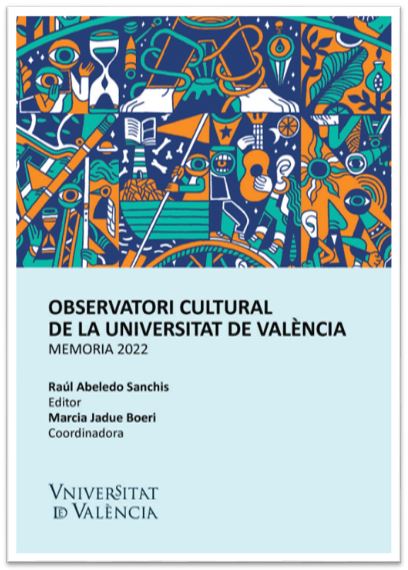
Cultural Observatory of the Universitat de València. Report 2022.
Abeledo Sanchis, Raúl Jadue Boeri, Marcia
Universitat de València: UV Cultura. Observatori cultural , 2023. InformesThrough a careful thematic selection, this second publication of the Cultural Observatory of the Universitat de València introduces into the public agenda emerging issues with a special priority visibility for the artistic and cultural sector. It is a book written by several authors that reproduces the voices of PhDs in Fine Arts, Economics, Humanities or Media, but also reflects the valuable experience of cultural agitators, scriptwriters, social movement activists, cultural managers, researchers, journalists and specialists in illusionism. Together, their testimonies manage to integrate the challenges faced by the local cultural ecosystem from a cross-disciplinary perspective and with an...
Through a careful thematic selection, this second publication of the Cultural Observatory of the Universitat de València introduces into the public agenda emerging issues with a special priority visibility for the artistic and cultural sector. It is a book written by several authors that reproduces the voices of PhDs in Fine Arts, Economics, Humanities or Media, but also reflects the valuable experience of cultural agitators, scriptwriters, social movement activists, cultural managers, researchers, journalists and specialists in illusionism. Together, their testimonies manage to integrate the challenges faced by the local cultural ecosystem from a cross-disciplinary perspective and with an international scope from a territorial point of view. This publication aims to contribute to the generation of specific knowledge for Cultural Management, but even more to transfer it in a sensitive way to the university community and society as a whole by emphasising the experience and professionalism of the people involved.
Read more HidePp. 188
DOI: 10.7203/PUV-OA-596-2HANDLE: 10550/90000
 Research Unit in Cultural Economics and Tourism (ECONCULT)


© 2026 UV. - Avinguda dels Tarongers, s/n. 46022 València. Phone number: (+34) 963 828 645