

-
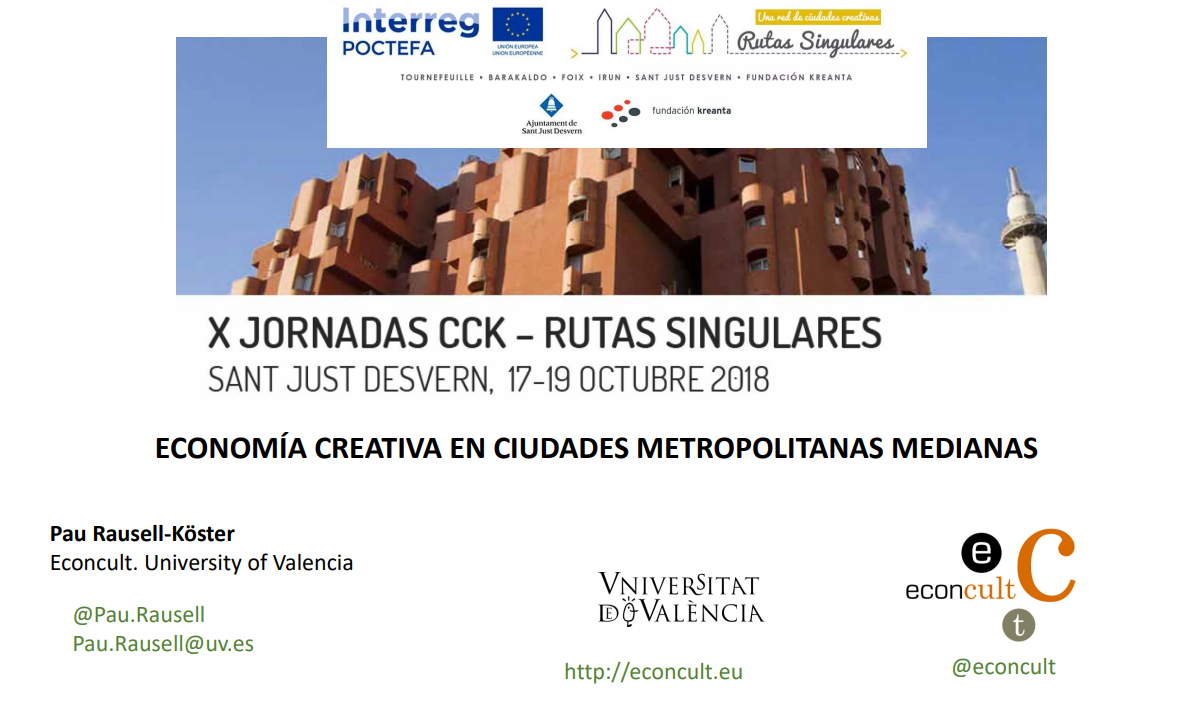
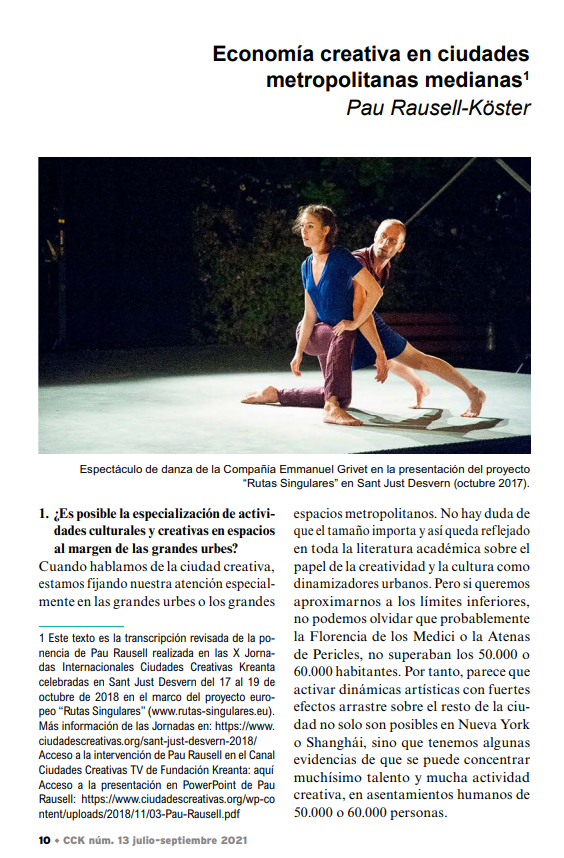
Creative economy in medium-sized metropolitan cities
Rausell Köster, Pau
(2021). RevistaCCK Revista. No.Nº 13, 2021
This text is the revised transcription of Pau Rausell's presentation at the X Jornadas Internacionales Ciudades Creatives Kreanta held in Sant Just Desvern from 17 to 19 October 2018 within the framework of the European project Singular Routes (www.rutas-singulares.eu). More information on the conference at: https://www.ciudadescreativas.org/sant-just-desvern-2018
-
Culture for Recovery Strategic actions for strengthening the Valencian cultural ecosystem, aimed at social, economic and territorial transformation through culture..
Ramon Marrades, Paloma Medina, Pau Rausell, Chema Segovia
València: Conselleria de Educació, Cultura i Esport , 2021. LlibreThis document presents the actions that will guide the bulk of the work of the Department of Culture of the Generalitat Valenciana during the 2021–2023 period. Its preparation has taken place in a particular context, defined by the convergence of three elements: the pandemic, the proactivity and contributions of the cultural sector aimed at improving its conditions, and the need to continue the strategic planning of cultural policies following Fes Cultura.
-
The impact of the music industry in Europe and the business models involved in its value chain
Blanca de Miguel-Molina, Rafael Boix-Doménech & Pau Rausell-Köster
(2021). LlibreThis chapter analyses the impact of the music industry in Europe. Although the direct and indirect impact of this industry in the European economy is significant, the sector is made up of different activities and companies, which compete and encounter diverse challenges in it. The current situation of these companies and organisations is presented through an analysis of the business models of several enterprises engaging in a variety of activities throughout the industry’s value chain, such as music production, publishing, distribution and exhibition. Moreover, we analyse digital transformation and the growth in rivalry detected in these activities.
ISBN: 978-3-030-76881-2 -

CIUTAT DE L’ARTISTA FALLER. Strategic framework for its recovery and transformation
Chema Segovia, Pau Rausell Tony R. Murphy Antonio Laguna Guillem Bacete
València: CULTURALINK , 2021. InformesCIUTAT DE L’ARTISTA FALLER. Strategic framework for its recovery and transformation.
The main purpose of this project is to establish the Strategic Framework for the recovery and economic transformation of the productive space of the Ciutat de l’Artista Faller, located in the Benicalap district of the city of Valencia. This proposal leverages the different studies, participation processes and specific propo¬sals, already undertaken, concerning the exploration of the potential development oppor¬tunities going forward of this highly unique urban enclave. Of particular importance here is the Decalogue for the Revitalisation and Improvement of the City of the Fallas Artist, developed in partnership with the professional sector and unanimously approved by the Valencia City...
The main purpose of this project is to establish the Strategic Framework for the recovery and economic transformation of the productive space of the Ciutat de l’Artista Faller, located in the Benicalap district of the city of Valencia. This proposal leverages the different studies, participation processes and specific propo¬sals, already undertaken, concerning the exploration of the potential development oppor¬tunities going forward of this highly unique urban enclave. Of particular importance here is the Decalogue for the Revitalisation and Improvement of the City of the Fallas Artist, developed in partnership with the professional sector and unanimously approved by the Valencia City Council in 2015. The design process for this Strategic Framework has sought to increase the commitment of those desiring to revitalise the Ciutat de l’Artista Faller and has sought to broaden their support by exploring new avenues for engagement. Thus, the preparation of this project was undertaken with substantial involvement of the Gremio de Artistas Falleros de València (Guild of Fallas Artists of Valencia), that provided a snapshot of the actual situation of the workshops that are currently located in the Ciutat de l’Artista Faller and served to gauge their interest. Initial contacts were also established with a range of potentially relevant stakeholders, including the Directorate General for the Coordination of Government Action of the Generalitat Valenciana, the Department of Culture and Education, the association València World Design Capital 2022, as well as others involved in European projects linked to cultural and creative initiatives, such as Designscapes and MESOC. The proposal to reactivate the Ciutat de l’Artista Faller was strengthened through close aligned with higher ranking frameworks, such as the Missions València 2030 strategy and the guidelines of the New European Agenda for Culture. Other potential avenues for the promotion of the project, such as the European funding programs Next Generation EU and React-EU, the state guidelines of the PERTE (Strategic Projects for Economic Recovery and Transformation), or the initiative in deployment of the New European Bauhaus, were also considered.
Read more Hide -
Informe 2021 de ceramistas de la Comunitat Valenciana. Datos y conclusiones..
Pau Rausell Köster (Coord.) Jordi Sanjuán Belda Aitana Cabedo Pérez Rafa Boix Doménech
(2021). InformesCeramics is one of the oldest art and craft forms created by mankind, and today ceramic know-how has gradually spread all over the world, creating districts and clusters of artists, craftsmen, associations, art schools and museums. National and international networks have been built and consolidated through cultural, productive and institutional collaborations, developing contacts and cooperation, organising and promoting events such as festivals, markets, workshops, symposiums, exhibitions and awards. Artistic ceramics represents a central part of the European tradition, and from a production point of view it is mainly made up of small and micro enterprises that were affected by the...
Ceramics is one of the oldest art and craft forms created by mankind, and today ceramic know-how has gradually spread all over the world, creating districts and clusters of artists, craftsmen, associations, art schools and museums. National and international networks have been built and consolidated through cultural, productive and institutional collaborations, developing contacts and cooperation, organising and promoting events such as festivals, markets, workshops, symposiums, exhibitions and awards. Artistic ceramics represents a central part of the European tradition, and from a production point of view it is mainly made up of small and micro enterprises that were affected by the economic crisis of 2008 and by competition from low-cost production.
Read more Hide -
The impact of cultural and creative industries on the wealth of countries, regions and municipalities
Rafael Boix Domenech, Blanca De Miguel Molina, Pau Rausell Köster
(2021). RevistaEuropean Planning Studies. No.Volume 30
This paper compares the total impact of cultural and creative industries (CCIs) on per capita income of countries, regions and municipalities. We estimate the total effects of CCIs in 78 developed and developing countries in 5 continents, in 275 European regions and in 518 municipalities in the European region of Valencia, using data obtained from multiple databases and nonparametric local linear least squares. The average effects of CCIs are positive in the three territorial scales, in both low- and high-income locations, and increase in conjunction with increases in development, with high and very high developed places showing greater impacts. CCIs are, thus, a powerful resource for...
This paper compares the total impact of cultural and creative industries (CCIs) on per capita income of countries, regions and municipalities. We estimate the total effects of CCIs in 78 developed and developing countries in 5 continents, in 275 European regions and in 518 municipalities in the European region of Valencia, using data obtained from multiple databases and nonparametric local linear least squares. The average effects of CCIs are positive in the three territorial scales, in both low- and high-income locations, and increase in conjunction with increases in development, with high and very high developed places showing greater impacts. CCIs are, thus, a powerful resource for improving the well-being of rich and poor places at all geographic scales; however, they also act as a double-edged sword, as they increase inequalities between places.
Read more HideDOI: https://doi.org/10.1080/09654313.2021.1909540
-
White paper on design enabled innovation in Europe
Chuan Li, Pau Rausell, Francesco Molinari, Nicola Morelli, Luca Simeone, Hadas Azohar, Grazia Concilio, Talita Medina, Ilaria Tosoni
(2021). InformesDesign can express culture, develop novel concepts and new products, underpin business growth, facilitate social innovation, humanise technology, and support and guide systemic change to deliver a better life. It has been a decade since the time when the EU first recognised design as the source of innovation and included it in the core themes of Europe 2020 flagship initiative Innovation Union1. In the last ten years, both the design discipline and the policy environment have changed considerably. Therefore, it is urgent for EU policy makers to adopt a new dynamic and update existing design innovation policies to meet new challenges in today’s new and complex policy environment. This...
Design can express culture, develop novel concepts and new products, underpin business growth, facilitate social innovation, humanise technology, and support and guide systemic change to deliver a better life. It has been a decade since the time when the EU first recognised design as the source of innovation and included it in the core themes of Europe 2020 flagship initiative Innovation Union1. In the last ten years, both the design discipline and the policy environment have changed considerably. Therefore, it is urgent for EU policy makers to adopt a new dynamic and update existing design innovation policies to meet new challenges in today’s new and complex policy environment. This White Paper proposes a next generation of EU design innovation policies with a focus on the shift from traditional design-driven innovation to Design enabled Innovation (DeI), with a view to harnessing the full potential of design to trigger systemic change in a broader socio-technical level to address pressing global challenges today.
Read more Hide DOI: 10.13140/RG.2.2.17559.09127 -
The COVID-19 pandemic and cultural industries in Spain
Raúl Abeledo-Sanchis & Guillem Bacete-Armengot
(2021). LlibreCultural Industries and the Covid-19 Pandemic.
In recent years, the Cultural and Creative Sectors (CCSs) have faced significant challenges despite the recognition of the intrinsic value of culture as a driver of economic growth, social fairness, active citizenship, and identity and have had limited resources at their disposal to do so. At a time when the effects of the financial crisis are still being felt within the Spanish cultural ecosystems, the COVID-19 crisis has highlighted the relevance of culture as a social remedy, especially during the lockdown, although it has also exposed the vulnerability of the CCSs in terms of labour conditions and public support. This chapter examines how Spanish cultural and creative organizations...
In recent years, the Cultural and Creative Sectors (CCSs) have faced significant challenges despite the recognition of the intrinsic value of culture as a driver of economic growth, social fairness, active citizenship, and identity and have had limited resources at their disposal to do so. At a time when the effects of the financial crisis are still being felt within the Spanish cultural ecosystems, the COVID-19 crisis has highlighted the relevance of culture as a social remedy, especially during the lockdown, although it has also exposed the vulnerability of the CCSs in terms of labour conditions and public support. This chapter examines how Spanish cultural and creative organizations reacted to the lockdown measures implemented in March 2020 following the outbreak. It provides descriptive data on the early-stage impact of lockdown on the operational structure of CCS organizations, the actions they took to adapt to the situation, and the resources at their disposal, as well as their prospects in the medium and long term. This chapter concludes by raising questions around the effectiveness of the subsidy scheme implemented in Spain to support the CCS, highlighting the need for a strategic recovery plan.
Read more Hide ISBN: 9781003128274 -
Creative industries and productivity in the European regions. Is there a Mediterranean effect?
Rafael Boix-Domenech, Jesús Peiró-Palomino & Pau Rausell-Köster
(2021). ArticleRegional Science Policy & Practice. No.13
The existence of a Mediterranean way of creativity and its effects on regional performance has been discussed in European development strategies. However, there is little evidence supporting that idea. This paper addresses this issue by using data on creative industries for a sample of 276 European regions and the local linear least squares estimator, able to deal with parameter heterogeneity. The results suggest that creative industries increase labor productivity. Nevertheless, the paper contributes by providing, for the first time, evidence that the average impact of the creative industries for Mediterranean regions is not substantially different from that for the rest of European...
The existence of a Mediterranean way of creativity and its effects on regional performance has been discussed in European development strategies. However, there is little evidence supporting that idea. This paper addresses this issue by using data on creative industries for a sample of 276 European regions and the local linear least squares estimator, able to deal with parameter heterogeneity. The results suggest that creative industries increase labor productivity. Nevertheless, the paper contributes by providing, for the first time, evidence that the average impact of the creative industries for Mediterranean regions is not substantially different from that for the rest of European regions. However, other territorial patterns emerge, showing the heterogeneity of the impacts of creative industries, which can be even negative in some regions. This evidence has implications for regional, economic and cultural policies.
Read more HideMinisterio de Economía y Competitividad, Grant/Award Number: ECO2017-85746-P; EU H2020, Grant/Award Number: 870935 - MESOC project
DOI: 10.1111/rsp3.12395
-
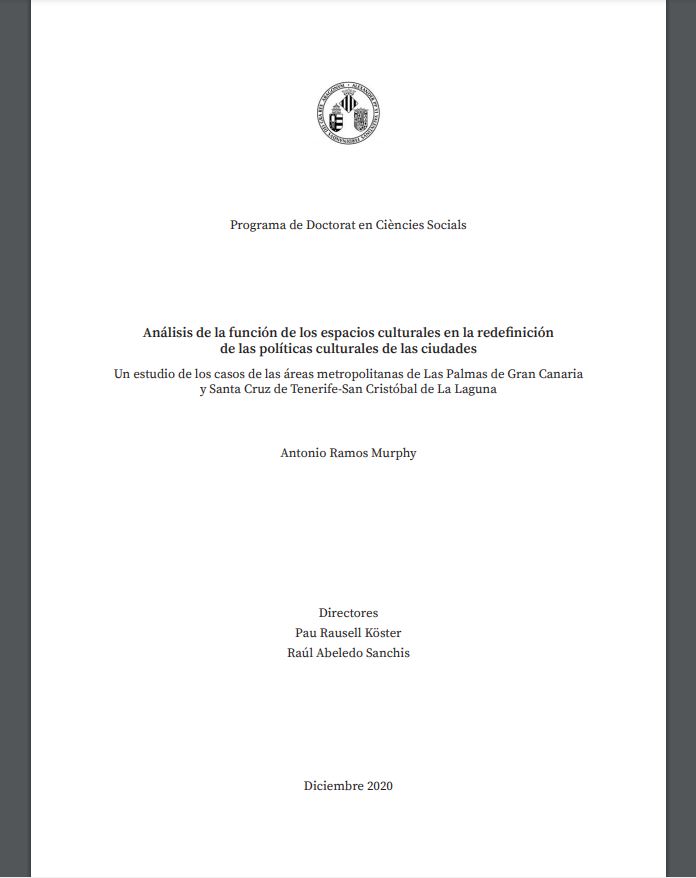
Analysis of the role of cultural spaces in the redefinition of cultural policies in cities. A case study of the metropolitan areas of Las Palmas de Gran Canaria and Santa Cruz de Tenerife-San Cristóbal de la Laguna.
Antonio Ramos Murphy
(2020). ThesisThis thesis deals with the relationship between cultural spaces and cultural policies, in particular in the urban sphere. Specifically, in this research project we argue, firstly, that urban cultural policies and policies for the creation of cultural spaces are governed by the same logic and are articulated in a functional whole to the dominant paradigm of cultural policy (in which cultural spaces are both a derivative and a condition of the model of cultural democratisation). Secondly, we maintain that cultural spaces are the keystone of cultural democratisation policies, as they constitute the main tool for their effective materialisation. Finally, we claim that a redefinition of the role...
This thesis deals with the relationship between cultural spaces and cultural policies, in particular in the urban sphere. Specifically, in this research project we argue, firstly, that urban cultural policies and policies for the creation of cultural spaces are governed by the same logic and are articulated in a functional whole to the dominant paradigm of cultural policy (in which cultural spaces are both a derivative and a condition of the model of cultural democratisation). Secondly, we maintain that cultural spaces are the keystone of cultural democratisation policies, as they constitute the main tool for their effective materialisation. Finally, we claim that a redefinition of the role and models of use and management of urban cultural spaces has the potential to reformulate local cultural policies in a more effective, efficient and equitable way. The research proposal is basically composed of a theoretical analysis, from an interdisciplinary perspective, which tries to project a critical view on the conventional models of cultural policies, supported by the empirical case study. The case study, composed of the analyses of the cultural spaces of the metropolitan areas of the two capitals of the Autonomous Community of the Canary Islands, has been approached in a detailed and exhaustive manner. Within this framework, the analysis of the spaces in the metropolitan area of Las Palmas de Gran Canaria has the epistemological function of corroborating the limits of conventional cultural policies; while the second analysis, referring to the model of the Tenerife Arts District Project, exercises the projective function of devising, on a concrete and real scenario, the possibilities of defining in a new way the uses of the spaces with the desire to convey this new cultural policy which overcomes the limitations detected. In other words, the methodology of case analysis allows us, on the one hand, to falsify conventional theory and, on the other, to test the plausibility of a new approach to cultural policy. In this sense, the research has focused on two main issues. Firstly, it aims to test the internal coherence of a theoretical framework for the definition and legitimisation of a new model of cultural policy capable of overcoming —in terms of effectiveness, efficiency and equity— the main limitations and deficits of a paradigm, that of cultural democratisation, which we argue is exhausted (both from the intrateorical perspective —inconsistent— and from the extrateorical one —inoperative and incapable of advancing the very practical objectives proposed—). Secondly, the research aims to examine the possibilities of designing a model of cultural space that will contribute to shaping a new urban cultural policy that overcomes the main deficits —in terms of effectiveness, efficiency and equity— of the cultural democratisation paradigm.
Read more HideDirectors: Pau Rausell Köster & Raúl Abeledo Sanchis
 Research Unit in Cultural Economics and Tourism (ECONCULT)


© 2026 UV. - Avinguda dels Tarongers, s/n. 46022 València. Phone number: (+34) 963 828 645