

-

Democracia, información y mercado. Propuestas para democratizar el control de la realidad.
Rausell Köster, Claudia Rausell Köster, Pau
Madrid: Tecnos , 2003. LlibreIn the wake of the increase in human interest news to the detriment of social interest news, this essay highlights the inadequacy of media information to the communicative needs of the democratic system. It tries to make explicit some of the contradictions between the needs of the democratic system and the outcome of the actual production of information in a market environment. He denounces not only the fact of turning media reality into a soap opera, but also the illegitimacy of the political power currently exercised by the media, and proposes that the information consumer should participate in the conception of the social reality proposed by the media. To this end, he proposes the need...
In the wake of the increase in human interest news to the detriment of social interest news, this essay highlights the inadequacy of media information to the communicative needs of the democratic system. It tries to make explicit some of the contradictions between the needs of the democratic system and the outcome of the actual production of information in a market environment. He denounces not only the fact of turning media reality into a soap opera, but also the illegitimacy of the political power currently exercised by the media, and proposes that the information consumer should participate in the conception of the social reality proposed by the media. To this end, he proposes the need to diversify the range of information on offer and to define news of social interest. Finally, with the arrival of new technologies, he warns of the growing importance of new social mediators and points towards ideological consumption as a possible mode of social participation.
Read more HideISBN: 84-309-3803-6 -
Culture and Symbolic Production in the Valencian Community. A sectoral analysis and territorial implications. .
Rausell-Köster, Pau Carrasco Arroyo. Salvador
(2002). ArticleIn this paper we intend to present a description of the characteristics and the position of a part of this diffuse set of the symbolic production that is “culture”, understood in our case in a very restricted sense, and how it is distributed over the territory of the Valencian Community. In point 2 we try to come closer to the quantitative dimension of the phenomenon in terms of employment and revenues. In point 3 our analysis locates the territorial dimensions erga-intra (that is to say the hierarchy of cultural local systems inside the Valencian Community), and erga extra (with regard to other territorial locations in Spain). Later, in points 4, 5 and 6 we try to describe the most...
In this paper we intend to present a description of the characteristics and the position of a part of this diffuse set of the symbolic production that is “culture”, understood in our case in a very restricted sense, and how it is distributed over the territory of the Valencian Community. In point 2 we try to come closer to the quantitative dimension of the phenomenon in terms of employment and revenues. In point 3 our analysis locates the territorial dimensions erga-intra (that is to say the hierarchy of cultural local systems inside the Valencian Community), and erga extra (with regard to other territorial locations in Spain). Later, in points 4, 5 and 6 we try to describe the most characteristic features of different cultural sectors in the Valencian Community, to go on to point 7 in which we explain the role played by the cultural policies in the configuration of the above mentioned sectors. Finally we offer some conclusions.
Read more Hide HANDLE: https://hdl.handle.net/10550/76447 -

Language economy.
Rausell-Köster, Pau
(2002). ArticleThat economic science considers language as a subject of study requires at least a brief introduction. It has been customary for some years now for other social sciences, and even the most critical aspects of the economy itself, to accuse the imperialism of the economic paradigm. The economy, rejected, first as a mystical of the contemporary age with the Marxist dissolution, then discredited as a technocratic ointment with the difficulties of Keynesianism, and finally bored by the prosaic miseries of the market, sought new fields of cultivation. Econometrics, health and education economics, game theory, justice and crime economics, ecological economy, family economy, mathematical onanism,...
That economic science considers language as a subject of study requires at least a brief introduction. It has been customary for some years now for other social sciences, and even the most critical aspects of the economy itself, to accuse the imperialism of the economic paradigm. The economy, rejected, first as a mystical of the contemporary age with the Marxist dissolution, then discredited as a technocratic ointment with the difficulties of Keynesianism, and finally bored by the prosaic miseries of the market, sought new fields of cultivation. Econometrics, health and education economics, game theory, justice and crime economics, ecological economy, family economy, mathematical onanism, etc. are some of the forward leaks and some of the impasses where Smith's science ends in disbelief. Two hundred and fifty years have been enough to turn the economy, almost the youngest in the sciences, into a decadent old lady. It did not seem to have dared with the major words of Art, Aesthetics, Culture, Language..., but it has done so (e.g. Frey, 2000; Towse and Khakee, 1992; Mosseto, 1993; Trimarchi, 1993; Bretton, 1999). Perhaps, as economist David Levy says: "Linguistics may be the last of the social sciences to avoid the rational choice approach". However, he himself describes how Adam Smith, more than two centuries ago, interactions between language and economy: [Smith's] argument in Wealth of Nations is that trade and language are two aspects of the same process; humans trade because we have language, nonhumans do not trade because they do not.
Read more HidePp. 15
HANDLE: 10550/76555 -

Network and symbolic production
Rausell-Köster, Claudia Rausell-Köster, Pau
Valencia: Nau llibres , 2002. LlibreEl debate sobre la cultura de la imagen.
We find ourselves in a world that is no more (and no less) than a good cocktail of information and matter. However, the social sciences have not been characterised by their profusion in attending to the implications of this essential division of reality. Sociology is the science that, since Bourdieu's work, has worked most on the concept of symbolic capital. In economics, however, the differentiations between symbolic (or informational) goods and material goods have not proved to be very useful except for some marginal sub-disciplines such as the Economics of Culture, the Economics of Communication or the more recent Netnomics.
Pp. 15
HANDLE: 10550/76556ISBN: 9788476426715 -
New employment opportunities in the culture sector. The experience of the case of the museums of San Juan (Argentina) and the management of Musical Societies in Valencia..
Arredondo, Jorge Rausell-Köster, Pau Carrasco Arroyo, Salvador Fombuena Borràs, Enric
València: INAUCO , 2001. ArticleIt is no secret to note that cultural activities, in western and developed societies, constitute a sector of growing demand with strong implications on the quality of life of citizens, and increasingly, with a greater economic impact in terms of income and employment. Even cultural policy has become another dimension of development strategies. So in Ibero-America is generating a whole process of reflection on the importance of culture and so much cultural policies. Culture generates meaning and significance, and shapes identities. But so is welfare and wealth, and is a dynamizing activity of the economy. In addition, it has a key role in the endogenous development processes, based on the...
It is no secret to note that cultural activities, in western and developed societies, constitute a sector of growing demand with strong implications on the quality of life of citizens, and increasingly, with a greater economic impact in terms of income and employment. Even cultural policy has become another dimension of development strategies. So in Ibero-America is generating a whole process of reflection on the importance of culture and so much cultural policies. Culture generates meaning and significance, and shapes identities. But so is welfare and wealth, and is a dynamizing activity of the economy. In addition, it has a key role in the endogenous development processes, based on the own potentialities of the nations and regions. From this point of view, the culture should not be linked only to the own dynamic markets, but also in a fundamental way, the development policies. Although they are not yet in any case differentiated sectors for accounting purposes (in terms of national accounts), some studies suggest that a generic definition of "culture and leisure" could already account for more than 3 or 4% of GDP in countries such as Spain.
Read more HideNo. 38-39, pp.149-166.
HANDLE: 10550/76445ISSN: 0212-7687 -
An analysis of the management of IVAM.
Rausel-Köster, Pau
Barcelona: Ariel Practicum , 2001. ArticleThe Valencian Institute of Modern Art (IVAM) is one of the most significant institutions in the cultural space of the Valencian Community. Its role as a museum of Modern Art is today one of the most important references in national reality museumistics. The consistency of its project, its impact and its consolidation in a relatively short space of time have attracted the attention of specialists. The fact that it arises from an initiative of the public sector and in a relatively periphery in terms of the strong concentration and centralisation that the artistic world is experiencing gives it a special speciality that requires a certain attention to its patterns of management.
Pp. 41-63
HANDLE: 10550/76443 -
La provisión de cultura en España desde una perspectiva del análisis regional
Carrasco Arroyo, Salvador; Rausell Köster, Pau
(2001). ArticleInformación Comercial Española, ICE: Revista de economía. No.Nº 792
The culture and leisure industry continues to be a sector that economic and social analysis does not take into sufficient consideration, despite the fact that from a broad perspective it can be considered one of the most important productive sectors in the country. The culture and leisure industry enters in its own right into the emerging sectors of the "new economy", as content providers of the new informational capitalism. The consequences of this academic procrastination are the scarcity of research from the social sciences and the limited methodological background with respect to economic analysis. From this perspective, this article addresses the multiple factorial methodology as a...
The culture and leisure industry continues to be a sector that economic and social analysis does not take into sufficient consideration, despite the fact that from a broad perspective it can be considered one of the most important productive sectors in the country. The culture and leisure industry enters in its own right into the emerging sectors of the "new economy", as content providers of the new informational capitalism. The consequences of this academic procrastination are the scarcity of research from the social sciences and the limited methodological background with respect to economic analysis. From this perspective, this article addresses the multiple factorial methodology as a suitable technique for regional analysis in the study of cultural provision. By means of multiple factor analysis (MFA) we attempt to systematise the characteristics of cultural provision, for the sub-sectors of classical music, theatre and cinema, in each Spanish province.
Read more Hidepags. 79-92
-
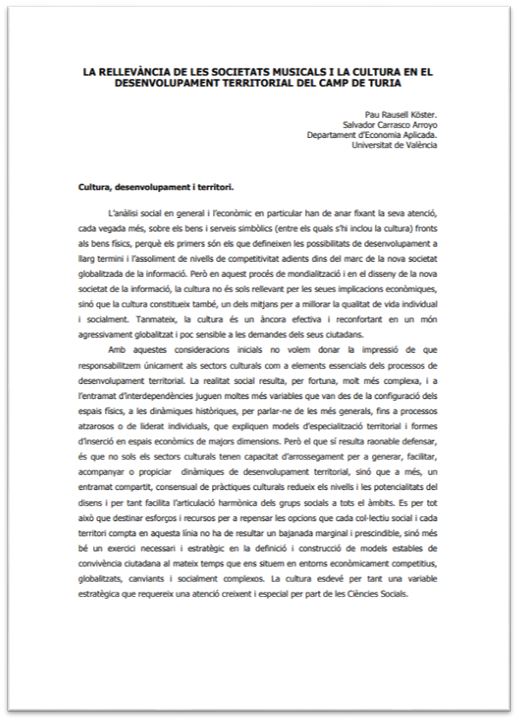
The relevance of Musical Societies and Culture in the territorial development of the Turia Camp.
Rausell-Köster, Pau Carrasco Arroyo, Salvador
Universitat de València , 2000. ArticleSocial analysis in general and economic analysis in particular must increasingly focus on symbolic goods and services (including culture) as opposed to physical goods, because the first are those that define the possibilities for long-term development and the achievement of suitable levels of competitiveness within the framework of the new globalised information society. But in this process of mondialisation and in the design of the new information society, culture is not only relevant because of its economic implications, but culture is also one of the means of improving the quality of life individually and socially. However, culture is an effective and comforting anchor in an aggressively...
Social analysis in general and economic analysis in particular must increasingly focus on symbolic goods and services (including culture) as opposed to physical goods, because the first are those that define the possibilities for long-term development and the achievement of suitable levels of competitiveness within the framework of the new globalised information society. But in this process of mondialisation and in the design of the new information society, culture is not only relevant because of its economic implications, but culture is also one of the means of improving the quality of life individually and socially. However, culture is an effective and comforting anchor in an aggressively globalised world that is not sensitive to the demands of its citizens.
Read more HideNo. 2, pp. 11-19.
HANDLE: 10550/76437 -
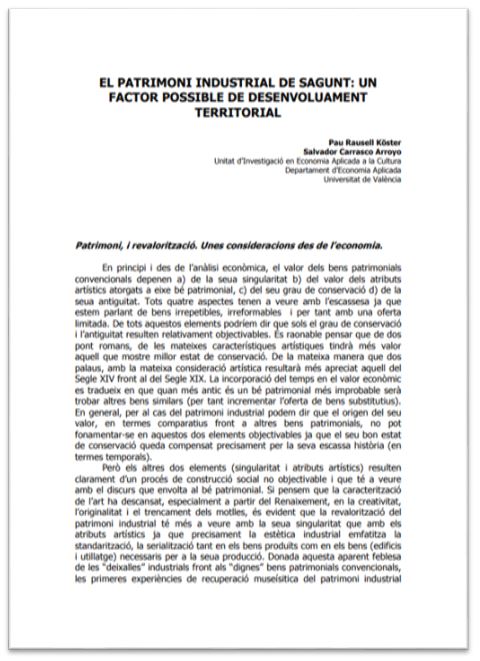
The industrial heritage of Sagunto: a possible factor in territorial development
Rausell Köster, Pau Carrasco Arroyo, Salvador
València: Universitat de València , 1999. LlibreRECONVERSIÓN Y REVOLUCIÓN. Industrialización y Patrimonio en el Puerto de Sagunto..
In principle and from an economic analysis, the value of conventional heritage lambs depends a) on their uniqueness b) on the value of the artistic attributes given to that heritage asset, c) on their degree of conservation d) on their age. All four aspects have to do with scarcity, since we are talking about unrepeatable, unreformable lambs and therefore with a limited supply. Of all these elements, we could say that only the degree of preservation and the age are relatively *objectivable. It is reasonable to think that of two Roman bridges, with the same artistic characteristics, the one in a better state of preservation will be more valuable. In the same way that two palaces, with the...
In principle and from an economic analysis, the value of conventional heritage lambs depends a) on their uniqueness b) on the value of the artistic attributes given to that heritage asset, c) on their degree of conservation d) on their age. All four aspects have to do with scarcity, since we are talking about unrepeatable, unreformable lambs and therefore with a limited supply. Of all these elements, we could say that only the degree of preservation and the age are relatively *objectivable. It is reasonable to think that of two Roman bridges, with the same artistic characteristics, the one in a better state of preservation will be more valuable. In the same way that two palaces, with the same artistic consideration, the one from the 14th century will be more valuable than the one from the 19th century. The incorporation of time in the economic value means that the older a heritage asset is, the more improbable it will be to find other similar lambs (thus increasing the supply of substitute lambs). In general, in the case of industrial heritage, we can say that the origin of its value, in comparative terms compared to other heritage lambs, cannot be based on these two *objective elements, since its good state of conservation is compensated precisely by its scarce history (in terms of time).
Read more HidePp. 11
HANDLE: 10550/76420 -
Power and culture. The origin of cultural policies.
Rausell-Köster, Pau
(1999). LlibreThe initial aim of this text was to approach the analysis of cultural policies, on the understanding that these, within the sphere of public action, had been excessively left out of the fields of interest of social science researchers. The author's own singularity in the environment and research themes of the Department of Applied Economics of the Universitat de València meant that our first questions consisted of trying to guess why educational, health, social, economic and environmental policies arouse much more interest from the point of view of research than cultural policies. Paradoxically, since the dawn of civilisations, power has made decisions about what cultural goods to produce,...
The initial aim of this text was to approach the analysis of cultural policies, on the understanding that these, within the sphere of public action, had been excessively left out of the fields of interest of social science researchers. The author's own singularity in the environment and research themes of the Department of Applied Economics of the Universitat de València meant that our first questions consisted of trying to guess why educational, health, social, economic and environmental policies arouse much more interest from the point of view of research than cultural policies. Paradoxically, since the dawn of civilisations, power has made decisions about what cultural goods to produce, consume and distribute, and perhaps much earlier than in other areas of collective life. It is true that cultural policies, at the budgetary level, in Western welfare societies, always occupy rather modest positions, and we might think that this hierarchisation of public priorities would have been transferred in parallel to the interests of researchers. However, we do not find this answer entirely convincing, and we sensed from the outset that something in the nature of cultural goods and services themselves made them particularly elusive for the social sciences.
Read more HideCap. 1, pp. 29
HANDLE: 10550/76426ISBN: 9788480028233
 Research Unit in Cultural Economics and Tourism (ECONCULT)


© 2026 UV. - Avinguda dels Tarongers, s/n. 46022 València. Phone number: (+34) 963 828 645