

-
Los sectores culturales y creativos como estrategia de desarrollo local en Sagunt
Sanjuán, Jordi Rausell, Pau
Valencia: Universitat de València , 2022. LlibreSagunt, camins patrimonial, cruïlles culturals.
Sagunt's heritage site deserves careful consideration, as it constitutes a historical and cultural landmark that places it as a clear example of what Unesco classifies as a heritage site. The remains, testimonies of an exceptional past, position the city as a paradigm of integral heritage that encompasses cultural assets from ancient times and from its more recent industrial past, as well as emblematic cultural landscapes fossilised from antiquity, but also others from more modern times, including the mountains, the historic irrigated land and the port areas: from the Grau Vell to the blast furnaces and the iron and steel industry. Sagunt can be considered a meta-site in itself, a key city...
Sagunt's heritage site deserves careful consideration, as it constitutes a historical and cultural landmark that places it as a clear example of what Unesco classifies as a heritage site. The remains, testimonies of an exceptional past, position the city as a paradigm of integral heritage that encompasses cultural assets from ancient times and from its more recent industrial past, as well as emblematic cultural landscapes fossilised from antiquity, but also others from more modern times, including the mountains, the historic irrigated land and the port areas: from the Grau Vell to the blast furnaces and the iron and steel industry. Sagunt can be considered a meta-site in itself, a key city in the culture of the Mediterranean, a cultural and historical crossroads and a place of confluence of both land and sea routes.
Read more Hide ISBN: 978-84-9133-425-5 -
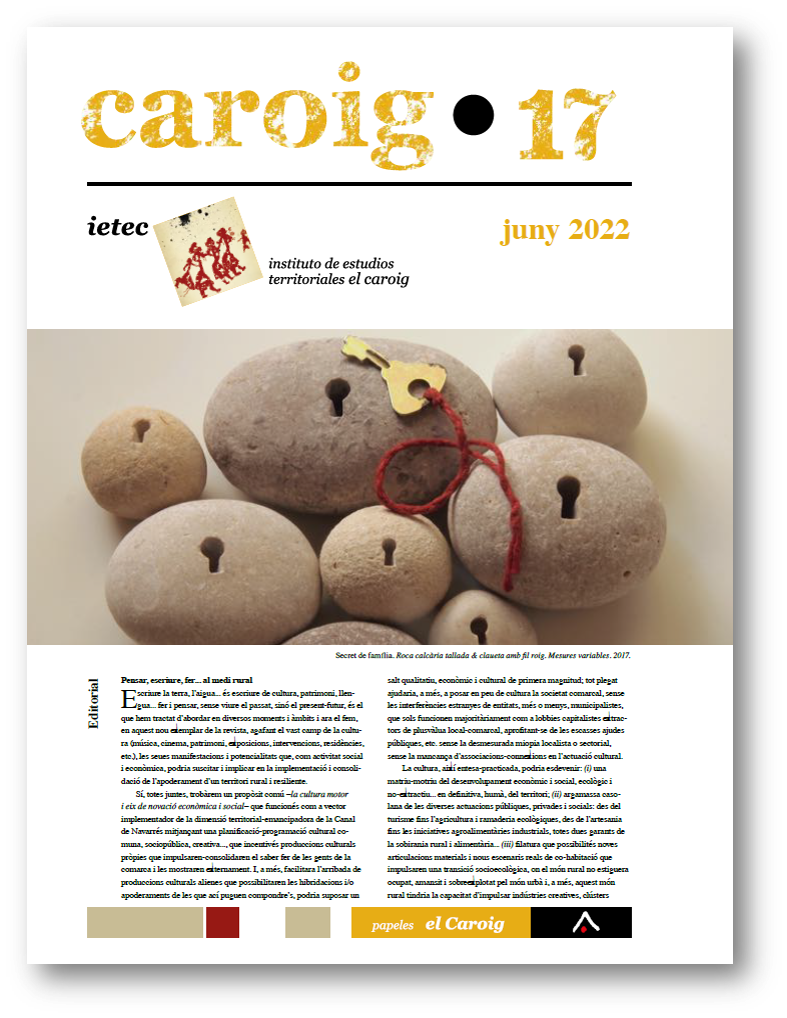
La cultura com a factor d’innovació socio-econòmica en el territori rural.
Abeledo Sanchis, Raül Rausell Köster, Pau
(2022). ArticleThe approach to the rural environment from the perspective of culture must be based on the recognition of the rural as a cultural category in itself. A culture that must be understood from the collective memory, identity and social cohesion, from the territorial perspective and the social projection of its historical and natural, material and immaterial heritage. A culture capable of valuing and updating its own local resources, helping to reinforce the social capital of the territory, and the community's vertebration and confidence in the site.
-
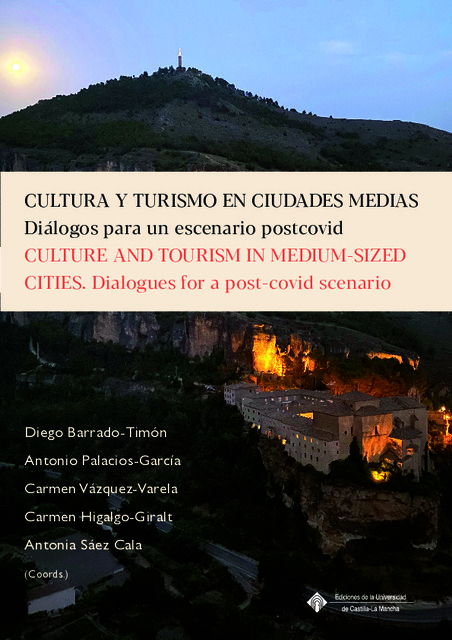
The economy of culture: a reading from the mediumsized cities
Rausell Köster, Pau
Cuenca: Ediciones de la Universidad de Castilla la Mancha , 2022. LlibreCulture and Tourism in Medium-Sized Cities. Dialogues for a post-COVID scenario..
La ética y los valores de la creciente centralidad de la condición humana en el escenario urbano se extienden a través del espacio, social y económico y posibilita la aparición de nuevas actividades, algunas de ellas con valor económico y que empujan a la innovación tecnológica y el desarrollo de la comunidad. El desarrollo sostenible, la creatividad, la transparencia, la participación, la rendición de cuentas, la tecnología y el compromiso como los pilares de las nuevas actividades sociales y nuevos sectores productivos; la innovación social, las actividades creativas, la economía de proximidad, la economía colaborativa, la economía circular, las actividades del cuidado, la economía verde,...
La ética y los valores de la creciente centralidad de la condición humana en el escenario urbano se extienden a través del espacio, social y económico y posibilita la aparición de nuevas actividades, algunas de ellas con valor económico y que empujan a la innovación tecnológica y el desarrollo de la comunidad. El desarrollo sostenible, la creatividad, la transparencia, la participación, la rendición de cuentas, la tecnología y el compromiso como los pilares de las nuevas actividades sociales y nuevos sectores productivos; la innovación social, las actividades creativas, la economía de proximidad, la economía colaborativa, la economía circular, las actividades del cuidado, la economía verde, la economía del bien común. Es en estos ámbitos donde la ciudadanía informada, consciente y dueña de sus grados de libertad desean desarrollar sus trayectorias profesionales y vitales, ya que es en estas actividades donde puede encontrar el compromiso, el placer y el significado de las acciones cotidianas. Los determinantes del comportamiento, en este ámbito, responde a una nueva jerarquía de valores asociados con las prácticas culturales: el placer, el deseo expreso de la innovación, del consumo relacional (versus el transaccional) y el intercambio libre, el pensamiento crítico, el desarrollo personal, la solidaridad, la cooperación, el trabajo en red, el valor de la diversidad y la belleza, el sentido de justicia, la participación, la importancia de la dimensión lúdica y vital en comparación con un beneficio puramente económico (BoixDomènech & Rausell-Köster, 2018).
Read more Hide ISBN: 978-84-9044-509-9ISSN: 2697-049X -
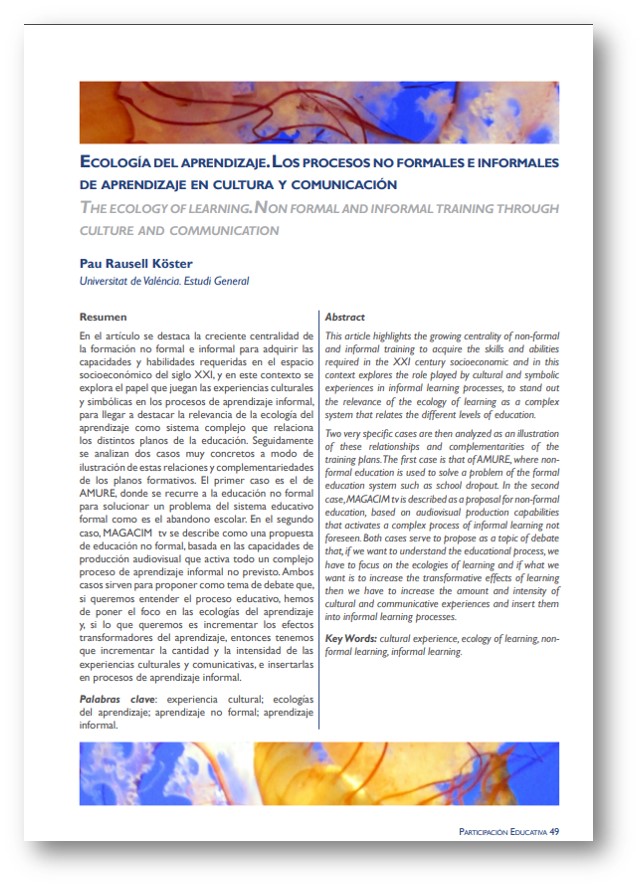
Ecology of learning. Non-formal and informal learning processes trhough culture and communication.
Pau Rausell-Köster
(2022). ArticleThis article highlights the growing centrality of non-formal and informal training to acquire the skills and abilities required in the XXI century socioeconomic and in this context explores the role played by cultural and symbolic experiences in informal learning processes, to stand out the relevance of the ecology of learning as a complex system that relates the different levels of education. Two very specific cases are then analyzed as an illustration of these relationships and complementarities of the training plans. The first case is that of AMURE, where nonformal education is used to solve a problem of the formal education system such as school dropout. In the second case, MAGACIM...
This article highlights the growing centrality of non-formal and informal training to acquire the skills and abilities required in the XXI century socioeconomic and in this context explores the role played by cultural and symbolic experiences in informal learning processes, to stand out the relevance of the ecology of learning as a complex system that relates the different levels of education. Two very specific cases are then analyzed as an illustration of these relationships and complementarities of the training plans. The first case is that of AMURE, where nonformal education is used to solve a problem of the formal education system such as school dropout. In the second case, MAGACIM tv is described as a proposal for non-formal education, based on audiovisual production capabilities that activates a complex process of informal learning not foreseen. Both cases serve to propose as a topic of debate that, if we want to understand the educational process, we have to focus on the ecologies of learning and if what we want is to increase the transformative effects of learning then we have to increase the amount and intensity of cultural and communicative experiences and insert them into informal learning processes.
Read more HideParticipación educativa nº 12, pp. 49-59
ISSN: 1866-5097 -
The impact of cultural and creative industries on the wealth of countries, regions and municipalities.
Boix Domenech, Rafael De Miguel Molina, Blanca Rausell-Köster, Pau
València: Routledge , 2022. ArticleThis paper compares the total impact of cultural and creative industries (CCIs) on per capita income of countries, regions and municipalities. We estimate the total effects of CCIs in 78 developed and developing countries in 5 continents, in 275 European regions and in 518 municipalities in the European region of Valencia, using data obtained from multiple databases and nonparametric local linear least squares. The average effects of CCIs are positive in the three territorial scales, in both low- and high-income locations, and increase in conjunction with increases in development, with high and very high developed places showing greater impacts. CCIs are, thus, a powerful resource for...
This paper compares the total impact of cultural and creative industries (CCIs) on per capita income of countries, regions and municipalities. We estimate the total effects of CCIs in 78 developed and developing countries in 5 continents, in 275 European regions and in 518 municipalities in the European region of Valencia, using data obtained from multiple databases and nonparametric local linear least squares. The average effects of CCIs are positive in the three territorial scales, in both low- and high-income locations, and increase in conjunction with increases in development, with high and very high developed places showing greater impacts. CCIs are, thus, a powerful resource for improving the well-being of rich and poor places at all geographic scales; however, they also act as a double-edged sword, as they increase inequalities between places.
Read more HideVol. 30, No. 9, Pp. 1777–1797
DOI: 10.1080/09654313.2021.1909540
-

PLAN ESTRATÉGICO DE LA CULTURA Y LA CREATIVIDAD DE LA CIUDAD DE JEREZ.
Director: Tony R. Murphy Equipo técnico: Pau Rausell Chema Segovia Sendy Ghirardi Patricia Ferragud Aitana Cabedo Andreu Frances Fernando Macías
Jerez: CULTURALINK , 2022. InformesDocuments of the Jerez Strategic Plan developed by the Econcult team in collaboration with CULTURALINK
-
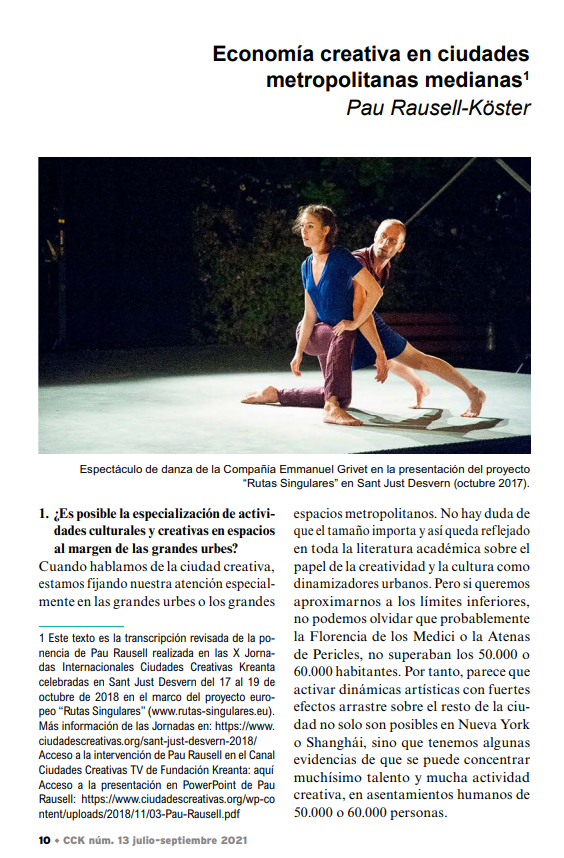
Creative economy in medium-sized metropolitan cities
Rausell Köster, Pau
(2021). RevistaCCK Revista. No.Nº 13, 2021
This text is the revised transcription of Pau Rausell's presentation at the X Jornadas Internacionales Ciudades Creatives Kreanta held in Sant Just Desvern from 17 to 19 October 2018 within the framework of the European project Singular Routes (www.rutas-singulares.eu). More information on the conference at: https://www.ciudadescreativas.org/sant-just-desvern-2018
-
Culture for Recovery Strategic actions for strengthening the Valencian cultural ecosystem, aimed at social, economic and territorial transformation through culture..
Ramon Marrades, Paloma Medina, Pau Rausell, Chema Segovia
València: Conselleria de Educació, Cultura i Esport , 2021. LlibreThis document presents the actions that will guide the bulk of the work of the Department of Culture of the Generalitat Valenciana during the 2021–2023 period. Its preparation has taken place in a particular context, defined by the convergence of three elements: the pandemic, the proactivity and contributions of the cultural sector aimed at improving its conditions, and the need to continue the strategic planning of cultural policies following Fes Cultura.
-
The impact of the music industry in Europe and the business models involved in its value chain
Blanca de Miguel-Molina, Rafael Boix-Doménech & Pau Rausell-Köster
(2021). LlibreThis chapter analyses the impact of the music industry in Europe. Although the direct and indirect impact of this industry in the European economy is significant, the sector is made up of different activities and companies, which compete and encounter diverse challenges in it. The current situation of these companies and organisations is presented through an analysis of the business models of several enterprises engaging in a variety of activities throughout the industry’s value chain, such as music production, publishing, distribution and exhibition. Moreover, we analyse digital transformation and the growth in rivalry detected in these activities.
ISBN: 978-3-030-76881-2 -

CIUTAT DE L’ARTISTA FALLER. Strategic framework for its recovery and transformation
Chema Segovia, Pau Rausell Tony R. Murphy Antonio Laguna Guillem Bacete
València: CULTURALINK , 2021. InformesCIUTAT DE L’ARTISTA FALLER. Strategic framework for its recovery and transformation.
The main purpose of this project is to establish the Strategic Framework for the recovery and economic transformation of the productive space of the Ciutat de l’Artista Faller, located in the Benicalap district of the city of Valencia. This proposal leverages the different studies, participation processes and specific propo¬sals, already undertaken, concerning the exploration of the potential development oppor¬tunities going forward of this highly unique urban enclave. Of particular importance here is the Decalogue for the Revitalisation and Improvement of the City of the Fallas Artist, developed in partnership with the professional sector and unanimously approved by the Valencia City...
The main purpose of this project is to establish the Strategic Framework for the recovery and economic transformation of the productive space of the Ciutat de l’Artista Faller, located in the Benicalap district of the city of Valencia. This proposal leverages the different studies, participation processes and specific propo¬sals, already undertaken, concerning the exploration of the potential development oppor¬tunities going forward of this highly unique urban enclave. Of particular importance here is the Decalogue for the Revitalisation and Improvement of the City of the Fallas Artist, developed in partnership with the professional sector and unanimously approved by the Valencia City Council in 2015. The design process for this Strategic Framework has sought to increase the commitment of those desiring to revitalise the Ciutat de l’Artista Faller and has sought to broaden their support by exploring new avenues for engagement. Thus, the preparation of this project was undertaken with substantial involvement of the Gremio de Artistas Falleros de València (Guild of Fallas Artists of Valencia), that provided a snapshot of the actual situation of the workshops that are currently located in the Ciutat de l’Artista Faller and served to gauge their interest. Initial contacts were also established with a range of potentially relevant stakeholders, including the Directorate General for the Coordination of Government Action of the Generalitat Valenciana, the Department of Culture and Education, the association València World Design Capital 2022, as well as others involved in European projects linked to cultural and creative initiatives, such as Designscapes and MESOC. The proposal to reactivate the Ciutat de l’Artista Faller was strengthened through close aligned with higher ranking frameworks, such as the Missions València 2030 strategy and the guidelines of the New European Agenda for Culture. Other potential avenues for the promotion of the project, such as the European funding programs Next Generation EU and React-EU, the state guidelines of the PERTE (Strategic Projects for Economic Recovery and Transformation), or the initiative in deployment of the New European Bauhaus, were also considered.
Read more Hide
 Research Unit in Cultural Economics and Tourism (ECONCULT)


© 2026 UV. - Avinguda dels Tarongers, s/n. 46022 València. Phone number: (+34) 963 828 645