

-
The professional sector of culture in the Region of Murcia. Characteristics of cultural management and the detection of training needs.
Rausell-Köster, Pau Cabañés Martínez, Francesc Abeledo Sanchis, Raül
Murcia: Murcia Cultural , 2009. LlibreThe profession of cultural management is an occupational activity that is currently at a real crossroads, as it finds itself, after more than 25 years of development, in a process - we believe definitive - of consolidation and definition. From the reflections of the sector itself -difusely defined-, the dynamics of the professional experience itself and the structuring of the sector on the basis of professional associations, the growing centrality of culture in the public and private spheres, and the consolidation in the training system of regulated proposals make up a whole process that converges towards the definition of a more precise approach to the characteristics, the conditioning...
The profession of cultural management is an occupational activity that is currently at a real crossroads, as it finds itself, after more than 25 years of development, in a process - we believe definitive - of consolidation and definition. From the reflections of the sector itself -difusely defined-, the dynamics of the professional experience itself and the structuring of the sector on the basis of professional associations, the growing centrality of culture in the public and private spheres, and the consolidation in the training system of regulated proposals make up a whole process that converges towards the definition of a more precise approach to the characteristics, the conditioning factors of professional development. In the last 5 years, there has been a notable increase in studies and research on the activity of cultural management, and underlying many of these initiatives is the intention to delimit the margins of the process of transforming "this work" into a profession.
Read more HidePp. 116
HANDLE: 10550/78173ISBN: 978-84-96898-47-9 -
Culture as a factor for Economic and Social Innovation.
Scientific coordination: Pau Rausell Köster Editorial coordination: Raúl Abeledo Sanchis Contributors: Blanco Sierra, Óscar (Econcult, UV) Boix Doménech, Rafael (Economic Structure Department, UV) De Miguel Molina, Blanca (UPV) Hervás Oliver, José Luis (UPV) Marco-Serrano, Francisco (K|P|K, UV) Pérez-Bustamante Yábar, Diana (Universidad Rey Juan Carlos) Pérez Vázquez, Pedro (MC2, UV) Vila Lladosa, Luis (MC2, UV)
(2009). InformesSostenuto, which brought together seven partners of a very different nature,aimed to encourage reflection on social and economic innovation in the Medspace. It enabled the experimentation, modeling and dissemination of newmanagement and organizational models in the cultural sector.With the intent of making a significant contribution and participating in theongoing mutations, all the partners made consistent efforts to open thedebate, confronting opinions, widening the thematic and geographical scopeand taking a stance. The recent crises have only reinforced the need for publicdiscussion and alternative views on development.The publication that puts the final note to the Sostenuto project,...
Sostenuto, which brought together seven partners of a very different nature,aimed to encourage reflection on social and economic innovation in the Medspace. It enabled the experimentation, modeling and dissemination of newmanagement and organizational models in the cultural sector.With the intent of making a significant contribution and participating in theongoing mutations, all the partners made consistent efforts to open thedebate, confronting opinions, widening the thematic and geographical scopeand taking a stance. The recent crises have only reinforced the need for publicdiscussion and alternative views on development.The publication that puts the final note to the Sostenuto project, based on twocomplementary volumes, was also written from this perspective.This first volume, elaborated by the Cultural Economics Research Unit(Econcult) - University of Valencia (Spain), proposes an economic analysis ofthe relationships between culture, innovation and development in Europe andparticularly in the Med space.The results of Econcult’s research are put into perspective in the secondvolume: “Culture & Innovation(s), Europe seen from the South”, coordinated byRelais Culture Europe.
Read more Hide -
La renovación de las políticas públicas y del marco regulatorio para el sector cultural
Rausell Köster, Pau
(2009). LlibreEl sector cultural hoy: oportunidades, desafíos y respuestas. Seminario Internacional. MEMORIAAS.
Pág 117-133
ISBN: 978-958-8387-34-5 -
El Valor Económico de la Cultura en la Isla de Gran Canaria.
Uriel Jiménez, Ezequiel Rausell Köster, Pau Murphy, Tony R.
Gran Canaria: CONSEJERÍA DE DESARROLLO ECONÓMICO, OBRAS PÚBLICAS E INFRAESTRUCTURAS Y TRANSPORTES CABILDO DE GRAN CANARIA , 2009. Informes -

A Double-Hurdle model of urban green areas valuation: Dealing with zero responses.
del Saz-Salazar, Salvador Rausell-Köster, Pau
(2009). ArticleDue to the widespread support for public parks and open spaces in urban areas, there is an increasing need to analyse the social benefits that are generated by such amenities. The city of Valencia (Spain) has a large park that can be considered its green backbone due to its transversal layout running along 9 of the 19 districts into which the city is divided. A contingent valuation survey was therefore conducted in order to obtain the non-market benefits derived from the use of this park by the inhabitants of Valencia. In addition, to deal with the large number of zero responses obtained, a Double-Hurdle model was applied. The results show that this model is more appropriate than other,...
Due to the widespread support for public parks and open spaces in urban areas, there is an increasing need to analyse the social benefits that are generated by such amenities. The city of Valencia (Spain) has a large park that can be considered its green backbone due to its transversal layout running along 9 of the 19 districts into which the city is divided. A contingent valuation survey was therefore conducted in order to obtain the non-market benefits derived from the use of this park by the inhabitants of Valencia. In addition, to deal with the large number of zero responses obtained, a Double-Hurdle model was applied. The results show that this model is more appropriate than other, simpler approaches. They also show that willingness to pay is positively related with the respondent's income and education, as was expected. Another interesting finding is that willingness to pay is also affected by the section of the park in which the interview was conducted. The information gathered form this study is of interest to decision-making with regard environmental issues.
Read more HideVolume 84, Issues 3–4, 3 March 2008, Pages 241-251
[Read more] [Hide] -
CULTURAL POLICIES AND ECONOMIC SCIENCES. Beyond the positive logic of public action
Rausell-Köster, Pau
Uruguay: Fundación de Cultura Universitaria (FCU) , 2009. Participació en congressosEnter: The Economics of Culture as a "byproduct" of cultural policy The Economics of Culture, as a subdiscipline of the Economy, actually develops from a strict discussion of cultural policy. Despite this observation, it is clear that from the point of view of positive analysis and from the perspective of the disciplinary approach of the economy, the conceptual framework explaining public intervention in culture stems from the schemes for rationalising public action processes.
Pp. 77-83
ISBN: 978-9974-2-0734-9 -
Cultural Policies and Economic Sciences. Beyond the positive logic of public action.
Rausell-Köster, Pau
Montevideo: Fundación de Cultura Universitaria (FUC) , 2009. LlibreUn encuentro no casual: Cultura, Ciencias Económicas y Derecho.
The Economics of Culture, as a sub-discipline of Economics, actually develops from a strict discussion of cultural policy. Despite this observation, it is clear that from the point of view of positive analysis and from the disciplinary approach of economics, the conceptual framework that explains public intervention in culture comes from the schemes of rationalisation of the processes of public action. If there is an agreement in the field of the Economics of Culture, it is that, despite the mentions made by some of the classics on cultural goods and services, the work that kick-started the formation of the speciality of the Economics of Culture is the work of Baumol and Bowen: "Performing...
The Economics of Culture, as a sub-discipline of Economics, actually develops from a strict discussion of cultural policy. Despite this observation, it is clear that from the point of view of positive analysis and from the disciplinary approach of economics, the conceptual framework that explains public intervention in culture comes from the schemes of rationalisation of the processes of public action. If there is an agreement in the field of the Economics of Culture, it is that, despite the mentions made by some of the classics on cultural goods and services, the work that kick-started the formation of the speciality of the Economics of Culture is the work of Baumol and Bowen: "Performing arts, the economic dilemma. A study of problems common to theatre, opera, music and dance", which appeared in 1966. These works, commissioned by a foundation whose function was to provide funding for the arts and culture, will mark the characteristic that influences the main research to this day: the link with the disputes over the role of the public sector in subsidising culture, i.e. its attachment within Economics to those departments traditionally linked to the study of Public Finance.
Read more HidePp. 76-85
HANDLE: 10550/78114ISBN: 978-9974-2-0734-9 -
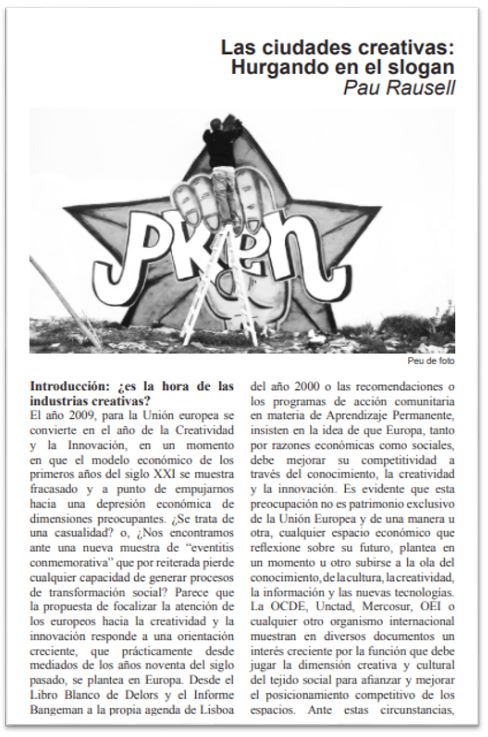
Creative cities: digging into the slogan.
Rausell Köster, Pau
València: Publicaciones Econcult: Área de Investigación en Economía de la Cultura y Turismo. Universitat de València. , 2009. LlibreEl año 2009, para la Unión europea se convierte en el año de la Creatividad y la Innovación, en un momento en que el modelo económico de los primeros años del siglo XXI se muestra fracasado y a punto de empujarnos hacia una depresión económica de dimensiones preocupantes. ¿Se trata de una casualidad? o, ¿Nos encontramos ante una nueva muestra de “eventitis conmemorativa” que por reiterada pierde cualquier capacidad de generar procesos de transformación social? Parece que la propuesta de focalizar la atención de los europeos hacia la creatividad y la innovación responde a una orientación creciente, que prácticamente desde mediados de los años noventa del siglo pasado, se plantea en Europa.
Pp. 11-21
HANDLE: 10550/78106 -
Cultural planning in the central counties. I tell you about an undeserved failure
Rausell-Köster, Pau
(2008). LlibreLa planificación cultural en las comarcas centrales. El relato de un fracaso inmerecido .
This case of cultural planning is interesting to analyse two questions. i) It is a matter of planning an unusual space; the Valencian central counties, in the sense that it constitutes a supra-municipal territory but has no administrative/political structure governing it. What is more, we are talking about a territory that is spread over two different provinces. The attributes of the planned territory point precisely to the fact that, from the perspective of the rationality of planning, as we explained most clearly, the definition of the territory that is the subject of this planning is the idiom ii) We are talking about a process of integrated planning which, at the end of the 1990s,...
This case of cultural planning is interesting to analyse two questions. i) It is a matter of planning an unusual space; the Valencian central counties, in the sense that it constitutes a supra-municipal territory but has no administrative/political structure governing it. What is more, we are talking about a territory that is spread over two different provinces. The attributes of the planned territory point precisely to the fact that, from the perspective of the rationality of planning, as we explained most clearly, the definition of the territory that is the subject of this planning is the idiom ii) We are talking about a process of integrated planning which, at the end of the 1990s, recognises unequivocally and without doubt that the cultural dimension is a strategic dimension for this planning, and this aspect and circumstance is only beginning to be accepted in a less exceptional way in the territorial planning processes at this stage – at the end of 2006.
Read more HidePp. 357-385
HANDLE: 10550/76788 -
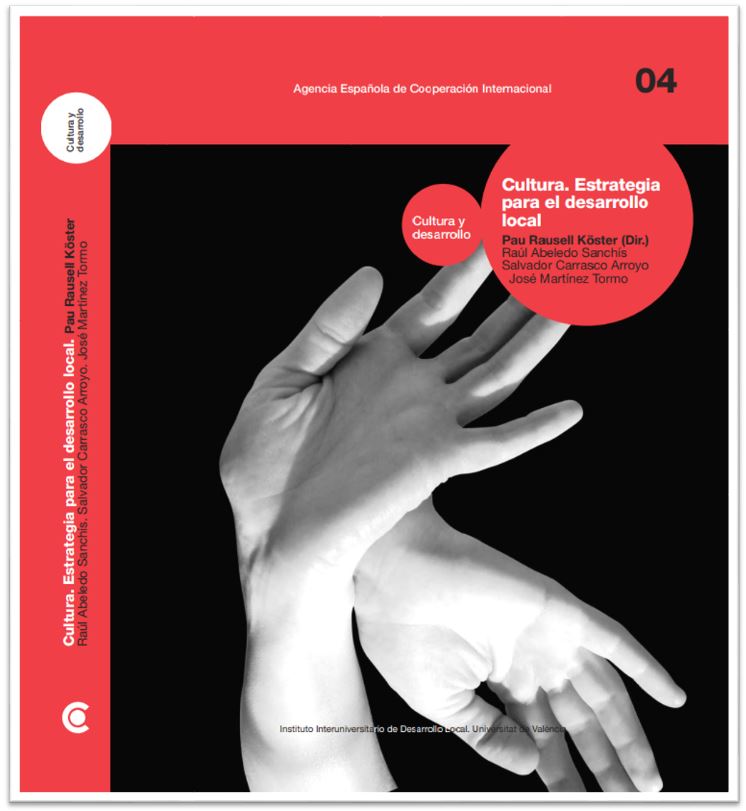
Cultura. Estrategia para el desarrollo local
Rausell Köster, Pau Abeledo Sanchís, Raúl Carrasco Arroyo, Salvador Martínez Tormo, José
Madrid: Dirección General de Relaciones Culturales y Científicas-AECI , 2008. LlibreCatálogo general de publicaciones generales.
Culture. Strategy for local development, is the work of a team consolidated in the research on the relationship between culture and territory and which defends an idea that is gradually gaining ground among experts: the competitiveness of a territory is increasingly dependent on the management model of its symbolic dimension, i.e. the set of meanings that permeate the territory. In its different chapters, the book sets out, among other things, how this relationship between culture and development takes shape, what the framework for action of cultural policy is, what Agenda 21 for culture means as a regulatory framework for cultural policy, what the Local Cultural System is, and what...
Culture. Strategy for local development, is the work of a team consolidated in the research on the relationship between culture and territory and which defends an idea that is gradually gaining ground among experts: the competitiveness of a territory is increasingly dependent on the management model of its symbolic dimension, i.e. the set of meanings that permeate the territory. In its different chapters, the book sets out, among other things, how this relationship between culture and development takes shape, what the framework for action of cultural policy is, what Agenda 21 for culture means as a regulatory framework for cultural policy, what the Local Cultural System is, and what specificities entrepreneurship in culture has to offer. A long journey that shows us the multidimensionality of social phenomena, especially those linked to culture. The authors of the present work, who start from the Economics of Culture paradigm, firmly believe in this main idea and develop both theoretical frameworks and recommendations for specific policy models, with the aim of intelligently managing the cultural capacities of a territory. Their recommendations come from a practice developed over the last 10 years in the analysis and diagnosis of cultural intervention models at the local level. As the authors point out, "the cultural defines an effective and hopeful new frontier in the field of development".
Read more Hide289 Pages
ISBN: 978-84-8347-032-9
 Research Unit in Cultural Economics and Tourism (ECONCULT)


© 2026 UV. - Avinguda dels Tarongers, s/n. 46022 València. Phone number: (+34) 963 828 645