

-

MAIN CONNECTIONS BETWEEN CULTURAL AND CREATIVE ACTIVITIES AND THE SOCIO-ECONOMIC SPACE
Rausell Köster, Pau Abeledo Sanchis, Raül
Olesncia (Poland) , 2016. Participació en congressosCULTURE FOR SHARED, SMART, INNOVATIVE TERRITORIES.
The symbolic structure of a community has always played a relevant role in the configuration of the socioeconomic space. However, this influence has become stronger in the last two decades. As the EU indicates in its Green Paper “Unlocking the cultural potential and creative industries” (2010), factory floors are progressively replaced by creative communities whose raw material is their ability to imagine, create and innovate. All formulations of the Knowledge or Information Society highlight the growing importance and centrality of the symbolic dimension in social and economic relations. However, this perception has become a topic that lacks complete evidence and is definitely necessary to...
The symbolic structure of a community has always played a relevant role in the configuration of the socioeconomic space. However, this influence has become stronger in the last two decades. As the EU indicates in its Green Paper “Unlocking the cultural potential and creative industries” (2010), factory floors are progressively replaced by creative communities whose raw material is their ability to imagine, create and innovate. All formulations of the Knowledge or Information Society highlight the growing importance and centrality of the symbolic dimension in social and economic relations. However, this perception has become a topic that lacks complete evidence and is definitely necessary to clearly explain the causes, variables, relationships between these variables and their consequences.
Read more Hide13 pàgines.
Citat a un document del Parlament Europeu
Explicat a un Podcast:
-
I am granted, therefore I create.
Caspar Nieuwenhuis Pau Rausell-Köster
(2016). InformesReport from the IETM Valencia Plenary Meeting, 3 - 6 November 2016 This session featured two futuristic, provocative and controversial concepts, which headed off from the idea that the status quo needs a radical change and it needs it now. The first one went into cyber anarchism by calling to clear away the whole subsidy based system and then substitute it with what seems to be a neoliberal paradigm of project based grants and audience retention estimations. The second concept appeared to comply with the established system of subsidies but it undermined the core wealth distribution principles of today by introducing the basic income model in art and cultural sector funding. Specific...
Report from the IETM Valencia Plenary Meeting, 3 - 6 November 2016 This session featured two futuristic, provocative and controversial concepts, which headed off from the idea that the status quo needs a radical change and it needs it now. The first one went into cyber anarchism by calling to clear away the whole subsidy based system and then substitute it with what seems to be a neoliberal paradigm of project based grants and audience retention estimations. The second concept appeared to comply with the established system of subsidies but it undermined the core wealth distribution principles of today by introducing the basic income model in art and cultural sector funding. Specific models differ greatly across countries; therefore, the local context’s influence on each speaker’s attitude towards government, funding, policies, evaluation has to be taken into consideration. As well as their professional backgrounds, of course.
Read more Hide -
The value of the Valencian musical heritage. An approach from the economics of culture.
Rausell-Köster, Pau
Universitat de València: Editorial Aranzadi, SA , 2016. LlibreEl valor cultural de la música. Punt de partida per a l'estudi del patrimoni musical.
Pp. 183-192
ISBN: 978-84-9098-859-6 -
La política cultural europea. 欧洲的文化政策
Rausell Köster, Pau
Yunnan: Yunnan University Press , 2016. LlibreResearc On Regional Culture Industries.
Europe now stands at a complex crossroads, where global issues such as development, citizenship, competitiveness and sustainability are at stake. Given the importance of creativity and social innovation for European development strategies, the potential of culture as a tool for strategy implementation is crucial. Therefore, a range of public policies in the field of culture and creative industries need to be rethought and reformulated in order to strengthen the multi-level coordination between different policies, to enhance their centrality in regional development and to provide legal and financing mechanisms for policy responses to different challenges. This paper provides a quick review...
Europe now stands at a complex crossroads, where global issues such as development, citizenship, competitiveness and sustainability are at stake. Given the importance of creativity and social innovation for European development strategies, the potential of culture as a tool for strategy implementation is crucial. Therefore, a range of public policies in the field of culture and creative industries need to be rethought and reformulated in order to strengthen the multi-level coordination between different policies, to enhance their centrality in regional development and to provide legal and financing mechanisms for policy responses to different challenges. This paper provides a quick review of the main features of the different cultural policies implemented by the EU member states, analyses the financial budgets allocated by the main EU countries to their cultural policies and outlines the main features of European cultural policies as reflected in the European Agenda for Culture. Finally, the need to reformulate cultural policies in accordance with a more comprehensive paradigm is elaborated
Read more HideEn Chino
ISBN: 978-7-5482-2835-6 -
Economic Development and the Creative Industries: A Tale of Causality
Marco-Serrano, Francisco Rausell-Köster, Pau Abeledo Sanchís, Raül
(2016). LlibreThis timely volume explores the emerging field of the economics of creative industries. Professor Potts has selected key papers, authored by leading scholars, which cover the evolution and development of this new subject of study. Topics addressed include: the economic theory foundations, creative economic agents, contracts and organizations, creative industries dynamics and innovation, creative cities and clusters, as well as digital new media and intellectual property.
Edited by Jason Potts, RMIT Blockchain Innovation Hub, School of Economics, Finance and Marketing, RMIT University in Melbourne, Australia
With an original introduction by the author, this in-depth and considered collection will be an invaluable source of reference for academics, scholars and practitioners.ISBN: 978 1 78536 150 0 -
Cultura, creatividad y sistema de diagnóstico territorial. El caso de Creative Med Toolkit
Rausell Köster, Pau Abeledo Sanchis, Raul,
Portoalegre (Brazil): UFGRS EDITORA , 2016. ArticleEconomia Criativa, Cultura e Políticas Públicas.
ISBN: 978-85-386-0321-4 -

Study visit at Nord Pas de Calais region, 19-21 October 2015
(2016). ArticleThe Nord-Pas de Calais region has been investing quite massively in culture over the past few years (€52 million in 2014 – 3rd region in France), despite the fact that it is below national average in terms of employment, GDP per capita and number of people earning enough to pay an income tax. So culture is really seen as a driver of regional development here. This study visit in Nord-Pas de Calais aimed at exploring territorial dynamics around two iconic cultural projects of the region in the Euralens area: 1) The Louvre-Lens museum, a large-scale cultural investment 2) The UNESCO labelling of the mining basin. The main objective was to understand how these two initiatives had been...
The Nord-Pas de Calais region has been investing quite massively in culture over the past few years (€52 million in 2014 – 3rd region in France), despite the fact that it is below national average in terms of employment, GDP per capita and number of people earning enough to pay an income tax. So culture is really seen as a driver of regional development here. This study visit in Nord-Pas de Calais aimed at exploring territorial dynamics around two iconic cultural projects of the region in the Euralens area: 1) The Louvre-Lens museum, a large-scale cultural investment 2) The UNESCO labelling of the mining basin. The main objective was to understand how these two initiatives had been implemented and how local dynamics took over to reel in projects benefiting territorial development. Another key aspect to explore was the link between locals and the Louvre-Lens project – which can be seen as a ‘foreign’ object to this territory. The question of impacts was also on the agenda: such a large-scale project is expected to contribute to quantifiable results in terms of local development. The key aspects to the success of the initiative were: – Strong political drive to facilitate implantation of the Louvre-Lens with early discussions back in 2004. – Large-Scale cultural investment – a “cultural shock” – Valorisation of territorial assets – cultural heritage to drive territorial attractiveness – Cultivating local ownership of these two iconic projects. – Euralens – linking up contrasting approaches through labelling of local projects.Perhaps more importantly, the approach has been strongly participatory – through workshops, ad hoc events. The whole territorial regeneration project is still nascent in many ways, with only two waves of projects labelled through Euralens and a third one coming up, for example. The development of the mining basin UNESCO site is also work in progress towards a smart articulation of a comprehensive touristic offer. It has however yielded significant results in terms of local participation, with 1/6 visitors to the Louvre Lens coming from the Euralens area, 1/2 from the region and 1/4 are international visitors. In total, 2 million people have visited the Louvre Lens already since its opening in December 2012 (around 500.000 per year). Monitoring of impacts will play an important role in future developments. This has been identified as a priority for the Louvre-Lens, through a partnership with INSEE (national statistics institute) in order to monitor 25 key indicators around the Louvre-Lens on a yearly basis.
Read more Hide -

Culture as a factor of socio-economic innovation in rural areas: The case of the artistic craftwork cluster of La Città Europea dei Mestieri d’Arte (CITEMA).
Abeledo Sanchis, Raúl Coll Serrano, Vicente Rausell-Köster, Pau
València , 2016. ArticleCultural and creative activities are an increasingly important factor for the development of territories. In times of globalization, competitiveness requires public policies that promote social and economic innovation. This phenomenon places culture and creativity at the center of strategies for regional and local development. Organizations and cultural agents become promoters of innovation. The rural world is no stranger to this dynamic, although it has its own specifics. Cultural entrepreneurship in relation to a cluster of artistic craftwork in the Chiana Valley (Tuscany, Italy) is used for illustrating and discussing these and other issues. For that, we turn to the main results...
Cultural and creative activities are an increasingly important factor for the development of territories. In times of globalization, competitiveness requires public policies that promote social and economic innovation. This phenomenon places culture and creativity at the center of strategies for regional and local development. Organizations and cultural agents become promoters of innovation. The rural world is no stranger to this dynamic, although it has its own specifics. Cultural entrepreneurship in relation to a cluster of artistic craftwork in the Chiana Valley (Tuscany, Italy) is used for illustrating and discussing these and other issues. For that, we turn to the main results generated by this project: promoting the craftwork sector and artistic mobility, international projection of the territory, awareness and social revitalization, and improvement of institutional coordination through the establishment of network actions.
Read more HideNo 20, pp: 73-103
DOI: 10.4422/ager.2015.15ISSN: 1578-7168 -

Estimating the economic impact of museums through new information technologies: the case of the thermal energy museum.
Pau Rausell-Köster, Raul Abeledo-Sanchís, Vicente Coll-Serrano
(2015). ArticleIt is increasingly necessary to emphasize the potential of culture as an engine for economic development and its ability to generate income and create jobs. For this reason, this paper evaluates the economic impact of the Ene.térmica museum in the territory in which it is located, Ponferrada (Castilla y León Community, Spain). In order to achieve this aim, the estimation of the different types of effects needed to determine the impact of economic of the activities linked to the existence of Ene.Térmica is calculated by using the tool Impactrimonio, a web-based application that applies the Input-Output Tables methodology. The results show that due to both activities of the museum and demand...
It is increasingly necessary to emphasize the potential of culture as an engine for economic development and its ability to generate income and create jobs. For this reason, this paper evaluates the economic impact of the Ene.térmica museum in the territory in which it is located, Ponferrada (Castilla y León Community, Spain). In order to achieve this aim, the estimation of the different types of effects needed to determine the impact of economic of the activities linked to the existence of Ene.Térmica is calculated by using the tool Impactrimonio, a web-based application that applies the Input-Output Tables methodology. The results show that due to both activities of the museum and demand flows made bby the visitors, between 2011 and 2012, an increase in production was generated of over 15 million euros, an increase in the incomes of the population of nearly 10 million and an increase in employment of 327 jobs.
Read more Hide DOI: 10.1590/0103-37862015000300008 -
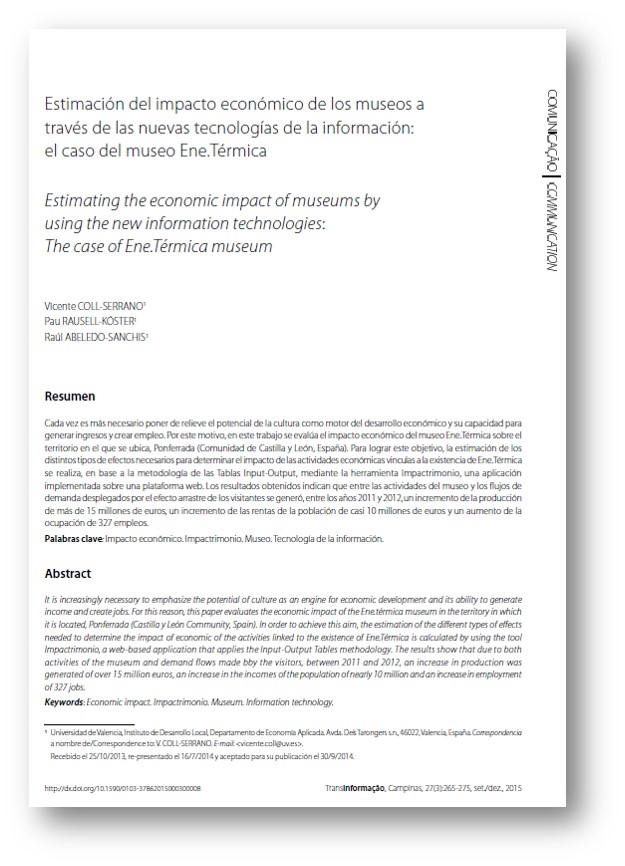
Estimating the economic impact of museums by using the new information technologies: The case of Ene.Térmica museum.
Coll-Serrano, Vicente; Rausell-Kóster, P.; Abeledo-Sanchis, R.
Brazil: Scielo Brazil , 2015. ArticleIt is increasingly necessary to emphasize the potential of culture as an engine for economic development and its ability to generate income and create jobs. For this reason, this paper evaluates the economic impact of the Ene.térmica museum in the territory in which it is located, Ponferrada (Castilla y León Community, Spain). In order to achieve this aim, the estimation of the different types of effects needed to determine the impact of economic of the activities linked to the existence of Ene.Térmica is calculated by using the tool Impactrimonio, a web-based application that applies the Input-Output Tables methodology. The results show that due to both activities of the museum and demand...
It is increasingly necessary to emphasize the potential of culture as an engine for economic development and its ability to generate income and create jobs. For this reason, this paper evaluates the economic impact of the Ene.térmica museum in the territory in which it is located, Ponferrada (Castilla y León Community, Spain). In order to achieve this aim, the estimation of the different types of effects needed to determine the impact of economic of the activities linked to the existence of Ene.Térmica is calculated by using the tool Impactrimonio, a web-based application that applies the Input-Output Tables methodology. The results show that due to both activities of the museum and demand flows made bby the visitors, between 2011 and 2012, an increase in production was generated of over 15 million euros, an increase in the incomes of the population of nearly 10 million and an increase in employment of 327 jobs.
Read more Hide
 Research Unit in Cultural Economics and Tourism (ECONCULT)


© 2026 UV. - Avinguda dels Tarongers, s/n. 46022 València. Phone number: (+34) 963 828 645