

-
Creative economic development: a history of causality
Francisco Marco Serrano, Pau Rausell Köster, Raül Abeledo Sanchis
(2014). ArticleCreative Industries Journal. No.Volume 7
Cultural and creative industries are seen as a driver of economic growth. Over the last decade, research has attempted to link the increased intensity of these industries to the region's well-being. However, this is a controversial relationship that has yet to be proven. In this article we build a conceptual framework to help us test the possible causality between regional income generation and employment in the cultural and creative sectors. Using European regional data for 1999-2008, our results show that there is a significant feedback (bidirectional causality) between GDP per capita and employment intensity in the cultural and creative industries, which allows us to conclude that there...
Cultural and creative industries are seen as a driver of economic growth. Over the last decade, research has attempted to link the increased intensity of these industries to the region's well-being. However, this is a controversial relationship that has yet to be proven. In this article we build a conceptual framework to help us test the possible causality between regional income generation and employment in the cultural and creative sectors. Using European regional data for 1999-2008, our results show that there is a significant feedback (bidirectional causality) between GDP per capita and employment intensity in the cultural and creative industries, which allows us to conclude that there is a "virtuous circle" fuelled by these industries.
Read more Hide -
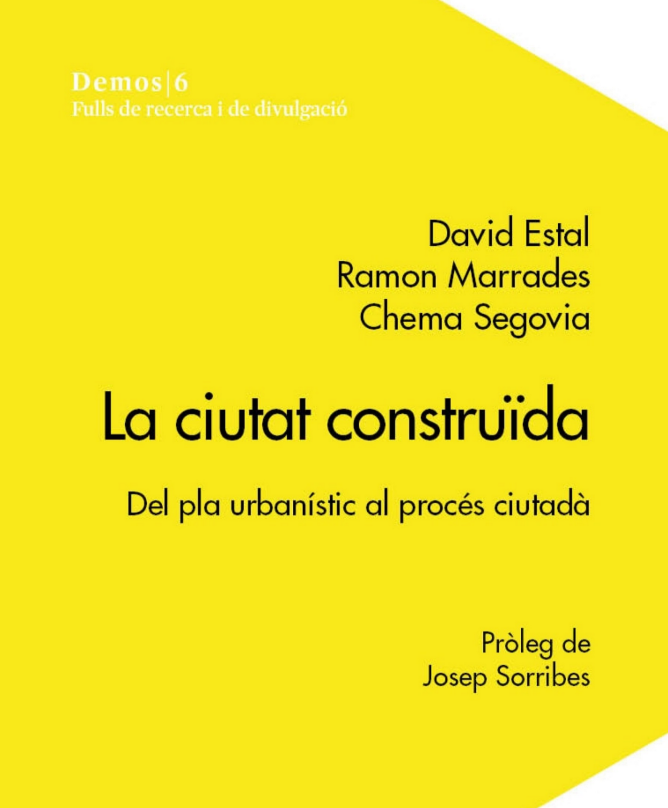
The built city: from the urban plan to the citizen process
Ramón Marrades, David Estal, Chema Segovia
(2014). LlibreWhat do we mean by the built city? The temporary city, the spontaneous city, the city that decreases, the city after abandonment, the vacant city, the city of the meantime, the city in transition, the improvised city, the adaptable city, the retired city, the arrhythmic city, the intermediate city. All these names try to delimit the same reality: the city of the present. We offer you the possibility of accompanying us in what we consider to be a fundamental shift in the way of making the city, from the orthodox urban plan to the innovative citizen process. Throughout these pages you will find a theoretical framework, open with questions, but contrasted with five applications in the...
What do we mean by the built city? The temporary city, the spontaneous city, the city that decreases, the city after abandonment, the vacant city, the city of the meantime, the city in transition, the improvised city, the adaptable city, the retired city, the arrhythmic city, the intermediate city. All these names try to delimit the same reality: the city of the present. We offer you the possibility of accompanying us in what we consider to be a fundamental shift in the way of making the city, from the orthodox urban plan to the innovative citizen process. Throughout these pages you will find a theoretical framework, open with questions, but contrasted with five applications in the territory. David Estal Herrero (Valencia, 1979) is an architect. Ramon Marrades Sempere (Valencia, 1986) is an urban economist. Chema Segovia Collado (La Línea, 1982) is an architect. The three of them work together on proposals related to the concept of the built city from L’Ambaixada, a studio at the foot of the Carme district. With the aim of promoting the dissemination of these ideas, they collaborate regularly with eldiario.es/cv, Econcult and Aula Ciutat (UV-UPV).
Read more Hide ISBN: 978–84–940877–7–6 -
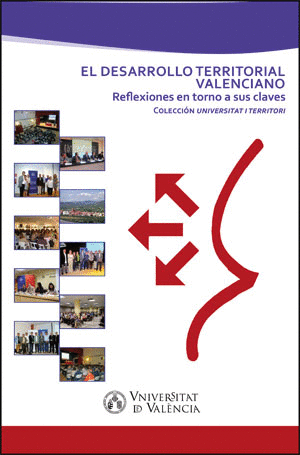
The role of cultural organisations in promoting rural development: a case study
Raúl Abeledo Sanchis
(2014). LlibreEl desarrollo territorial valenciano: reflexiones en torno a sus claves.
Throughout this article, the need to integrate territorial development models with the innovation potential of cultural activities is identified. A better understanding of the evolution of rural areas requires the introduction of extra-economic variables such as values, behaviours and cultural aspects into the socio-economic analysis. In this scenario, the dynamisation, research and training services developed by CITEMA, the identification of new audiences to interact with; the design of alternative business models; the creation of cultural value or the economic impact, to cite a few examples, are part of this scenario.
ISBN: 978-84-370-9445-8 -
Cultural marketing
Diana C. Pérez-Bustamante Yábar, Pau Rausell Köster
MADRID: ESIC , 2014. LlibreOrganisations need people trained to the highest level in the field of marketing. As Peter Drucker said, "a good CEO will be a marketing manager who can read a balance sheet". However, today's competitive environment is characterised by a high degree of specialisation in their respective sectors, with very different competitive trends and characteristics. For the company, the key is to design and implement a strategy based on the inherent relationships between the general socio-economic environment and its sector of activity, adapting and managing its various functional areas to the particular characteristics of its sector and the general trends of the national and international...
Organisations need people trained to the highest level in the field of marketing. As Peter Drucker said, "a good CEO will be a marketing manager who can read a balance sheet". However, today's competitive environment is characterised by a high degree of specialisation in their respective sectors, with very different competitive trends and characteristics. For the company, the key is to design and implement a strategy based on the inherent relationships between the general socio-economic environment and its sector of activity, adapting and managing its various functional areas to the particular characteristics of its sector and the general trends of the national and international environment. The conceptual foundations of marketing science are generally the same in all sectors: a good market orientation aiming at creating value for all stakeholders of the company (mainly consumers, shareholders and employees). However, the probability of success in business decisions increases when the company defines its target audience and market well and implements strategies and policies adapted to the specificities of that market. The aim of this book is to address, for the marketing area, this growing specialisation in sectors of activity, which requires more specific and sectorial knowledge. The book is aimed primarily at advanced undergraduate and MBA students with prior knowledge in the field of marketing. The fourteen-chapter structure, covering specialist areas of growing interest in business, is designed to fit easily into the teaching weeks of a four-month academic term within the new Bologna system of bachelor's degrees. In addition, due to the in-depth coverage of the topics and the support of examples and case studies from companies, it is also an excellent tool for intensive executive courses and a support manual for marketing managers in any type of company. The book is a joint effort by a large group of professors and specialists from various universities, business schools and companies, who have pooled their academic knowledge and professional experience in their different areas of specialisation. The contents are developed in a practical, entertaining and at the same time rigorous and profound way, which will allow the reader to discover the various sectorial specialities within the exciting world of marketing.
Read more Hide ISBN: 9788473569927 -
Comprender la economía de la cultura como vía para salir de la crisis .
Rausell-Köster, Pau
(2013). ArticleDefensa de la necesidad de redefinir las políticas culturales, convirtiéndolas en el eje central de las acciones para salir de la crisis. Aunque el objetivo intrínseco de la política cultural es la satisfacción de los derechos culturales de los ciudadanos, en muchos casos ni siquiera éstos se cumplen. Hay que proponer unas políticas culturales de nueva planta que persigan dichos derechos pero que también sean capaces de dirigir la transformación del modelo productivo y la persecución de otros objetivos sociales. La dimensión de los sectores culturales tiene efectos causales sobre la riqueza de las regiones europeas. Esta nueva política deberá reconocer de una nueva manera los derechos de...
Defensa de la necesidad de redefinir las políticas culturales, convirtiéndolas en el eje central de las acciones para salir de la crisis. Aunque el objetivo intrínseco de la política cultural es la satisfacción de los derechos culturales de los ciudadanos, en muchos casos ni siquiera éstos se cumplen. Hay que proponer unas políticas culturales de nueva planta que persigan dichos derechos pero que también sean capaces de dirigir la transformación del modelo productivo y la persecución de otros objetivos sociales. La dimensión de los sectores culturales tiene efectos causales sobre la riqueza de las regiones europeas. Esta nueva política deberá reconocer de una nueva manera los derechos de propiedad intelectual y sus derechos económicos asociados, facilitar el emprendimiento cultural, democratizar el uso de los equipamientos y los espacios públicos y tratar de conocer en mayor profundidad la relación entre el individuo y el hecho cultural.
Read more Hide22(4), 286–289
DOI: 10.3145/epi.2013.jul.02ISSN: 1386-6710 -
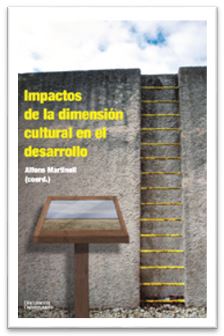
Culture, innovation and creativity as challenges and opportunities for Europe's future
Rausell-Köster, Pau Abeledo Sanchis, Raúl
Girona: Casalini , 2013. ArticleThis publication presents studies on the impacts of culture on development from different perspectives and experiences. This work responds to the need to make progress in the concrete and practical application of the reflections that have been built on a cultural approach to development. The incorporation of the cultural dimension into development policies has made considerable progress in recent years on the basis of UN resolutions and very significant experiences in the field of MDGs at local and international level. The effectiveness of development policies is a requirement of the international community to achieve poverty reduction and exclusion, where they must be addressed from all...
This publication presents studies on the impacts of culture on development from different perspectives and experiences. This work responds to the need to make progress in the concrete and practical application of the reflections that have been built on a cultural approach to development. The incorporation of the cultural dimension into development policies has made considerable progress in recent years on the basis of UN resolutions and very significant experiences in the field of MDGs at local and international level. The effectiveness of development policies is a requirement of the international community to achieve poverty reduction and exclusion, where they must be addressed from all dimensions. Assessing the impacts of culture on development is currently in need because of the characteristics of culture and its need for greater visibility in development processes.
Read more HidePp. 101-126
DOI: 10.1400/240757 -
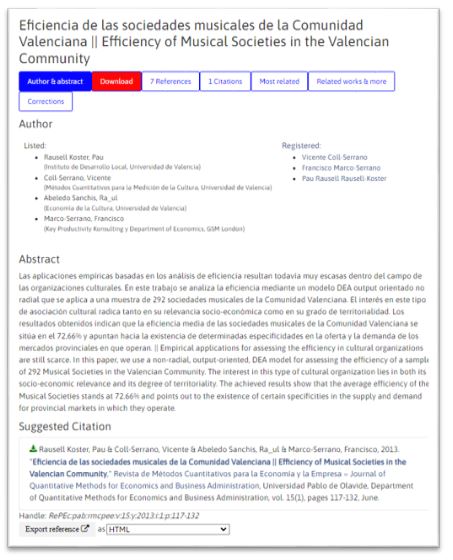
Efficiency of Musical Societies in the Valencian Community
Rausell Koster, Pau Coll-Serrano, Vicente Abeledo Sanchis, Raul Marco-Serrano, Francisco
Universidad Pablo de Olavide , 2013. ArticleEmpirical applications for assessing the efficiency in cultural organizations are still scarce. In this paper, we use a non-radial, output-oriented, DEA model for assessing the efficiency of a sample of 292 Musical Societies in the Valencian Community. The interest in this type of cultural organization lies in both its socio-economic relevance and its degree of territoriality. The achieved results show that the average efficiency of the Musical Societies stands at 72.66% and points out to the existence of certain specificities in the supply and demand for provincial markets in which they operate.
Vol. 15(1), pp.117-132
HANDLE: RePEc:pab:rmcpee:v:15:y:2013:i:1:p:117-132 -
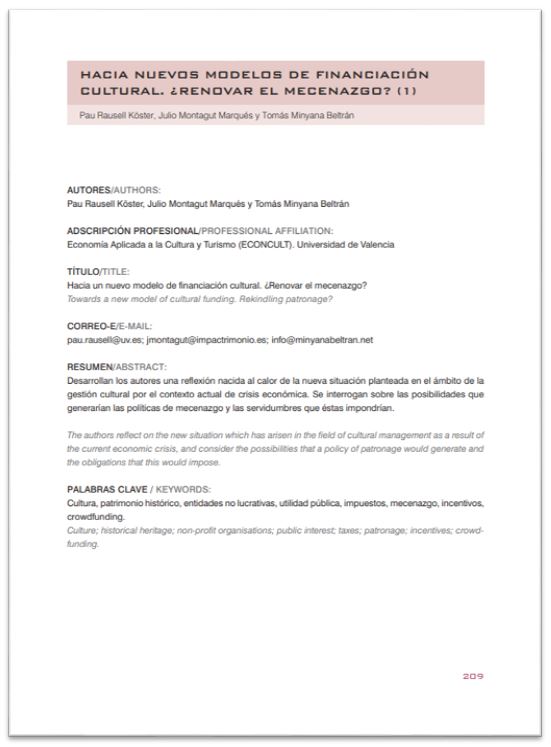
Towards a new model of cultural funding. Rekindling patronage? .
Rausell Köster, Pau Montagut Marqués, Julio Minyana Beltrán, Tomás
Cádiz: Universidad de Cádiz, Servicio de Publicaciones , 2013. ArticleThe authors reflect on the new situation which has arisen in the field of cultural management as a result of the current economic crisis, and consider the possibilities that a policy of patronage would generate and the obligations that this would impose.
No. 14, Pp. 209-233
ISSN: 15771172 -
Aposta per uns sectors culturals i creatius que contribueixin de manera més significativa a la reactivació econòmica de Catalunya .
Ezequiel Baró Tomás, Xavier Cubeles Bonet, Pere Galí Kelonen, Alfons Martinell Sempere, Pau Rausell Köster,
Barcelona: Generalitat de Catalunya. Departament de Cultura , 2012. InformesThis paper looks exclusively at the role that cultural and creative activities play in the country's economy. It focuses on the interaction between the symbolic and identity aspects with the creative and innovative ones and analyses how culture can contribute to the reactivation and transformation of our economy, to job creation and to the internationalisation of the country.

-
Propuesta de Viabilidad para la Unidad Museística Ene. Térmica.
PAU RAUSELL KÖSTER, (DIR)] Julio Montagut Marqués, Francisco Marco Serrano, Joan Llinares Palau
(2012). InformesIn this context, and at the request of those in charge of the Ene.Térmica museum unit of the National Energy Museum in Ponferrada, the objectives of this work are as follows: - Starting from a given theoretical framework, to carry out an analysis of the current functioning of the Ene.Térmica in the context of the truncated Ene.Museo Nacional de la Energía project. - To establish a plausible contextual framework in which the functioning of museums will move in the coming years and whose axes are the consequences of the fiscal consolidation of the public sector and its restrictive framework in terms of funding, as well as a contained demand for cultural goods and services and an environment...
In this context, and at the request of those in charge of the Ene.Térmica museum unit of the National Energy Museum in Ponferrada, the objectives of this work are as follows: - Starting from a given theoretical framework, to carry out an analysis of the current functioning of the Ene.Térmica in the context of the truncated Ene.Museo Nacional de la Energía project. - To establish a plausible contextual framework in which the functioning of museums will move in the coming years and whose axes are the consequences of the fiscal consolidation of the public sector and its restrictive framework in terms of funding, as well as a contained demand for cultural goods and services and an environment that is not very conducive to sponsorship and patronage proposals. - To carry out a descriptive exercise on the reality of the operation of the Ene.Térmica museum unit in the year it has been in operation, both in terms of the budgetary situation and the number of visitors. - To obtain a global and orderly vision of the institution's objectives. - To approximate the impact in terms of employment and gross added value of the economic activities linked to the existence of Ene Térmica by means of estimates, using the methodology of the Input-Output Tables.
Read more Hide
 Research Unit in Cultural Economics and Tourism (ECONCULT)


© 2026 UV. - Avinguda dels Tarongers, s/n. 46022 València. Phone number: (+34) 963 828 645