

-

Creative regions in China: trends and issues
Qianni Feng, Chuan Li, Jing Wang
(2025). ArticleThis chapter examines the development of creative regions in China within a specific institutional, territorial, and political context. It shows how creativity unfolds in an environment characterised by sharp urban–rural disparities and active state intervention. By moving beyond Eurocentric perspectives, the chapter broadens the comparative framework of the Handbook and contributes to a more diverse understanding of global creative geographies.
ISBN: 978 1 03531 787 5 -

In search of the creative grail: methodological issues to understand what creativity is, how to measure it and how to use it in policy strategies for creative regions
Pau Rausell
(2025). ArticleThis chapter addresses the main epistemological and methodological challenges involved in defining and measuring creativity at the regional level. By conceptualising creativity as an economic, social, and symbolic resource, it critically examines simplistic indicators and dominant narratives. The chapter provides conceptual criteria and analytical tools for a more rigorous and contextualised interpretation, contributing to a more responsible use of the concept in research and policy design.
ISBN: 978 1 03531 787 5 -

Handbook of creative regions
Rafael Boix-Domènech and Luciana Lazzeretti
(2025). LlibreThis pioneering Handbook brings together experts from a broad array of disciplines to explore creative regions worldwide. Pairing theoretical and practical insights, it presents an integrated and multidimensional account of the creative region, addressing major issues surrounding the concept and proposing a future research agenda. Through global analyses and case studies from both developing and developed regions, this Handbook studies the origins of the concept of creative regions in scientific literature and policymaking, shedding light on the global geographies of creativity from metropolitan regions to the rural-urban divide. It also examines the positive and adverse effects of...
This pioneering Handbook brings together experts from a broad array of disciplines to explore creative regions worldwide. Pairing theoretical and practical insights, it presents an integrated and multidimensional account of the creative region, addressing major issues surrounding the concept and proposing a future research agenda. Through global analyses and case studies from both developing and developed regions, this Handbook studies the origins of the concept of creative regions in scientific literature and policymaking, shedding light on the global geographies of creativity from metropolitan regions to the rural-urban divide. It also examines the positive and adverse effects of creativity on the well-being and the economy of regions, as well as the technological and social dimensions of creative geographies, including the role of artificial intelligence. This Handbook is an essential resource for scholars of regional economics and regional studies, economic geography and cultural economics. It also provides insightful strategies for regional policymakers, urban planners, economic developers, and cultural and creative managers.
Read more Hide ISBN: 978 1 03531 787 5 -
How do cultural and creative industries shape wellbeing? A multidisciplinary review.
Jordi Sanjuán
(2025). ArticleEuropean Journal of Cultural Management and Policy (ENCATC).
The article provides a multidisciplinary review of the literature, both theoretical and empirical, to establish the state of the art regarding the relationship between cultural and creative industries and multidimensional well-being. Beyond a thorough analysis of the existing research, it also proposes an innovative theoretical framework that explains how this relationship is structured and through which channels impacts on well-being are generated. This approach seeks to contribute to both academic research and the design of public policies and cultural strategies. It is especially relevant for cultural managers, researchers, and policymakers aiming to better understand and enhance the...
The article provides a multidisciplinary review of the literature, both theoretical and empirical, to establish the state of the art regarding the relationship between cultural and creative industries and multidimensional well-being. Beyond a thorough analysis of the existing research, it also proposes an innovative theoretical framework that explains how this relationship is structured and through which channels impacts on well-being are generated. This approach seeks to contribute to both academic research and the design of public policies and cultural strategies. It is especially relevant for cultural managers, researchers, and policymakers aiming to better understand and enhance the connections between culture and quality of life.
Read more Hide ISSN: 2663-5771 -
Cultural and Creative Sectors and Green Transition. Some Evidence and Reflection
Pau Rausell-Köster, Raul Abeledo-Sanchis, i Jordi Sanjuán
(2025). LlibreCulture, Innovation and the Green Economy Towards a Sustainable Future in Europe.
The book offers a theoretical and practical analysis of the contemporary approach to art, culture and innovation, with special emphasis on the relationship between culture, innovation and the economy, in the context of green transition, as an indispensable sustainability factor. It presents new models that can be implemented, especially within strategic cultural planning, serving to ensure future development and attain certain levels of stability. The book argues that the cultural ecosystem should not be treated as merely a segment of the economy, but rather as a system that contains the economy. One of the main issues covered in the book is climate change. More than fifty years have...
The book offers a theoretical and practical analysis of the contemporary approach to art, culture and innovation, with special emphasis on the relationship between culture, innovation and the economy, in the context of green transition, as an indispensable sustainability factor. It presents new models that can be implemented, especially within strategic cultural planning, serving to ensure future development and attain certain levels of stability. The book argues that the cultural ecosystem should not be treated as merely a segment of the economy, but rather as a system that contains the economy. One of the main issues covered in the book is climate change. More than fifty years have passed since the first major conference of the United Nations (UN) on the Environment held in Stockholm in 1972, which gave birth to the "Stockholm Declaration", and also cemented the global environmental movement. Thanks to Agenda 2030, the 17 Sustainable Development Goals and the Paris Agreement, there is an increased awareness of the dangers posed by climate change and of the need to switch to sustainable energy sources and a circular economy in the hope of preventing environmental problems that threaten life on Earth. Each chapter provides an accessible bank of knowledge on which existing theory and practice can be developed and new projects undertaken. The book adopts a highly interdisciplinary approach for open science, bridging theoretical insights with practical applications, and offers a comprehensive perspective that is both informative and actionable, so it can be used by academics, researchers, policymakers and cultural professionals for planning and development within the cultural sector.
Read more Hide ISBN: 9781032952772 -
Estimating Cultural Tourists in Spanish Regions through Machine Learning
Sanjuán, Jordi Rausell-Köster, Pau Álvarez-Teresa, Fernando
(2025). Article"Cultural tourism is receiving increasing attention and plays a significant role in shaping the global tourism landscape. However, defining cultural tourism remains ambiguous, and there are no standardized methods to measure its extent. This study introduces a novel methodology to quantify cultural tourists in Spanish regions. The proposed approach involves calculating the elasticity of tourist flows in a region concerning the dimension of the cultural and creative sectors. To achieve this, machine learning techniques, in particular Causal Forest, are applied, employing a comprehensive database that gathers information from European regions spanning the years 2008 to 2019. A counterfactual...
"Cultural tourism is receiving increasing attention and plays a significant role in shaping the global tourism landscape. However, defining cultural tourism remains ambiguous, and there are no standardized methods to measure its extent. This study introduces a novel methodology to quantify cultural tourists in Spanish regions. The proposed approach involves calculating the elasticity of tourist flows in a region concerning the dimension of the cultural and creative sectors. To achieve this, machine learning techniques, in particular Causal Forest, are applied, employing a comprehensive database that gathers information from European regions spanning the years 2008 to 2019. A counterfactual scenario is simulated, assuming the absence of cultural and creative workers in each region in order to identify the number of overnight stays attributed to cultural tourism. The results indicate that cultural tourism accounts for 18.6% of total overnight stays in Spain, above the traditional method that accounted for 10.1% of overnight stays. Though there are important differences between regions, ranging from 65% in Galicia to almost negligible in the Canary Islands or Cantabria. The proposed methodology is promising and could become an acceptable and comparable standard for other regions.
Read more HidePodcast exlaining the article l'article: https://notebooklm.google.com/notebook/636053ed-ee32-4be6-b9e0-9cb30464e2bd/audio
[Read more] [Hide] -
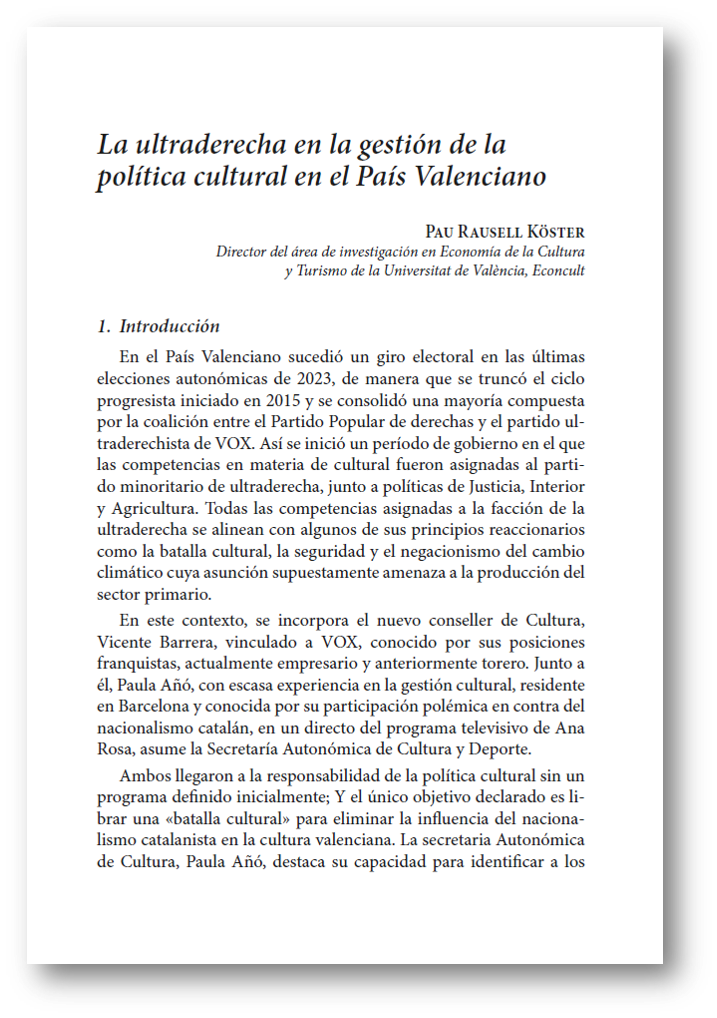
La ultraderecha en la gestión de la política cultural en el País Valenciano
Pau Rausell Köster
València: PUBLICACIONS UNIVERSITAT DE VALÈNCIA , 2025. LlibreIn the Valencian Country there was an electoral shift in the last regional elections of 2023, so that the progressive cycle that began in 2015 was cut short and a majority was consolidated, made up of the coalition between the right-wing Partido Popular and the far-right party VOX. Thus began a period of government in which cultural competences were assigned to the minority far-right party, along with Justice, Interior and Agriculture policies. All the competences assigned to the far-right faction are aligned with some of its reactionary principles such as the culture war, security and climate change denialism, the assumption of which supposedly threatens production in the primary sector.
Article extractat del llibre
-

Observatori Cultural de la Universitat de València: Reflections, experiences and practices on contemporary cultural management
Raúl Abeledo Sanchis, Marcia Jadue Boeri
(2025). LlibreThis third volume edited by the Cultural Observatory of the University of Valencia addresses urgent and significant issues for the cultural and creative sectors. From the perspective of experts with recognized experience, we reflect on the intersections between culture and politics, with special emphasis on the contemporary exercise of cultural rights and the risks of the political instrumentalization of culture. The experience of projects that have made the leap to internationalization is also shared, revealing the strategies with which those responsible have overcome the complex challenges that entails. Finally, voice is given to local initiatives, highlighting the historical significance...
This third volume edited by the Cultural Observatory of the University of Valencia addresses urgent and significant issues for the cultural and creative sectors. From the perspective of experts with recognized experience, we reflect on the intersections between culture and politics, with special emphasis on the contemporary exercise of cultural rights and the risks of the political instrumentalization of culture. The experience of projects that have made the leap to internationalization is also shared, revealing the strategies with which those responsible have overcome the complex challenges that entails. Finally, voice is given to local initiatives, highlighting the historical significance of alternative spaces that, supported by autonomous management models, have collaborated in the survival of local ecosystems and the construction of community identities.
Read more Hide DOI: doi.org/10.7203/PUV-OA-747-8 -
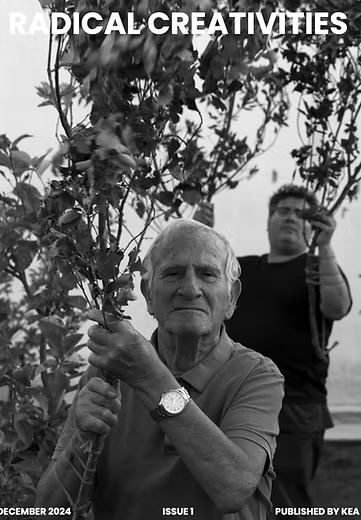
Virtuopolis.
Pau Rausell Francesco Molinari
Radical Creativities , 2024. ArticleThis article introduces "Virtuopolis", an innovative concept of a digital city designed around the principles of virtue and excellence across the social, cultural, intellectual, and ethical dimensions. Unlike traditional digital twins, Virtuopolis aims to replicate not only the physical aspects of a city but also its cultural, emotional, and symbolic dimensions. The three-layer framework of Virtuopolis comprises "The Things", focusing on digitizing and preserving cultural heritage; "The Flows", capturing dynamic cultural interactions; and "The Experiences", measuring the impact of cultural experiences on personal and social life. By leveraging advanced computational methods and network...
This article introduces "Virtuopolis", an innovative concept of a digital city designed around the principles of virtue and excellence across the social, cultural, intellectual, and ethical dimensions. Unlike traditional digital twins, Virtuopolis aims to replicate not only the physical aspects of a city but also its cultural, emotional, and symbolic dimensions. The three-layer framework of Virtuopolis comprises "The Things", focusing on digitizing and preserving cultural heritage; "The Flows", capturing dynamic cultural interactions; and "The Experiences", measuring the impact of cultural experiences on personal and social life. By leveraging advanced computational methods and network theory, Virtuopolis provides a platform for urban planning experimentation, fostering collaboration among diverse stakeholders and enhancing the liveability of cities through the integration of cultural and artistic values.
Read more Hide HANDLE: URL Podcast -

Collaborating for Museum Innovation. Technological, Cultural, and Organisational Innovation in Spanish Museums
Li, Chuan
(2024). Llibrehis book is a fresh reflection on the study of museum innovation, with special attention paid to the enabling role of collaboration within the process. It sets out to capture the innovation dynamics of museums and explore to what extent and how collaborative arrangement can contribute to different types of innovative activities in the museum sector. The book presents a holistic review of museum innovation from multiple perspectives of, among others, economics, sociology, museology, and organisational study, while adopting an interdisciplinary approach to explore and analyse the innovation process and collaboration mechanism from the viewpoint of economics and sociology. The research...
his book is a fresh reflection on the study of museum innovation, with special attention paid to the enabling role of collaboration within the process. It sets out to capture the innovation dynamics of museums and explore to what extent and how collaborative arrangement can contribute to different types of innovative activities in the museum sector. The book presents a holistic review of museum innovation from multiple perspectives of, among others, economics, sociology, museology, and organisational study, while adopting an interdisciplinary approach to explore and analyse the innovation process and collaboration mechanism from the viewpoint of economics and sociology. The research presented is based on three interdependent aspects: first, a holistic definition and taxonomy of innovation in museum organisations; second, qualitative and quantitative analysis of the enabling role of collaboration in technological, cultural, and organisational innovation in museums; and third, multiple case studies for the identification and evaluation of effective collaboration models in different types of innovation. This is a problem-oriented study, which avoids focusing on those large and super museums that have been well-documented in prior studies; instead, it concentrates on small- and medium-sized museums, which account for more than 85% of museums in the world and have become the main resources of cultural tourism and the creative economy at a regional level. Primarily written for postgraduates, researchers, and academics interested in innovation study, innovation in cultural and creative sectors, and museum study, the findings may also have important implications on innovation management and policy for regional museums and public authorities.
Read more Hide
 Research Unit in Cultural Economics and Tourism (ECONCULT)


© 2026 UV. - Avinguda dels Tarongers, s/n. 46022 València. Phone number: (+34) 963 828 645