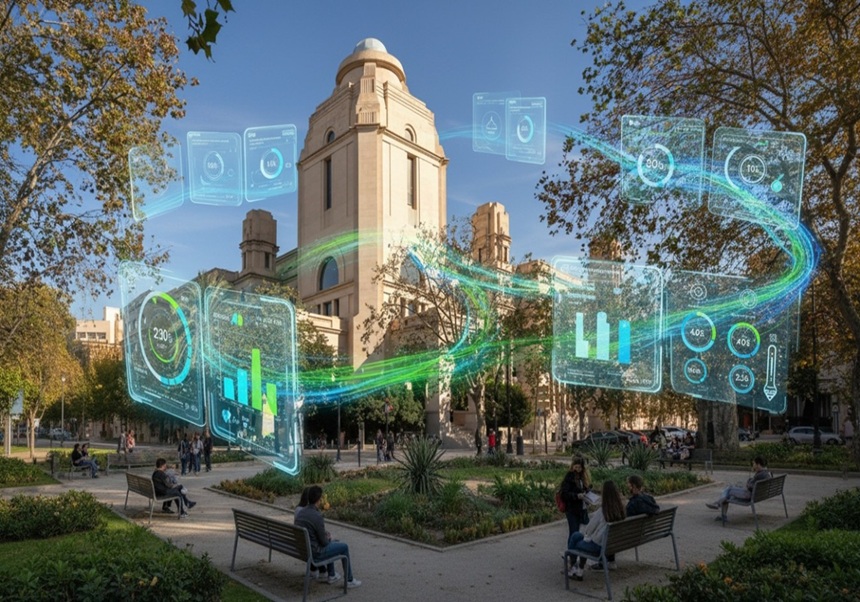
Energy efficiency can be defined as the ability to use the least possible amount of energy when carrying out an activity, without compromising its performance or its quality
With the aim of reducing energy waste, optimising resources and minimising its environmental impact, the Universitat de València (UV) has announced the launch of an innovative energy efficiency project, which will enable the real-time monitoring and optimising of electricity, natural gas and potable water consumption, as well as energy production in all the UV campuses and buildings.
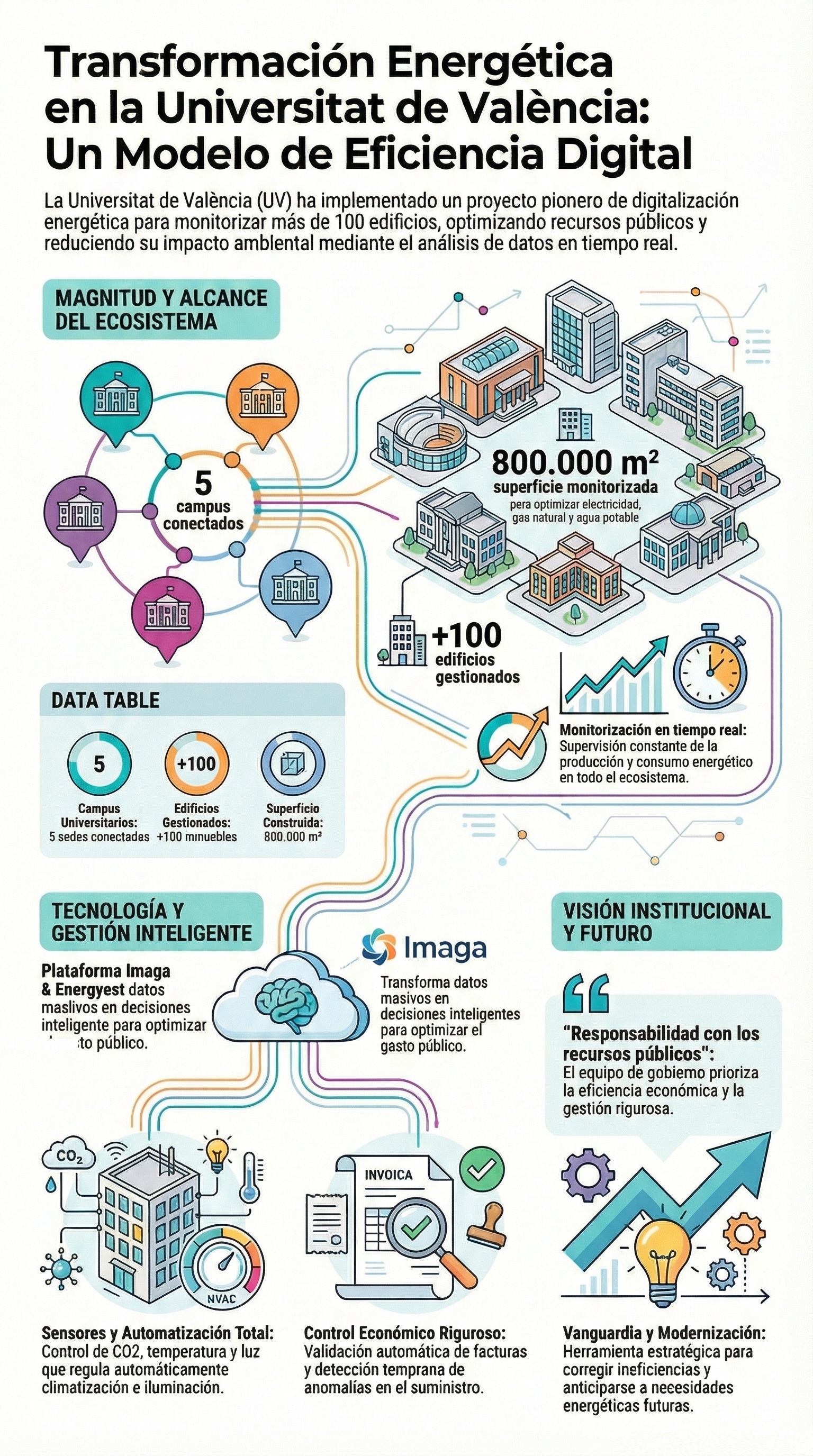
This project will be unprecedentedly relevant for the institution, since it will encompass more than 100 buildings, distributed across its five campuses, covering an immense area of 800.000 square metres, without taking into account landscaped areas or open-air parking zones.
Strategically promoted by the Office of the Vice-Rector for Economics and Infrastructure and coordinated by the Technical and Maintenance Service, the efficient management of this huge ecosystem represents a major technological and organisational challenge for the university.
According to Justo Herrera, the Vice-Rector for Economics and Infrastructure, this intervention plays a key role for the long-term strategy of the institution – “Our university’s energy optimisation project may be one of the most significant projects within the economic efficiency policies developed by the University’s governing team”. – Moreover, the Vice-Rector has highlighted the UV’s ethical duty towards society, emphasising that “as a public university we have the responsibility for using efficiently all the resources available”.
In order to overcome this challenge, the University has implemented a new and advanced energy management platform developed jointly with the Imaga group and based on Energyest Teleyest technology.
This system represents a decisive step in the modernisation and digitisation of the Universitat de València, as it transforms data into smart decisions that enable a significant reduction of energy waste and an optimisation of public funds usage. At an operational level, the system is able to automatically validate invoices, to detect any type of anomaly and to optimise supply contracts, which ensures a far greater economical control for the institution.
Technological progress goes beyond simple data monitoring. The new UV’s infrastructure may include a wide network of environmental sensors, which constantly measure CO2 levels, temperature, humidity, light and air quality. Thanks to these sensors, critical facilities such as climate control and lighting systems can be managed automatically, adjusting their operation to usage schedules, real-time market prices or fully personalised scenarios.
In this regards, Cristina Mateo, director of the Technical and Maintenance Service, has emphasized the deep transformative and practical value of this digitisation process: “This platform is a strategic tool that allows us to know in detail how we consume energy, correct inefficiencies and anticipate future needs”. In addition, Mateo has underlined that “with it we make an approach to a more modern and efficient university, prepared to manage resources rigorously”.
The University’s governing team has expressed its satisfaction with the magnitude and the expected results of the initiative, stating that “the comprehensive energy management platform may be one of our most emblematic projects and one of which we are most proud of”. In the same vein, the synergy achieved with the private sector is positively valued, highlighting the importance of “the collaboration on this project of Imaga, which is the supplier company we are going to work with”.
In short, this project combines technological innovation with a rigorous control of institutional waste, ensuring that the Universitat de València is provided with a solid and foreseeable energy management for the following years.
This strategic progress places the UV at the forefront of efficient management, at the same time as it strengthens its unavoidable commitment to the responsible usage of public resources and guarantees significant economic savings.