
.jpg)
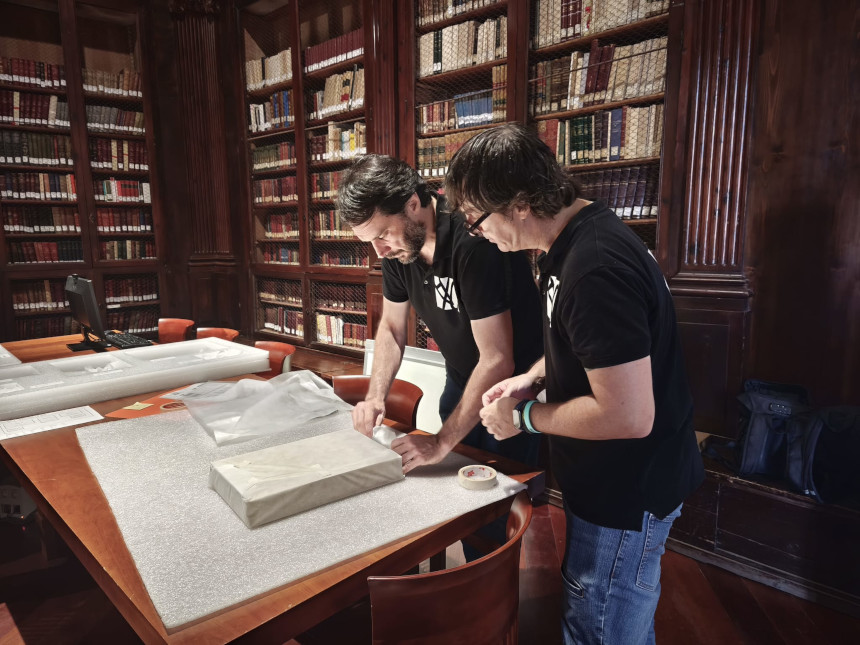
The treasures of the Historical Library of the Universitat de València have already begun their trip to Mexico. The facsimiles that form part of the exhibition "Ink, Parchment and Paper. Treasures of the Historical Library of the Universitat de València" were packed this week for its transfer to Mexico City, where they will be part of the cultural programme of the VIII International Fair of the University Book (FILUNI). This fair will take place from 25 to 30 August and the Universitat de València will be the guest of honour institution.
The exhibition can be visited from 24 August to 3 October at the Sala Santos Balmori de la Casa Universitaria del Libro (CASUL), a cultural space of the Universidad Nacional Autónoma de México (UNAM). The showing is organised by the Historical Library of the Universitat de València, in cooperation with the Office of the Vice-Principal for Culture, Sports and Social Engagement and the Publishing Service of the Universitat de València, within the wide programme that the Universitat de València will use to participate in FILUNI.
Considered one of the main editorial cities in the Ibero-American university field, each year FILUNI gathers universities, academic editorials, researchers and book professionals from multiple countries. Aside from its editorial programme, the fair pushes forward the scientific and cultural exchange between higher education institutions and has consolidated itself as one of the greatest international showcases of university production in the Spanish language.
A tour for some of the greatest bibliographic treasures of the Universitat
Among the pieces there are codices by the Duke of Calabria that stand out. The three of them are from the library of the Aragonese monarchs from Naples started by Alfonso the Magnanimous: la Cosmosgraphiae, by Claudius Ptolemy; the works of Virgil; and the codex on bathrooms by Peter of Eboli, considered the first treatise on balneotherapy with an index attributed to the Valencian doctor Arnau de Vilanova.
The exhibition gathers a selection of facsimiles of some of the most representative work that is preserved at the Historical Library of the Universitat de València. The tour is constructed around five manuscripts and ten prints from the XV and XVI centuries that showcase the extraordinary wealth of the bibliographic heritage protected by the institution
Among the pieces there are codices by the Duke of Calabria that stand out. The three of them are from the library of the Aragonese monarchs from Naples started by Alfonso the Magnanimous: la Cosmosgraphiae, by Claudius Ptolemy; the works of Virgil; and the codex on bathrooms by Peter of Eboli, considered the first treatise on balneotherapy with an index attributed to the Valencian doctor Arnau de Vilanova.
The showing also includes the Llibre de Sent Soví, one of the oldest medieval cookery books in Europe written in its own language and the renowned Pomar Codex, an atlas of natural history created at the end of the XVI century and the start of the XVII century that incorporates multiple illustrations based on scientific expeditions made by Francisco Hernández to Mexico between 1571 and 1577, considered the first great scientific expedition to the New World.
Among the prints, there are two milestones in book history: Trobes en lahors de la Verge Maria, the first literary work printed in Spain and of which there is only one copy left, and Tirant lo Blanc, considered one of the greatest works of European literature, the main Valencian contribution to literary history and described by Miguel de Cervantes as "the best book in the world".
Beyond the artistic value of these works, Ink, Parchment and Paper proposes a tour for the transfer of knowledge from the Middle Ages to the modern era and gives prominence to the written word as a vehicle to preserve the collective memory.
Moreover, the exhibition enables the approach to history of the own Historical Library of the Universitat de València, whose origins date back to 1785 thanks to the donation of the Valencian scholar Francesc Pérez Bayer. Currently, the library preserves more than 100,000 copies, among of them there are more than 1,000 manuscripts, 447 incunabula and one of the most important patrimonial bibliographical collections in Spain, as well as, posters from the Civil World, medals, numismatic pieces, and celestial and world globes from the XVII century.
The Historical Library develops a permanent task of preserving, restoring, cataloguing, and studying of this heritage. Another of its lines of work is the dissemination via exhibitions, digitisation projects, and spreading information in order to move these sources closer to society.
All the works included in the exhibition have been digitised and can be accessed for free via the Somni collection, the digital repository of the bibliographical heritage of the Universitat de València.



