
.jpg)
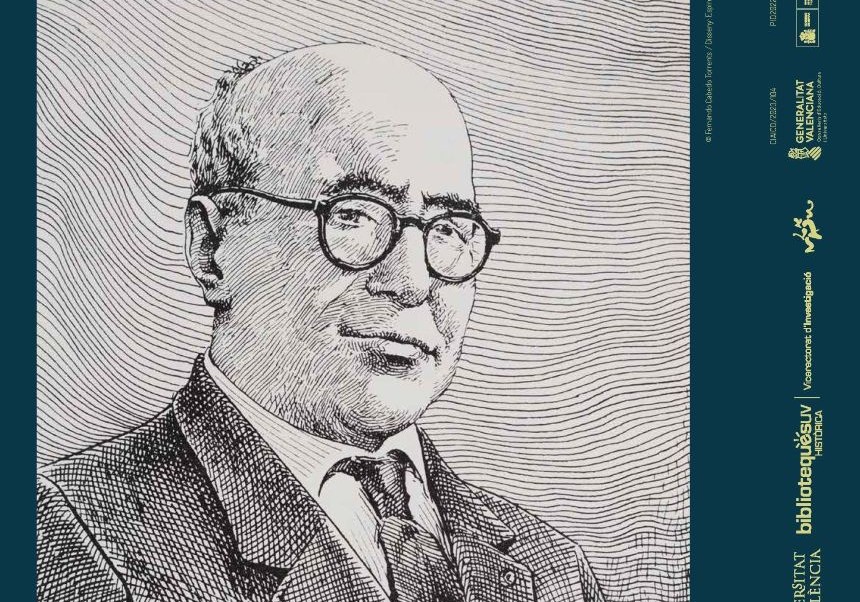
The Historical Library of the University of Valencia is organising the exhibition “Francesc Almela i Vives. Another Forgotten Intellectual”, which will open on 7 October 2026 and run until 3 January 2027 at the Sala Duque de Calabria. The exhibition aims to recover and highlight the life and intellectual career of Francesc Almela i Vives.
Francesc Almela i Vives is, without a doubt, one of the most significant men of letters of the so-called “Generation of 1930.” He worked across virtually every facet of the profession of writer and intellectual: he was a journalist, bibliographer, scholar and historian, and produced a substantial body of poetry, fiction and theatre.
He was born on 9 November 1901 in Vinaròs, although he lived there for only a short time, as his family soon moved to Valencia. There, he attended secondary school at the Instituto General y Técnico, but the death of his father in 1914 forced him to combine his studies with work as a clerk in a notary’s office. Despite these difficulties, he went on to graduate in Philosophy and Letters from the University of Valencia, specialising in Historical Sciences.
From a young age, he devoted himself to cultural activities, where he developed an intense and varied career. He presided over La Nostra Parla, an organisation founded in 1916 with branches in Valencia, Palma and Barcelona, whose aim was to strengthen the unity of the language. He was also vice-president of the Agrupació Nacionalista Escolar, founded in late 1918 within the university environment. Years later, together with figures such as Navarro Borràs, Caballero Muñoz, Adolf Pizcueta and Miquel Duran de València, he took part in the founding of Taula de Lletres Valencianes, a journal which he would eventually direct during its final period. From this group, he promoted considerable literary activity and supported the campaign for orthographic unification, which culminated in the Castellón Agreement of 1932. At the same time, through the gatherings held at the Cercle de Belles Arts, he helped launch the journal Nostra Novel·la, which first appeared in 1930 and of which he was literary director.
On 26 January 1935, he joined the Centre de Cultura Valenciana as a full member. By then, he had already published the poetry collections L’espill a trossos (1928) and Joujou (1933), and had premiered theatrical works such as L’Antigor, which were well received by both audiences and critics.
The Spanish Civil War, which brought about a profound rupture in cultural life, forced many writers into silence or led them to change direction. During the post-war period, Almela i Vives published La llum tremolosa (1948), La columna i les roses (1950) and Les taronges amargues (1955). At the same time, he received recognition from prestigious academic institutions: he was appointed a corresponding member of the Royal Spanish Academy and later of the Royal Academy of History, as well as of other institutions such as the Royal Academy of Fine Arts of San Fernando, the Royal Academy of Good Letters of Barcelona and the Hispanic Society of America. This recognition was further strengthened by his work as a bibliophile, particularly through the Llibreria Valenciana, which opened in 1941 and produced dozens of catalogues in little more than a decade. During these years, he also wrote and directed documentaries for Cifesa.
He remained active until the end of his life as a municipal archivist and chronicler of Valencia, the city where he died in 1967.
The exhibition, curated by Josep Ballester, is structured around four sections:
- Journalist
- Bibliophile and bookseller
- Scholar, historian and populariser
- Writer and translator



