.jpg)
.jpg)
The Historical Library of the Universitat de València will open La memòria de Jaume I. Edicions i traduccions del "Llibre dels fets", an exhibition that explores the enduring legacy and dissemination of one of the landmark works of medieval Catalan literature. Presented as part of the commemoration of the 750th anniversary of the death of Jaume I, the exhibition, curated by Vicent Josep Escartí i Soriano, Antoni Ferrando i Francés, and Mateu Rodrigo Lizondo, highlights the publishing history and translations of the Llibre dels fets through the centuries.
The exhibition will be open from July 27 to September 27, 2026.
King Jaume I was undoubtedly well aware of the power of the written word. He knew that writing was a way of transcending time, of preserving his memory beyond his own lifetime. For this reason, he commissioned the Llibre dels fets, a work presented as an autobiography, written in the first-person plural and distinguished by the fact that it encompasses the monarch's entire life (1208–1276). It is the only autobiographical text by a medieval European monarch. The king most likely recounted his life aloud before one or more collaborators, who recorded his words. They would later revise the text, producing a volume that recounts the king's life and conquests, his "feyts" (deeds), and which has undoubtedly remained throughout history the most important testimony preserving the memory of the monarch.
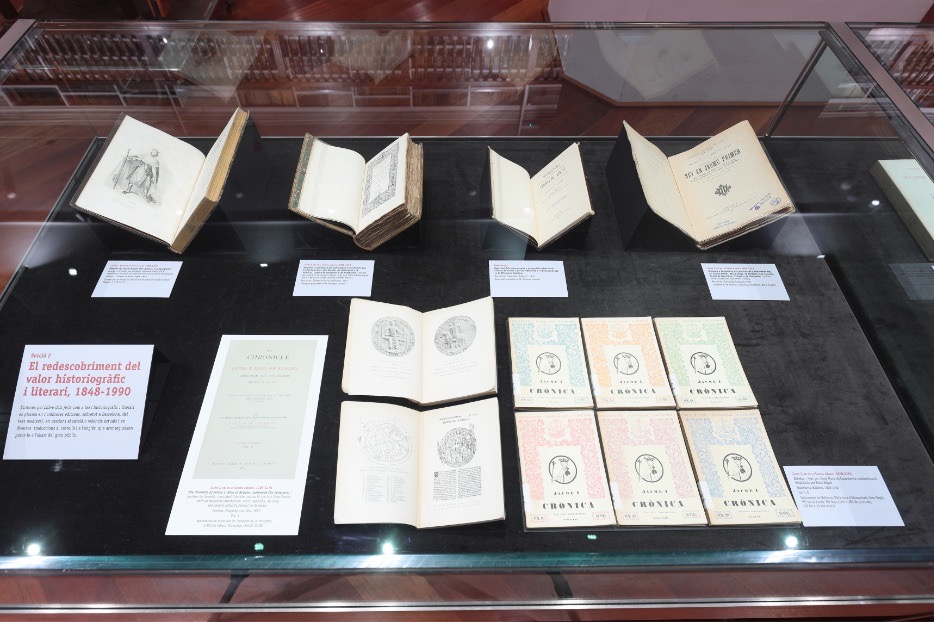
In 1515, in Valencia, the presses of Diego de Gumiel produced the first printed edition of the section of the Crónica recounting the conquest of the future Kingdom of Valencia. It appeared within the volume Aurem opus regalium priuilegiorum ciuitatis et regni Valentie cum historia cristianissimi regis Jacobi ipsius primi conquistatoris. For the first time, the words of King Jaume I reached a wider audience, leaving the exclusive sphere of the royal court and the noble and ecclesiastical libraries where the various manuscript copies had circulated. This process went even further in 1557, when the city of Valencia, at the request of the Habsburgs, published the Chronica o commentari del gloriosissim e invictissim rey en Jacme. This became the editio princeps of the royal text and, for centuries, remained its only printed edition. A few years later, thanks to the work of the Aragonese humanist and canon of Valencia Bernardino Gómez Miedes, the Crónica was published in Latin (1582) and in Castilian (1584).
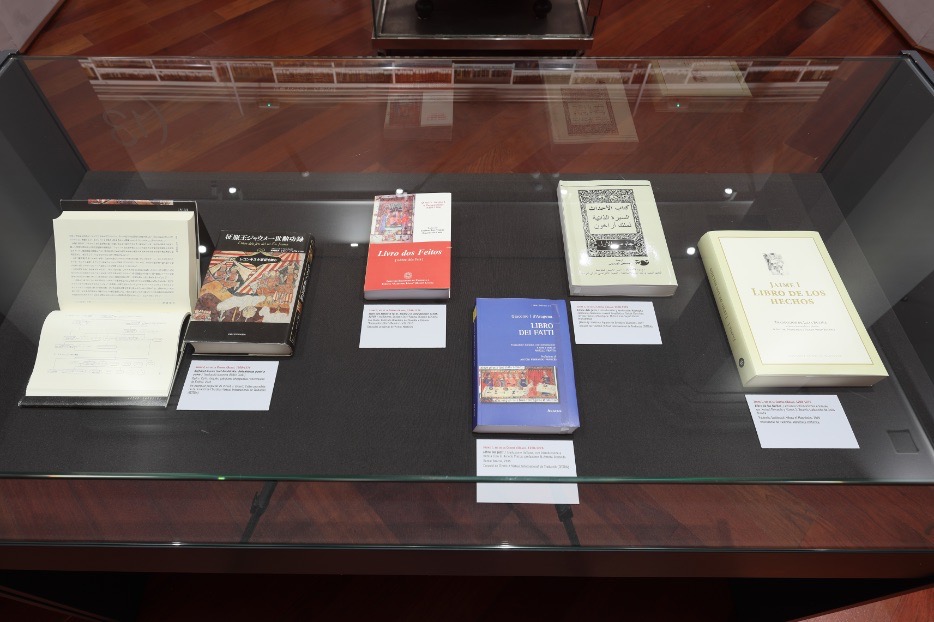
During the following centuries, the king's autobiography did not return to the printing press. This changed, however, with the Renaixença in the nineteenth century. The Majorcan scholar Marià Aguiló—who had served as director of the Library of the University of Valencia between 1858 and 1861—published an edition of the royal memoirs in Barcelona in 1873, which was reissued in modern Catalan in 1905. Earlier, in 1848, an initiative by Marià Flotats and Antoni de Bofarull had resulted in the publication of the Castilian translation of the king's work. Throughout the twentieth century, despite interruptions linked to the political circumstances of our territories, the Crónica of King Jaume I continued to be published. Critical editions, graphically modernised versions, adaptations into contemporary language, popular editions, and translations into several languages were produced. The best known are Ferran Soldevila's edition (1971), featuring modernised spelling and extensive historical annotation, and the two philological critical editions by Jordi Bruguera (1991), based on the Poblet manuscript, and by Antoni Ferrando and Vicent J. Escartí (2010, 2024), based on the Aiamans manuscript. The latter incorporates the canonical version sanctioned by King Pere el Cerimoniós together with the variants found in the Poblet manuscript, thus offering, for the first time, the complete text of the Crónica jaumina.
This exhibition traces the history of the editions of the Llibre dels fets, King Jaume's memoir, which, written in our language, stands as a classic of our literature, one of the foremost landmarks of our cultural heritage and, for the people of Valencia, a foundational text.
Images: